3D printing as a source of impetus for modern craftsmanship: direct production on site – time savings in critical moments
Screenshot youtube.com
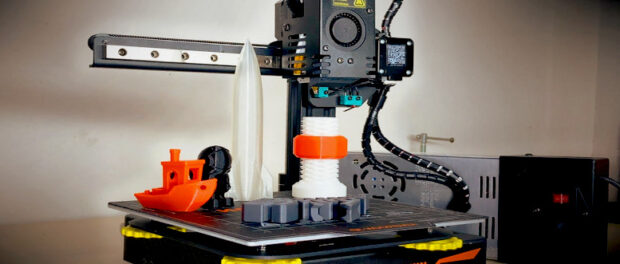
3D printers are becoming increasingly important in the field of craftsmanship because they offer the opportunity to produce the required components directly at the place of use. Especially in the case of repairs or individual custom-made products, where standard components have to be dispensed with, the long waiting time for deliveries from remote production sites is omitted. This immediacy acceleratesNot only workflows, but also significantly increases the responsiveness of craft businesses. Where days in the past or even weeks could pass before a spare part arrived, a functional solution can now be available within a few hours – a decisive advantage that strengthens customer loyalty and optimizes operations.
Individual production without expensive tools
The ability to produce custom shapes, structures and dimensions without using expensive special tools gives small craft businesses a flexibility once reserved for large industrial companies. Every requirement can now be digitally modeled and implemented directly without high fixed costs. This opens up completely newDesign freedom and makes it possible to produce even the smallest series or individual pieces economically. The boundary between design and realization becomes fluid, and craftsmanship gains in creative freedom and technical sovereignty.
Efficient use of materials – less waste, more value
Another significant advantage of 3D printing is the material-saving production. In contrast to classical methods, in which large amounts of raw material are often removed or wasted, only the material that is actually required is used for additive printing. This not only reduces the costs of raw materials, but also helps to make resources more consciousto use. The reduced waste and the precise dosing of the material are ideally suited to the requirements of an economical and sustainable workshop operation without having to foresee efficiency or quality.
Fast prototypes – ideas become tangible
The development of new products or solutions is significantly accelerated by 3D printers. Craftsmen can convert their designs into physical objects within a few hours, test them, evaluate them and adjust them immediately if necessary. This iterative process is done entirely in-house and eliminates external service providers or lengthy production cycles. mistakes can beRecognizing early, implementing improvements promptly, and creativity is inspired by direct feasibility. A first sketch quickly becomes a functional model that convinces customers and drives innovation.
New life for old equipment – strengthening the repair culture
3D printing also makes an important contribution to the maintenance and further development of the repair culture. Many devices do not exclude from use, but due to a lack of available spare parts. With a 3D printer, such parts can be remodeled and reproduced, even if they are no longer supplied by the manufacturer. This leaves the functionalityold machines, furniture or household appliances, and their lifespan is significantly extended. This reduces waste, saves resources and at the same time raises awareness of long-term use – a principle deeply rooted in the craft ethos.
Local Production – Strengthening Regional Value Added
By making components and products on site, 3D printers help stabilize and expand regional value chains. This reduces the dependence on global supply chains, which can easily stall through political, logistic or economic factors. Craftsmen gain autonomy and can be more flexibleRespond local needs. At the same time, new opportunities for cooperation with other regional players – be it in mechanical engineering, furniture trade or vehicle service – are emerging and thus strengthen the economic structure on site.
Bridge between tradition and future – craftsmanship rethought
After all, 3D printing acts as a bridge between traditional craftsmanship and modern technology. He shows that craftsmanship, precision, diligence and experience do not contradict digital innovations, but can be combined with them. For young people who have both craftsmanship and affinity for digital media, this will make the craftmore attractive again. It no longer appears as a backward-looking trade, but as a dynamic field in which creativity, technical understanding and practical implementation go hand in hand. 3D printing not only contributes to the modernization of individual companies, but also to the renewal of the entire manual trade profile.

 Screenshot youtube.com