American Vietnam policy under Kennedy: Strategies, Decisions and Consequences
Screenshot youtube.com
At the beginning of the 1960s, the world was in a phase of intense political tensions, especially in connection with the Cold War. The focus of these disputes was how the United States could secure its interests in Asia and curb the spread of communism. Especially in Southeast Asia, especially in Vietnam, aSituation that increasingly attracted the attention of the American government. The events surrounding the failure of secret service operations in Cuba, together with the failed negotiations on Laos, had a strong influence on the foreign policy situation. Within these framework conditions, Vietnam became more and more the focus of American foreign policy. The government in Washingtonwas determined not to leave the country to the fate of neutralization, as was the case in the case of the unimportant Laos. Instead, everything was done to actively influence Vietnam and to significantly control one’s political direction in order to curb the influence of the communists there. This decision reflected the belief that a passive attitudecould not be a solution, but rather a solution that would permanently endanger American interests. The importance of Vietnam became increasingly clear in this phase, as the American leadership realized that a crucial frontier in the global struggle against communism was emerging here, which was absolutely necessary to be controlled.
Kennedy’s personal bond with Vietnam and the foreign policy principles
The President had a special relationship with Vietnam, which was largely derived from his membership in the so-called ‘American Friends of Vietnam’. This organization embodied a clear pro-American attitude that vehemently supported the commitment to anti-communist policies in Southeast Asia. Kennedy’s foreign policy thinking was strongly influenced by this connection.He considered Vietnam as a last bastion against the spread of communism, which he wanted to stop at all costs. His closest advisors, including security and foreign policy experts, were also convinced that Vietnam’s fate was closely linked to the fate of the West. They believed that commitment in Vietnam was necessary to ensure credibilityto secure the United States at an international level and maintain its own position of power. The strategy was always geared towards military support, economic aid and political stabilization. The opposition within the United States, especially the Republicans, who at this time had hardly any doubts about the previous foreign policy courses,supported the government’s policy. They used the defeats in Cuba to attack the president domestically and accused him of abandoning American interests through a policy of neutralization in Lao. It was clear to them that the American influence in Southeast Asia should not be abandoned, so as not to weaken the sphere of influence of the Soviet Union and China. theGovernment was aware that Vietnam had a crucial importance for the Cold War global strategy and there was no alternative to give up or just passively treat the region.
Lack of reflection and central questions of politics
In this phase of American foreign policy, however, there was a lack of a profound reflection on the actual causes of the conflict and the long-term goals. The government focused primarily on short-term strategies without sufficiently discussing the fundamental questions of legitimacy, the prospects of success and the possible consequences of their commitment. itno systematic analyzes were made that showed the risk of failure or the risks of escalation. This led to central questions going unanswered, although they would have been essential for strategic planning. In retrospect, the then Defense Minister Robert McNamara later remarked that the government had failed to ask five fundamental questionsto ask: Whether the case of South Vietnam could mean the loss of all of Southeast Asia, whether this poses a serious threat to West security, what kind of war would develop, whether victory with American troops is possible and whether all the answers should be known before militarily intervening. At the time, these questions were hardly seriously discussed what thelaid the basis for many wrong decisions and favored the later escalation. The government acted more out of conviction and political pressure rather than making decisions based on a well-founded analysis, which increased the scope of the decisions of the time.
Kennedy’s strategies: containment, dictation and the options
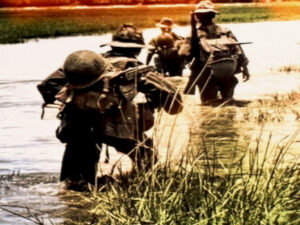
Kennedy’s basic foreign policy strategy was characterized by the idea of preventing the spread of communism through a consistent containment policy. This so-called ‘Dome theory’ was based on the belief that failure in Vietnam would inevitably lead to a chain reaction that could fall into the communist hand the entire Asian region. theThe government was fixated on two fundamentally different options for action: Either the regime of the South Vietnamese President should NGO Dinh Diem will be stabilized by increased military and economic aid, or American troops should be sent directly to South Vietnam to control the situation militarily. The baseline was clearly:The United States definitely wanted to win the conflict, whatever the cost. Kennedy’s decision-makers relied on aggressive upgrades. In the first months of his term, a massive rearmament program was launched. The South Vietnamese Army, the so-called ARVN, was to be expanded by 50,000 soldiers, accompanied by intensive trainingby American advisors. In addition, 400 elite units of the ‘Green Berets’ were sent to the jungle to mobilize ethnic minorities in the western mountainous country and to monitor the borders with them. The CIA was empowered to form sabotage and infiltration squads that were supposed to perform operations in the north. The military and economic support became clearIncreased, initially to $42 million, and modern weapons were delivered to the South Vietnamese self-defence forces. Kennedy politically flanked these measures by sending his Vice President Lyndon B. Johnson, who publicly celebrated Diem in Saigon as “Winston Churchill Southeast Asia”. The military leadership’s demand to use American ground troops directly,however, was rejected. Diem was also denied a request for a massive increase in financial aid, which made Kennedy clearly differed from the ‘Falcons’ that pushed for direct military intervention.
The crisis of the regime and the increasing escalation
But the efforts to stabilize the regime of Diem militarily and economically soon showed their limits. As early as autumn 1961, Diem was in a crisis that had clearly underestimated the American leadership. Alarming reports from the CIA indicated an increasing increase in the activities of the National Liberation Front. monthly over two hundred supporters of theSaigoner regimes killed, the number of wounded steadily increased to up to one thousand. Diem himself had to admit that he had lost control of the situation. In a haunting letter to Kennedy, he called for a military alliance and the sending of American combat troops. This request for help was a kind of political declaration of bankruptcy, because the previous onesRepressive measures and persecutions had brought nothing. On the contrary, they drove the guerrillas even further forward. The regime became increasingly authoritarian, the opposition grew and hopes for a quick solution were disappearing. In response to the crisis, Kennedy sent General Maxwell Taylor and adviser Walt Rostov to Saigon in October 1961. Your reports wereCharacterized by pessimism, however, also contained concrete recommendations to improve the situation. This pattern – a mixture of gloomy descriptions of the condition and optimistic forecasts – should shape American politics in the coming years. There were proposals to send military troops to ensure stability, with the number of soldiers between 5,000 and severalTen thousand varied. The discussion about a conversion of the military advisory units into a real headquarters was conducted. The military leadership initially called for up to 40,000 soldiers to stabilize the situation, while civilian advisors and the foreign ministry were more likely to pursue a more restrictive line and rely on negotiations. Ultimately, the government decided tothe middle ground, which did not provide for ground troops, but increased the number of advisors and economic help. This began a phase in which American intervention gradually led to a serious escalation.
The escalation and the consequences
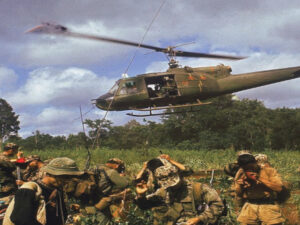
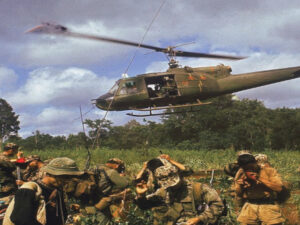
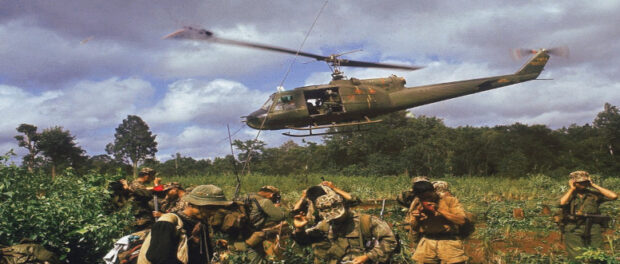
The decision to escalate a limited resulted in the American government being drawn ever deeper into the conflict. Military support has been massively expanded: By December 1961, 3,200 consultants were already in use, and a year later over 9,000. The US took over air surveillance, air transport and helicopter operations and transformed the’Military Aid and Advisory Group’ into a real ‘military auxiliary command Vietnam’ (MACV). At the same time, Kennedy demanded that Diem liberalize the government and more Americans had a say in political and military decisions. But these demands were only half-heartedly implemented. Diem stuck to his national character and hardly made any influence oninternal affairs too. In December 1961, the US government assured in a white paper that the fighting in South Vietnam was not an internal revolution, but an external aggression. This argument strengthened the willingness to expand the support. The escalation was thus pushed forward, although the danger of open American intervention became more and more tangible. theThe ‘limited measures’ policy increasingly developed into a war, the extent of which was hardly controllable. As early as November 1961, it was clear that a reversal was very difficult to achieve and that the willingness to further escalate the conflict grew. The goal of stopping communism in Southeast Asia became the central leitmotif of American foreign policy,although the risks became increasingly visible. The phase of that time marked the beginning of a development that finally led to the extensive war that the United States was leading to in Vietnam and laid the foundation for the later escalation stages that shook the country even more profoundly.

 Screenshot youtube.com