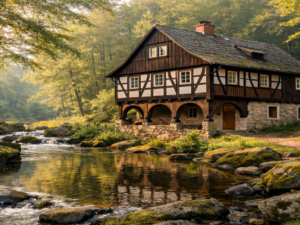
The comparison between urban and rural life is as old as human society itself. For centuries, there have been a variety of ideas and clichés about what life in the city looks like compared to life in the country, what advantages and disadvantages both ways of life have and what expectations are associated with them. Often these ideas areof romantic nature or based on idealized images that do not always correspond to reality. Actual life in both environments is far more complex and complex than it appears at first glance. It is important to question the clichés and take a look at the actual conditions to understand how people really live, what they are looking for and whatyou experience. Historical backgrounds, social developments and individual experiences play a decisive role in grasping and assessing the differences and similarities between city and country.
The origin of the saying and its meaning
One of the best-known sayings that combines the city with freedom is “Stadtluft makes you free!”. This term comes from a time when the legal system still played a significant role in everyday life. It has its origins in the Middle Ages and refers to a legal regulation that offered people a chance of freedom who fled to the city. thisPeople, often serfs or unfree, were able to gain their freedom by moving to the city, provided they were not reclaimed by their landlord within a certain period of time, usually one year. This made the city a refuge, a place where a new chance of self-determination was possible. This legal principle shows how closely the concept offreedom was connected to the city and how it was considered a place of liberation in people’s consciousness.
Social control and freedom in the city
Over the centuries, the importance of the city continued to develop. It was seen not only as a refuge from oppression, but also as a space where social control could be broken through by close communities. In the countryside, people were often involved in close village communities, where everyone knew everyone and social life was largely aroundcommon rules and traditions. This close interdependence meant that individual freedom was severely restricted there because the behavior was constantly observed and evaluated. In the city, on the other hand, everyone was able to expand their personal freedom through the greater anonymity and the diversity of social groups. The city offered the opportunity to get away from the close communityto free, to go their own way and to shape their own identity, regardless of the expectations and constraints of the village community.
The diversity of lifestyles in the urban environment
In the modern city, choosing a neighborhood and social environment is a central opportunity to shape your own life according to your own ideas. People can decide who they want to be in contact with and are less tied to fixed social roles. This freedom is shown in the fact that everyone forms their own circles of friends, clubs or groupsthat correspond to personal interests. In contrast to the village, where the community is often characterized by solid structures and there is little room for individual variations, the city offers a variety of ways to orientate yourself and develop. A dynamic environment is created that is constantly changing and in which social ties are flexibly received or alsocan be relaxed again. The freedom of choice of social contacts is a central prerequisite for the feeling of self-determination and for individual development within urban society.
Myths and reality of country life
The image of the idyllic village, which is characterized by red-cheeked peasants, singing children and happy animals, is deeply rooted in the collective imagination. It symbolizes a harmonious community in which life is still in harmony with nature. But this romanticized idea is no longer in reality. since the late 20s, when the first youngMusicians and artists discovered the country as a counterpoint to urban culture, the image of rural life has changed considerably. The reality in the country is often characterized by small conflicts, surveillance and a certain narrowness that hardly matches the idyllic idea. Again and again rural life is portrayed as backward and monotonous, but in truthit also reveals many challenges that determine everyday life. Nature may be beautiful, but it also brings its own difficulties, whether it is the dependence on the weather, the lack of infrastructure or the limited social opportunities.
The myth of closeness to nature and reality
Many people who move to the country expect a return to nature, a life in harmony with the environment and a simpler existence. But reality often looks different. Life in the countryside is characterized by technical modernization, agricultural monoculture and the use of chemical agents. The idea that one lives here close to nature is an illusion that onlypartly true. While huge tractors work on the field and the landscape often appears monotonous, city life is characterized by a variety of green spaces, parks and balconies, which enable a different kind of closeness to nature. The cliché of idyllic country life is often refuted by the reality of agricultural production and the associated environmental pollution. at the same timethe actual experience of the people in the country is repeatedly shaped by conflicts with neighbors and the need to find their way around in a close community. The longing for nature and simplicity remains, but it is often just a wishful thinking that hardly coincides with the actual living conditions.
Life in the community and reality
The image of a quiet, harmonious village life, in which everyone knows everyone and the community is still characterized by trust, is often just a facade in reality. There is a feeling of surveillance and constant observation in the small communities. The neighborhood in the village is characterized by mutual control and the need for social affiliation, which is sometimescan degenerate into conflicts and disputes. Instead of finding peace and privacy, people often have to live with the pressure to constantly face the expectations of the community. Life near nature does not automatically mean that you are free from conflict or pressure, rather the social dynamics are often more intense and less flexible. the idyllic image of the village,The tranquility, tradition and community are in contrast to the actual challenges that living together also brings with it in smaller communities. It turns out that life in the countryside is more complex than it appears at first glance and that the supposed idyll is often clouded by social tensions.
Ideas of life in town and country
Overall, it can be seen that the ideas of life in town and country are strongly influenced by myths and clichés that only conditionally correspond to reality. Both ways of life have their own advantages and disadvantages, which must be carefully weighed. City life offers a wide variety of possibilities, freedom and individuality, while living in the countrysideis often associated with a close community and nature-related experiences. But behind the romanticized images, there are often challenges that determine everyday life. It is important to be aware that no habitat is exclusively good or bad, but that personal ideas and needs are important in order to find the right habitat.

 Screenshot youtube.com