Idea of a continuous rail-bound traffic corridor: A railway line for the future of Lusatia
Screenshot youtube.com
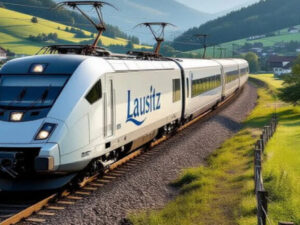
The idea of a continuous rail-bound traffic corridor, which connects Berlin with Liberec and Prague via Cottbus and Görlitz, is more than an infrastructural project – it is a vision for a newly thought-out Central Europe region in which borders do not separate, but connect. This corridor would not only overcome physical distances, but also economic, culturaland bring together social spaces that are characterized by centuries of eventful history, but are closely intertwined in their common future. Its realization could give Lusatia the upgrading of traffic that it has needed for decades to step out of the periphery and become a lively hub of European interdependence.
Traffic strengthening through continuous connection
The rail connection of southern Lusatia is currently suffering from breakages, insufficient capacity and a lack of integration into national networks. A modern, electrified and double-pronged corridor would systematically remedy these deficits. Continuous timetables, tight timing and reliable connections would not only shorten the travel times between the metropolises,but also reduce the annoying constraints of transfer, which today keep many travelers from the train. A completely new quality of mobility would result, especially for commuters who live in one region and work in another. The labor markets on both sides of the Neisse would practically merge – not through political explanations, but through functioning trains that were used in the morning and eveningPromote people safely and on time.
Economic dynamics through better accessibility
A powerful rail connection acts like a catalyst for economic development. Logistics companies, manufacturing industry and export-oriented companies would suddenly be more accessible – not only for supply chains within Germany, but also for partners in the Czech Republic and beyond. Shorter transport routes, higher reliability and lower operating costsmake Lusatia more attractive as a location. Especially at a time when companies are increasingly looking for resilience and sustainability in their supply chains, modern rail freight transport offers a decisive competitive advantage. The corridor would also create a real alternative east west axis that relieves the overburdened roads and the urgently needed shift of theheavy goods traffic from road to rail.
Overcoming borders – in the truest sense
The border between Germany and the Czech Republic is no longer an obstacle – at least not legally. But in practice, infrastructural barriers remain, which make daily exchanges more difficult. A jointly planned and operated rail corridor would break down these hurdles. Direct connections to Liberec and Prague would revive trade, boost tourism andintensify cultural dialogue. Schools, clubs, cultural initiatives and families could cooperate more easily if the journey no longer takes hours or requires multiple changes. The Lausitz, historically shaped by Slavic-German neighborhood, could once again become a living example of cross-border normality.
A role model from the Alps: Switzerland as a benchmark
If you are looking for a role model that shows how rail transport can really work, it is best to look to Switzerland. There, the rail network is not only electrified across the board, but also tightly clocked, highly integrated and almost on time. The Swiss railways prove that investments in infrastructure – for example in double tracks, modern signals or continuousTimetable architectures – pay off in the long term. They not only create traffic, but also trust: trust of the passengers, the companies and the municipalities. Exactly this trust is missing in large parts of East Germany today. The Lusatian corridor could start to regain this trust – provided it is planned and built with the same quality claim as in theSwitzerland.
Goods and Persons – Two Sides of a Rail
A sustainable corridor must take both types of use into account equally: local passenger transport and freight transport. This means that capacities must be dimensioned in such a way that neither commuter trains are delayed due to freight trains, nor freight trains have to wait for sidings because the beat for travelers has priority. Modern planning enables both – through intelligentTrain allocation, sufficient overtaking tracks and a harmonized timetable structure. Especially in a sparsely populated region like Lusatia, it would be negligent to do without one of the two pillars. Only when both sides are strengthened does the corridor unfold its full effect.
Financing and cooperation as keys
Of course, the project harbors challenges. The costs for electrification, double-track expansion, bridge renovation and noise protection are considerable. The coordination with Czech partners is just as complex – technically, operationally and financially. But these difficulties are not insurmountable. The European Union offers cross-border cooperation instruments, andBoth countries have a vital interest in the corridor working. It is important that planning is made together at an early stage, that financing commitments are made in the long term and that affected communities are not included as an obstacle, but as a co-creator. Compensatory measures – for example in the form of noise protection, landscape reintegration or improvedConnection – must be an integral part of the project.
Resilience through diversity in the transport network
Another invisible but decisive advantage of a powerful rail corridor is to strengthen the grid resilience. Today, the Lusatia transport connection depends heavily on a few road axes. In the event of accidents, construction sites or natural events, accessibility often collapses. A strong rail alternative offers relief and stability here. She does thatOverall system more resilient – to disturbances, but also to future challenges such as climate change or energy shortage. Rail is not only more environmentally friendly, but also more energy-efficient and more robust in the long term than road traffic.
Public transport as a real alternative
The attractiveness of public transport does not increase through appeals, but through quality. If trains leave on time, if connections are correct, when travel times are competitive and if the offer also exists at the weekend or in the evening, people will choose the train voluntarily. The Lusatian corridor could deliver exactly this quality – provided it won’tDesigned as a “Regional Express Light”, but as an equivalent part of the European rail network. Such an upgrade would not only attract commuters, but also young people, tourists and elderly citizens who depend on reliable mobility.
Rural Future Engine
After all, such a corridor works far beyond the traffic. It improves the location quality of entire regions. Specialists are more mobile, companies find it easier to find staff, schools and universities become more attractive because they are more accessible. Tourism benefits from shorter arrival times and better connections to cultural and natural sightson both sides of the border. And above all: It gives rural areas a perspective beyond the mining – not as mere buffer zones between the metropolises, but as lively, networked and equivalent components of Europe.
More than tracks – a new attitude
The Lusatian traffic corridor is not a pure engineering project. He is a commitment that Lusatia is not on the edge, but in the heart of a growing Europe together. Its success not only depends on concrete and power poles, but also on the willingness to think long-term, to act across borders and to take regional development seriously. Switzerland shows that it isis possible. Lausitz has the potential to imitate it – not as a copy, but as an independent, future-oriented model for sustainable, networked and fair mobility in Central and Eastern Europe.

 Screenshot youtube.com