Oybin – a jewel of nature, history and romance in the Zittau Mountains
Screenshot youtube.com
The Oybin mountain in the Lusatian Bergland is far more than just a distinctive sandstone rock. It impressively combines the fascination of nature, the traces of eventful history and the magic of romance. At 514 meters high, it rises majestically over the picturesque town of Oybin in the southern Zittau Mountains, just a few kilometers from the border with the Czech Republic. theCharacteristic silhouette of the Oybin, whose shape is often compared to a hive, makes it one of the most famous and popular destinations in Saxony. But not only its external appearance, but in particular the mysterious ruins of the castle and monastery on its summit, give the Oybin its outstanding importance and a unique aura thathas been captivating visitors and artists for centuries.
Geological origin and landscape peculiarities
The emergence of the Oybins goes far back into the history of the earth. During the Cretaceous period, mighty layers of sandstone were deposited, from which today’s rock massif was formed in later Tertiary through underground volcanic activities. This resulted in an impressive Table Mountain, which was built through steep rock faces, bizarre rock formations and one on two levelsarticulated plateau. The location of the Oybin in a valley surrounded by mountains, surrounded by other peaks such as the high forest, gives it an almost fairytale backdrop. This special landscape, characterized by deep gorges, moss-covered stones and ancient forests, attracted nature lovers, painters and poets early on, who were characterized by the beauty and grandeur of the town.were inspired.
Early History and Strategy in the Middle Ages
The human colonization of the Oybin began in the early Bronze Age. Archaeological finds show that people on and around the mountain lived as early as the 11th century BC and left their mark. In the Middle Ages, the Oybin became strategically significant due to its difficult to access position and natural protective function. In the 13th century, robber barons built the firstFortifications, which were later expanded into an imposing section castle under Heinrich von Leipa. Especially the location on an important trade route, which connected Bohemia with the Lusatia, made the fortress an important military base and a control point of regional power.
Heyday under Emperor Charles IV and founding a monastery
A decisive turn in the history of the Oybin brought the year 1364, when Emperor Charles IV had the so-called imperial house built as his retirement home. Shortly thereafter, in 1366, the construction of an imposing late Gothic church on the plateau began. Three years later, the Emperor founded the Cölestines a monastery on the mountain. From now on, the castle, church and monastery formedArchitectural ensemble representing both worldly and spiritual power. In the Hussite wars of the 15th century, the complex was besieged several times. However, thanks to the strong stone walls and the natural rock fortification, it was possible to successfully fend off the attacks. Even valuable parts of the Prague cathedral treasure were temporarily taken to the Oybin to present themto get the Hussites to safety.
Decline, decay and rediscovery through the Romantic period
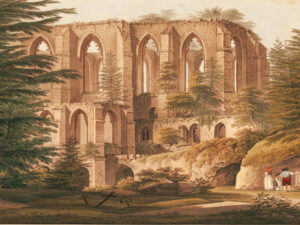
With the beginning of the Reformation in the 16th century, the monastery was dissolved, and the entire complex was gradually forgotten. A devastating lightning strike in 1577 and a heavy rock fall in 1681 caused major damage to the buildings. For centuries, the ruins fell into disrepair until they finally became known in the 19th century by Romantic artists like Caspar DavidFriedrich and Carl Gustav Carus were rediscovered. The melancholic mood between overgrown walls, mysterious passages and quiet nature became a popular motif in painting and poetry. Numerous works contributed to the image of the Oybin as a mystical and inspiring place throughout Europe.
Sights and experiences for visitors
Nowadays, the ruins of the castle and monastery on the Oybin are open to the public and can be visited all year round. Guests have the opportunity to explore the historic imperial house, the Gothic monastery church, the cloister, various defensive towers and the so-called Bahrhaus with its mysterious underground passage. The historical one is also particularly impressiveBergfriedhof, which is located directly below the monastery ruins. Nestled between ancient trees and mighty rocks, it is one of the most beautiful cemeteries in Saxony and was a popular motif of romantic painting as early as the 19th century.
The rise and other cultural highlights
The ascent to the Oybin peak begins in the center of the village of the same name and leads past the famous baroque mountain church, which was built picturesquely on the rocks. Their lovingly made of wood and the colorful peasant baroque paintings make them another cultural highlight. Alternatively, the Oybiner Mountain Express can be used to comfortablyto get close to the entrance to the historic castle complex. From there, numerous walking and hiking trails around the mountain are available, which always open up spectacular views of the Zittau Mountains.
Festivals, events and leisure activities
The Oybin is still a living place where history and present meet. Historical events take place regularly on the plateau, including the famous monks’ procession, atmospheric castle and monastery festivals and concerts in the impressive ambience of the monastery ruins. Hikers and nature lovers will get their money’s worth around the Oybin as well as those interested in culturevisitor. The surrounding area offers numerous opportunities for varied leisure activities – from a relaxed walk to a challenging hike.
A place where nature, history and art are united
The Oybin Mountain is a very special place where nature, history and artistic inspiration are fascinatingly combined. It tells of the flourishing epochs of medieval power, of faith and monastic life, of the re-enchantment of romantic artists and the geological diversity of a unique landscape. Anyone who visits the Oybin experiences not only oneimpressive castle ruins, but immerses yourself in a lively chapter in European history, embedded in one of the most beautiful and varied regions in Lusatia.

 Screenshot youtube.com