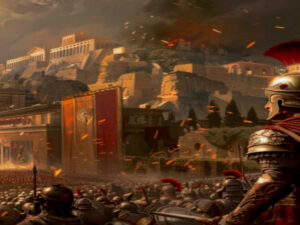
With the death of the Roman emperor Augustus, a wave of restlessness and insecurity spreads among the Roman legions. Many soldiers are seized by deep grief and take part in the official funeral services. This cancels numerous official obligations and military exercises. This unusual inaction means that the soldiers are becoming more and moreBoredom, to idleness and finally to give in mischief. Disputes, tensions and disputes arise within the military community.
Loss of structure and discipline
In this phase, a dangerous cycle begins: The soldiers cease to perform their duties and instead look for distraction. They are influenced by rumors, negative statements and complaints, long for debauchery, demand freedom and finally openly defend themselves against the discipline and order that otherwise forms the backbone of the Roman legions.They are suddenly similar to armies of other non-Roman cultures, where the lack of regular duty in a regular manner leads to nonsense, riots or disobedience.
Dangers of a lack of everyday work
Normally, a tightly organized everyday life ensures that soldiers do not come up with dangerous thoughts. But now in the Roman army on the Rhine front, exactly the conditions that one otherwise detests prevail: lack of discipline, disorientation and the constant danger that the army will lose control.
A new commander on the Rhine
The situation on the western border of the empire, on the Rhine, is particularly dramatic. Germanicus has recently taken over the command here. He was born in 15 BC, making him only one year younger than Arminius. At this point, Germanicus is at the age when his father Drusus died in a riding accident. He has always had the goal of crossing the Rhine and thatto complete his father’s work. Emperor Augustus has put a new father at his side with Tiberius and Germanicus was officially adopted.
The expectations of Germanicus
Augustus has high hopes in the young generals, revered by the legions. However, this ensures that the relationship with Tiberius is burdened, since the troops see Germanicus as their actual leader. In this tense situation, massive mutinies are taking place in large parts of the army. The soldiers even urge Germanicus to even look for the highestto grab power and stand up against Tiberius.
The decision of the Germanicus
Despite all the temptations, Germanicus remains loyal to his stepfather Tiberius – a loyalty, as is often found in history towards the wrong people. With great severity he suppresses the mutinies, supported by his sub-fielder Caecina. They succeed in inciting the insurgent soldiers against each other so that they begin to accuse and accuse each other offight.
The bloody acting in the camp
An unprecedented spectacle takes place in the camp: soldiers who ate and slept together the day before now get into bitter arguments. Flyings fly, screams through the camp, blood is shed and the real causes remain hidden. The commanders hold back and let the pack do so until the violence of itselfdischarged. When Germanicus later returns to the camp, he cries about what happened and does not describe it as a victory, but as a defeat.
Difference between occasion and reason
It is necessary to distinguish between the occasion and the deeper reasons of the mutiny. The immediate occasion was the favorable opportunity to repel new privileges during a change of power. However, the actual reasons for the bloody slaughter are much deeper and are not easy to explain with dissatisfaction or greed.
The psychological background
The legions are made up of men who have been drilled for years to kill with the weapon. Her everyday life is characterized by violence, blood and deprivation. For four years they have been missing the usual “rhythm” of fight, robbery and danger. A kind of “blood frenzy” develops, comparable to an addiction to alcohol or drugs. At the beginning, killing is an overcoming, but this inhibition threshold decreasesquickly, and the urge for violence becomes a fixed habit.
The emergence of habits and dependencies
Anyone who has crossed the threshold of violence once becomes more and more dependent on it. This is also evident in other contexts: Anyone who drinks or smokes regularly often remembers the reluctance on the first attempt – and later experiences a dependency that is hardly controllable. The need for violence can become as strong as other addictions. Criminology speaksof instincts for whose actions no special psychological defects are necessary. Anyone who is raised to murder becomes a murderer.
Comparisons with other extremes
This pattern is also evident in the torturers and guardians in concentration camps: they are initially inhibited, but after overcoming the first threshold, they dive deeper and deeper into their cruel craft. The addiction to violence is stronger than any rational consideration, and those affected follow it almost compulsively.
The continuity of human behavior
One could be tempted to consider these processes as relics of the past. But what is described here is by no means overcome. The external circumstances and “props” of our lives may have changed, the stage design looks different, but the roles and behavioral patterns of the people remain the same.
Systematic discharge of emotions
Again and again people are persuaded to identify with the systems they control. With the same methods and emotions that worked in ancient times, an artificially created emotional congestion is still created and finally discharged. The parallels between the behavior of the time and today are striking. The history of the humanSocieties is also a history of the repetitive patterns of violence, loyalty, addiction and systemic obligation.

 Screenshot youtube.com