The change in American foreign policy after World War II
Screenshot youtube.com
After the end of World War II and in the course of the intensifying Cold War, American foreign policy changed fundamentally. The United States increasingly saw itself in the role of the global defender against Soviet influence and communism. With the election of Dwight D. Eisenhowers in 1953, a leadership came to power over significant militaryexperience and pursued a clear strategy in the global struggle against communism. These changes were largely responsible for how the USA acted in the following years, especially in Asia and Europe. The conflicts in Vietnam and the defeat of France at Dien Bien Phu were the focus of international attention. this articleIlluminated the political developments, the changes in strategy and the military conflicts that shaped the image of the Cold War during this time.
Eisenhower takes the lead: experience and strategic new beginnings
In January 1953, Dwight D. Eisenhower took office as President of the Americans. In contrast to Harry S. Truman, who was considered more insecure and hesitant on foreign policy issues, Eisenhower brought a broad military and diplomatic experience with him. During World War II he had been commander-in-chief of the Allied Forces in Europe and later had the leadership of theNATO troops taken over. In both functions, he had demonstrated his diplomatic skills and proved that he was able to develop pragmatic solutions to complex global problems. His experience in the military field made him a politician who knew exactly what the possibilities and limits of military power were and knew how to use them. beForeign Minister John Foster Dulles also had a long career as a lawyer and diplomat. While Eisenhower determined the foreign policy strategies in the background, Dulles was the loud voice that found clear and open words. The team of the conservative, pragmatic president and the Christian-moral foreign minister worked perfectly.There was a broad consensus between them in the ideological principles, which made it possible to clearly align American foreign policy. This continuity and mutual understanding formed the basis for American decisions in the Cold War, especially in relation to the fight against communism in Asia and Europe.
The attitude to Vietnam: continuity, criticism and strategic new beginning
Already under Truman, Vietnam was seen as a crucial battlefield in the fight against international communism. Eisenhower also shared this assessment in principle, but primarily considered the conflict in the context of the global strategy against the Soviet Union and China. In the 1952 election campaign, he made it clear that he criticized Truman’s previous policy. He accused him offailed to end the war in Korea and complained that he had not appeared energetically enough towards the Soviet Union. Eisenhower and Dulles were convinced that the so-called “containment policy” – i.e. the strategy of limiting the communist influence – was too passive and reactive overall. Instead, they propagated a new, more active foreign andSecurity policy, which was summarized under the keywords “Massive Retribution” (Massive Retaliation) and “New Look”. The aim was to create a stable deterrent through credible nuclear deterrence and an aggressive attitude towards Soviet and communist threats. This policy should be primarily through a credible nuclear deterrent and aaggressive attitude toward the threats from the East. It was designed to act actively rather than just responding to attacks – a strategy that showed short-term success in some crises. Thus, the Eisenhower government’s energetic stance in 1953 led to the conclusion of an agreement to restore the status quo in the Korean War. this agreementFormally ended the Korean War and led to a ceasefire that confirmed the division of the Korean Peninsula in North and South Korea. Nevertheless, it turned out that this strategy did not always work in other crises. This became particularly visible in the 1956 uprising in Hungary, where neither Eisenhower nor Dulles were willing to “politics on the edge of the nuclear abyss”.(Brinkmanship) to implement consistently. Nuclear rearmament was operated while reducing conventional forces and their budgets, which restricted the ability to cope with the crisis. The principle of “more bang for the buck” was effective in the context of deterrence against the Soviet Union, but it was used to fight insurgency movements.In the Third World, the strategy proved unsuitable. This became particularly clear in Vietnam, where the strategy of the “New Look” reached its limits.
Criticism of French warfare in Vietnam is growing
With increasing commitment of the USA in Vietnam, criticism of French warfare became louder and louder. Eisenhower and Dulles called for a more determined military action against the Viet Minh, the communist independence movement in Vietnam. At the same time, they pushed for a final independence of the Vietnamese after the war, clearly as a proxy war to the conflictto mark against communism. Eisenhower was firmly convinced that only a clear declaration of independence and the unmasking of the Viet Minh as a Moscow henchman could convince the world public that this conflict was more than just colonial interests. Only in this way could the international allies be motivated, the French sidemilitary support. In Paris, the intensified rhetoric from Washington was reacted to with a dual strategy. On the one hand, the pressure was opposed, on the other hand, they tried to fend off the American demands. Since 1950, European states have been negotiating the establishment of a “European Defense Community” (EVG), which is also the Federal Republic of Germanyshould include. While the United States hoped for a quick agreement to strengthen Europe, the planned establishment of a German army only triggered heated debates in France. Washington wanted to enforce his interests, but had to take into account the French concerns, as the EVG – like NATO – followed a “double containment” strategy:It was intended to protect both the Warsaw Pact and ensure control over the Federal Republic. It was crucial for France that the German contribution to the defense of Western Europe was not allowed to exceed French interests. The conditions were difficult, because a large part of the French forces were not stationed in Europe, but in Vietnam.The French government tried to combine European and Southeast Asian issues to mitigate US pressure. Only when the Vietnam War was over did she plan to have the EVG ratified by Parliament. This approach, which was also considered a kind of leverage, significantly restricted the US’s options for action towards France.
The French Strategy and the Battle of Dien Bien Phu
At the same time, the French government decided to react to the US demands for a new tactic in the Vietnam War. The commander-in-chief in Indochina, General Henri Navarre, drew up a war plan that envisaged bundling the French forces. The aim was to force the Viet Minh into a decisive battle and offensively in the Red River deltabecome. But this plan failed in the early stages, because the Viet Minh under General Giap reacted lightning fast and mobilized their troops on the Laotian-Vietnamese border. The main goal of the Viet Minh was to control the area around Dien Bien Phu, a small village in northwest Vietnam, which later became a symbol of French failure. The Viet Minhattempted to destabilize the French troops by attacking Laotian territory in order to weaken French power in the region. These attacks were primarily distraction maneuvers to prevent a French offensive in eastern Vietnam. GIP’s strategy worked: In October 1953, France concluded a military assistance pact with the Laotian kingdom, which was part of theFrench Union was. Shortly thereafter, Navarre ordered the recapture of the border areas and the expulsion of the Viet Minh from northwest Vietnam. Navarre announced optimistically that the victory was “like the light at the end of the tunnel” within reach.
The siege of Dien Bien Phu and the failure of the French strategy
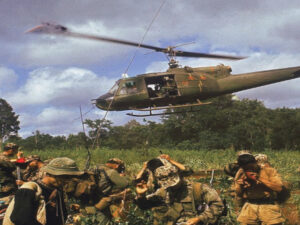
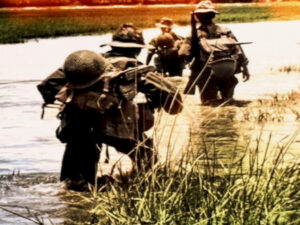
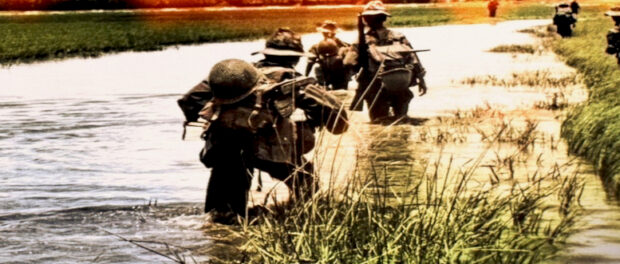
But the Viet Minh were determined to challenge the French. While French troops controlled the valley around Dien Bien Phu, GIP and his troops positioned their forces on the surrounding mountains surrounding the plain. In a master logistical achievement, the Viet Minh managed to supply, weapons and ammunition through human labor alonetransporting jungle-rich paths. By the beginning of 1954, 12,000 French elite soldiers were trapped in the isolated mountain region, while the supply was only possible by plane. The French commanderial believed that the Viet Minh could not use heavy weapons in mountainous terrain and ignored warnings from his intelligence service. Navarre decided to serveBien Phu and force the opponent into the decisive battle. But in the spring of 1954, everything changed: the Viet Minh intensified their attacks. Two of the three hills on which the French artillery was stationed fell into the hands of the Viet Minh. The runway was destroyed, so that the supply could only be made by parachutes. The situation of the French troopsdeteriorated dramatically, with crisis sentiment spreading to Saigon, Paris, and Washington. The French Chief of Staff, Paul Ely, arrived in Washington to discuss the situation. Here, the pent-up frustration about the politics of the other side was loud. Ely thanked for the support of American bombers, but vehemently resisted the desire to use AmericanSend trainers to Vietnam to upgrade the Vietnamese army. For Ely, this was an attempt to regulate the French. To prevent a possible Chinese intervention, Ely and Admiral Radford also talked about an American airstrike on the mountains around Dien Bien Phu. Air Force Chief Nathan Twining even openly speculated about a nuclear attack:“You could take all day to make sure the bomb is properly placed. No resistance. The communists would be gone, the French could withdraw from Dien Bien Phu in the best condition. And the communists would say to themselves, ‘Well, these guys might do it again. We should be more careful in the future.'” But Operation VULTURE – a plannedAttack – was ultimately not carried out. Radford and Twining fell on deaf ears among the chiefs of staff of other weapons. Eisenhower and Dulles did not want to allow a French defeat, but an airstrike or nuclear strike would have only increased the danger of Chinese intervention. Eisenhower feared that such an escalation would lead to a new version of theWar in Korea.
The strategic importance of Indochina
On April 7, 1954, in a press conference, he emphasized the importance of Indochina and spoke of the principle of the “falling domino”: if you knock over one domino, all the others fall after it. The aim was a “united action” (United Action): A coalition of the USA, Great Britain, France, Australia, New Zealand, Thailand, the Philippines and the states of Indochina should work together against theThis alliance should strengthen France and prevent a Chinese intervention. But the political realities were different: most congressmen were skeptical and opposed military intervention. Britain under Churchill and Eden was also cautious. Churchill warned of the consequences of an airstrike on Dien Bien Phu because he fearedthis could bring the still colonial administered areas into the focus of criticism and mean an escalation of the world war. In addition, he regarded military intervention as a major threat to world peace. Although the American government regretted the British stance and discussions continued, Eisenhower did not want unilateral action only with France.cautiously, because he wanted to know the global impact of his decision. This sealed the fate of the French troops in Dien Bien Phu: After 55 days of encirclement and continuous shelling, the French surrendered on 7 May 1954. This event not only marked the end of French colonial rule in northern Vietnam, but also led to the complete withdrawalFrance from all over Indochina.

 Screenshot youtube.com