The Cheruscan Revolt and the Political Power Games in the Roman Empire: A detailed analysis
Screenshot youtube.com
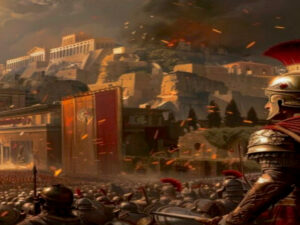
In the early history of the Roman Empire, conflicts with Germanic tribes and the associated uprisings are of central importance. The Cheruscans’ uprising under the leadership of Arminius in particular marks a decisive turning point in the Roman expansions in Germania. This conflict is not only a history of war, but also a complex interplayPolitical intrigue, personal power struggles and strategic decisions that influenced the fate of entire clans and ultimately entire nations. In order to understand what is happening, it is necessary to look at the military, political and social framework conditions of that time and to analyze the actors and their motives in detail.
Resistance to Roman undone power: natural forces and strategic setbacks
The French historian Theodor Mommsen once said that any foreign rule that rises against the independence of a people like a natural event meets resistance with tremendous power. This comparison makes it clear that the insurgent Germanic tribes always counter their power with unpredictable energy and incredible power. but just like aNatural event does not force any permanent change, a military setback is also just a short-term stumbling block. On the Roman side, despite the shock caused by the defeat at Varus, it was quickly re-acted. The loss of three legions, no matter how heavy it seemed, was only considered a single failure for Rome, which included strategic planningnot fundamentally questioned. On the contrary, the Romans understood that they had only temporarily offended them with the defeat. It was a challenge for them that they used as an incentive to further strengthen their troops in Germania and retake control in the region.
Expansion of the Roman forces and organizational measures
In order to compensate for the defeat, Augustus immediately reacted with a massive increase in his military presence in Germania. The number of legions was increased to eight, which meant a significant reinforcement. This decision was not only military strategically, but also symbolic: It was to show the German tribes that Rome did not lose the defeatwould continue to take control of the border regions. The organization of these forces has also been adjusted. The command was divided into two headquarters: one in the area around Mainz, the other in Xanten. This division was a clear strategic decision to improve control over the wide borders and the mobility of theincrease troops. The division into two independent units should enable rapid response to events in different regions and to effectively monitor Germanic settlements. This organizational structure, which was to last for years, was one of the most important measures to secure Roman power in Germania in the long term.
Tiberius, Germanicus and political caution in the power game
Shortly after the disaster at Varus, Tiberius, who had already been deployed in Illyria and the Pannonian-Dalmatian War, was called back to the Rhine. He took over the leadership of the Roman troops in Germania and was initially shown primarily through symbolic actions to signal to the Germanic and Gallic residents that Rome was still present. thisDemonstrations were primarily used to deter and maintain Roman power. The young Germanicus, a talented and impulsive officer, was also involved in these efforts. He was the son of the famous Drusus and had already distinguished himself in Dalmatia. Despite his skills, that didn’t change the fact that the political leadership in Rome,represented by Augustus, still pulling the strings. Augustus was already very old at this point and knew that the question of his succession could affect the stability of the empire. Therefore, Tiberius acted extremely cautiously, both at the military level and within domestic politics. He didn’t want to take any risks so as not to make any mistakes that would later become a disadvantage for himcould suffice.
The fate of Army: courage, strategy and one’s own actions
The fate of the Germanic leader Arminius is closely linked to the political and military circumstances of that time. It is important to understand that destiny is not just what you encounter, but rather the result of your own decisions and actions. Arminius realized that success in the fight against Rome was not only based on one’s own strength, but also of clever strategy andtiming depends on the time Before the decisive uprising against the Romans, Arminius had been lucky because the Roman officer Varus relied on enjoyment and comfort. Arminius used this inclination, which was a weakness for the Roman general, to plan the ambush. He put his enemies behind bars instead of destroying them at once, giving him the decisive advantage. Arminius also dealt with other Roman allies. The Gaugraf Biocaldus, an ally of the Cheruscans, was also chained, which shows how strategically Arminius had been used. Both Segestes and Biocaldus could later only hope for the magnanimity of the winners. Tacitus reports that Biocaldus was satisfied with resigned attitude,Because he believed that the gods would decide on fate and the Romans would have the right to give or take whatever they wanted.
Coexistence of the clans: power, alliances and betrayal
Arminius was aware that coexistence between unequal parties is only possible through submission. The power relations within the Germanic clans were strongly influenced by loyalties and political alliances. Initially, the situation was favorable for Arminius because practically the majority of the Cheruscans had come to him. especially his son Segimund and the nephew Sesithacuswere among the most loyal followers. But the relationships between the Cheruskern and the Chatten, another Germanic tribe, were characterized by decades of enmity. It is unclear whether the marriage ties between the Cheruskern and the Chatt already existed before the uprising or were closed only after it began to strengthen power. A significant elementIn this power game, the daughter of Segesges, Thusnelda. She was not only politically, but also personally on Arminius’ side. Despite her father’s resistance, she married the Cheruscan leader, which further deepened the break within the clan. This marriage was secretly concluded without the father’s consent, and led to considerable tension.
The Conflict of Kidnapping and Escalation
The break between the clans intensified when Segestes tried to get his daughter back. He went with armed power to free her, which ended in a fight. He managed to mobilize some men in order to take action against Arminius. But the situation remained confusing and uncertain. Shortly thereafter, Arminius himself kidnapped his wife Thusnelda, who was alreadywas pregnant, which escalated the situation further. Segestes responded by hiding his daughter on his fortified property and holding her there. It is assumed that this facility was on a strategically favorable hill, for example on the Obermarsberg or the Desenberg, both of which could be well defended.
The struggle for freedom: siege and negotiations
Arminius, who did not want to accept his wife’s kidnapping, moved with armed power to the seat of the Segesto to free his wife. There was a longer fight and a siege where no side could finally gain control. During this conflict, Segestes managed to send a message to the Romans. This was a group of messengersAmong whom was his son Segimer. He was still undecided, hesitant and shy at the time because he was aware of his guilt. But by hoping for the Roman mildness, he decided to deliver the message. The Romans, who were in the Germanic areas at this point in time, immediately responded to the call for help. They preferred troops to Segestesand to free Thusnelda. There was a longer fight, which led to a siege and where neither side could finally gain the upper hand. This conflict makes it clear how fragile the power relations in Germania were and how much the fate of individual decisions was able to influence the course of history.
Your own actions determine the fate
The entire history of the Cheruscans, Arminius and Roman power politics shows that fate is not just what one encounters, but above all the result of one’s own decisions and actions. Arminius succeeded in turning the tide through clever strategies and determined action, but his success was always also on the behavior of his opponents and the political frameworkdependent. In a time when political power, personal loyalties and the will to resist, it is above all the ability to actively shape one’s own destiny, which makes the difference between submission and freedom. The lesson that can be drawn from this is: courage, foresight and the willingness to take risks are the keyfactors for success. The central realization always remains: fate is not just what you come across, but above all what you make of it.

 Screenshot youtube.com