The Concussion in Rome: The Defeat of Legions and Collective Guilt
Screenshot youtube.com
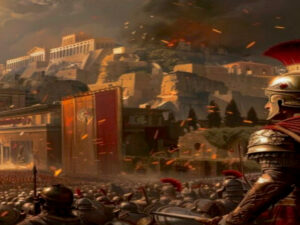
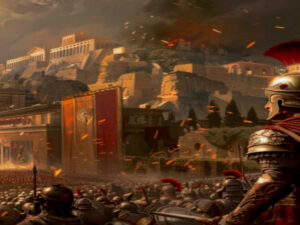
In the history of Rome, the events surrounding the destruction of Legions XVII, XVIII. and XIX. in the course of the Varus Battle a profound turning point. This incident, combined with the loss of the field signs and eagles, not only shaking the empire’s military power, but also hit the soul of Roman society in its core. It was a moment that the Empire inFear and terror stoked, comparable to a huge earthquake that shook the foundations of the Roman world. The subsequent events and the collective reactions reflect a deep-seated fear that still raises questions about guilt, faith and moral responsibility to this day.
The after-war shock: An unexpected slap in the heart
The loss of the three legions in Rome was an event that no one could foresee. It was not only a military defeat, but a symbol of the failure of the Roman power in distant Germania. This blow hit Rome after years of relative calm in the area beyond the Rhine, a region that was previously considered relatively safe. The war against the Germanic tribes was long agofinished, and the Romans had thought they had a firm grip on peace. But suddenly the news came that changed everything: the legions were destroyed, the field signs, including the eagles, had been lost. The news hit exactly five days after the official conclusion of the Pannonian-Dalmatian war, which the young general Germanicus had personally announced. this victoryIt was celebrated with great applause at the time, but now, just a few days later, everything was questioned. The new news triggered a wave of dismay that threw the city of Rome in deep anxiety.
The Reactions of the Roman Leadership: Panic and Insecurity
The emperor Augustus’ reaction to this news was dramatic. As three years earlier, he panicked. He saw the danger of an immediate uprising up all Germania and Gaul and recognized the serious threat to the empire. Within a very short time, fear across the city spread. For the security of the imperialists, action was taken immediately: theGermanic bodyguard, which protected the emperor, was transferred to one of the nearby islands on the site of Rome to protect them from possible attacks. Individual Germans and Gauls who were in Rome were forced to leave the city immediately. At night, newly furnished guards patrolled the streets, controlled the walls and caused an elevatedsecurity level. The Roman society came to a standstill: Public affairs were put on hold, the usual festivities and celebrations did not take place. It was as if the city was stuck in a collective grief. Reports tell that Augustus did not cut his hair and beard for months, hitting his head against the pillars of the palace several times andgroaned: “Varus, Varus, give me back my legions!” These desperate words reflect the deep despair of the Emperor mourning his lost troops.
The superstition and the fear of the gods
During this time, the fear of the gods was deeply rooted in Roman society. Many believed that this defeat was no coincidence, but a sign of the wrath of the divine powers. The Romans saw in the extraordinary events, the so-called “signs”, a message from the gods who took them seriously. So it was reported that the Temple of Mars was struck by lightningbecame what was considered an unfavorable sign. Locusts entered the city, where swallows were eaten, and bees placed wax slices on the altars in the temples. These phenomena were interpreted as a warning. Suddenly spears were thrown from the north onto the Roman legionary camps, and rumors that the Germans were already at the gates came toFraudulence around the eagles of the legions. It became even more threatening when it was reported that the peaks of the Alps collided and three columns of fire sped out, camets appeared in large numbers in the sky and showed themselves in terrible splendor. Finally, a statue of the Victoria, standing in Germania and looking to the east, suddenly turned to Italy andstared in the opposite direction. These events, as Dio says, seemed to disturb the divine order and to plunge the Roman world into chaos.
The collective guilt: The hidden fears of a nation
From today’s perspective, it is hardly possible to interpret any other than that all these “oops” point to a deeper, collective feeling of guilt. It is as if Roman society was repressing a great responsibility, a guilty conscience, under the surface. Since the beginnings of humanity, since the first humans made sacrifice to the gods when killing an animal, there was aMoral feeling towards animals and enemies. In the past, bones were left unharmed to enable reincarnation – a sign of respect for life. Nothing has changed since the early Homo sapiens, who eradicated the Neanderthal. The worse the conscience, the more violent the politics, the more cruel the war. The open or hiddenFear of the opponent leads to extremes. The repulsive image of the enemies grows to cover up one’s fear of the moment when you have to see yourself in the mirror. Not only the Romans, but all people carry this unconscious feeling of guilt – it is a universal drama. There have always been poets who have rationalized explanationstried to justify the wrong. For example, Ovid begged the gods that “the rebel Germania will finally be knocked down” in order to oust his own misconduct.
The constant struggle for guilt and responsibility
The events surrounding the annihilation of the Roman legions in Germania mark a moment of deep crisis for the empire. They show how closely fear, faith and moral consciousness are intertwined. The collective reactions, the superstitious signs and the desperate prayers reflect the unconscious knowledge that defeat is not just a militarycatastrophe, but also a moral one. The collective guilt that becomes visible in the “occupants” is an expression of the universal human experience of questioning yourself and your deeds. These events remind us that power and faith, war and morality are inextricably linked – an eternal drama that still has an impact today.

 Screenshot youtube.com