The development of Germanic art of war and its social consequences in the course of antiquity
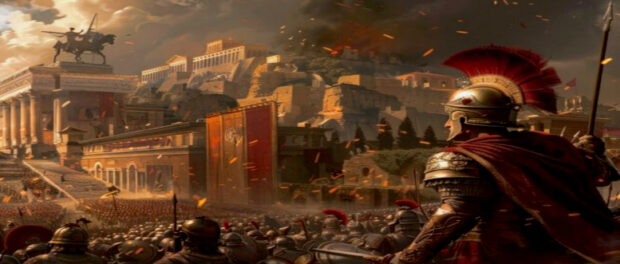
Screenshot youtube.com
In the course of ancient history, the struggles between Germanic tribes and Roman forces were of great importance for political and social development in Central Europe. The military clashes that took place on the meadows of the elf and angri-variant already showed that on the part of the Germans, a fundamental change in the speciesand wise of warfare. These early battles were a first indication that the Germans no longer only relied on crude violence and blind courage, but increasingly incorporated tactical elements into their warfare. But it was only the battle between Arminius and Marbod, which took place a short time later, that a decisive turning point in this development was marked. hermade it clear how far the Germans were on the way to a more conscious, strategically oriented warfare, because now two armies were faced with each other, which were structured according to the Roman model and apparently also acted in their tactics of much more trained. It was no longer just the impetuous, wild fighters who stormed into the battle with wild noise and contempt for death,but organized armed forces that acted in a planned and with a clear military structure.
The change in Germanic warfare
In the meantime, the Germanic tribes, especially the Cheruscans, had recognized that military success could only be achieved through discipline, a clear division of the army and tactical planning. They began to consistently implement the instructions of their generals and improve the structure of their forces. It became clear that it was necessary to use the army inStructure different units, forming up front sections, organizing rear guards, keeping reserves ready and making the wings so flexible that they can fend off flank attacks, lock the opponent and encircle the enemy. These new principles of warfare meant a departure from the previously common connection between riders and foot soldiers, in which the foot soldiers oftenhorsemen and held on to the horses mane to reach the enemy. Instead, cavalry and infantry were trained and used separately to make the most of their respective strengths. With these changes in the organization, the struggles for the Germans lost their “holy dignity” because the once sacred aura of struggle, combined withreligious Ideas of Odin or Wuotan, was pushed into the background by the increasing planning and tactical discipline. While the Divine Support was still believed, warfare was increasingly shaped by human planning and strategic thinking. The Romans and Germanic generals like Germanicus prayed before the battles to the gods, sacrificedAnimals and interpreted birdsview to gain divine goodwill. The belief in divine support continued to live vividly in both cultures, with the religious ideas about the signs of bird flight, the sacrificial rituals and the sacrificial blood rituals playing a central role.
Religious Dimensions of War
In the battle, the Germans felt close to their God, whom they supported in their military conflict through sacrifices and prayers. They sacrificed weapons, their own lives, and the enemy’s lives, believing that the gods were on their side in this battle. This religious devotion was particularly evident in the Hermundurs, the later Thuringians, whoChat, the later Hesse, fought. Before a decisive battle, they dedicated their enemies of the deity and drove the furor, the intoxication of battle, to a maximum. For her, war was the embodiment of a sacred ritual in which divine assistance was brought about by sacrifice and rituals. For the Germans, battle was not a purely worldly matter, but aRitual events in which Odin or Wuotan signaled their support in the form of sacrificial blood, birdsight and signs of the air bird. The religious dimension was so deeply rooted that it encouraged the warriors on the battlefield in their belief in divine leadership.
Social change through military changes
It is essential to see religious beliefs and military development also in connection with social changes. The wars of the Germans against the Romans and other tribes not only demanded military skills, but also influenced the social structure. with the military challenges that were in the course of the disputes between the Germans andRomans arose, profound social changes also occurred. If the Markomanni wanted to assert themselves against the Roman superiority, they had to adjust their forces and organized, which meant that pure “furor” warriors who only relied on the intoxication of the battle were no longer sufficient in the long run. Arminius had apparently understood that a functioningMilitary organization and some discipline were necessary to be able to stand against the Roman machine in the future. This realization was fundamental, but it remained unclear whether the Germanic society as a whole was willing to take the step towards a stronger social and political organization. The company was not yet centralized enough toto bear a durable and stable military structure, which would also exist in the war against well-organized Romans. Warfare was a sacred act, but social structures were not yet so far developed that permanent defense against the Roman supremacy was possible. The fighters continued to believe in divine support, but theorganizational and social conditions were still insufficient.
The struggle for leadership and social stability
The course of the fighting showed that the Germans knew very well who fought for their freedom and independence and who primarily wanted to secure their own power and honor. The warriors were in action for one thing, but the motivation was often characterized by loyalties to the respective leaders. The speeches before the battles, as documented in Germanicusproved that the warriors only fought as long as they saw the point in it, and this sense was not always apparent at first glance. The battles for the leadership and the outcome of the conflicts showed that political and military leadership was still extremely fragile. Many leaders hesitated to secure their position permanently and quickly changed fronts.
uncertainty in leadership
The uncertainties in leadership helped the fighting often end in a draw, although the armies presented huge forces. Marbod, a major prince, was in an extremely unsafe position. Despite the large masses of army that faced each other, the fighting was characterized by uncertainty, changing alliances and strategic withdrawals. After a firstDefeat Marbod withdrew to the surrounding heights to overcome the internal tensions in his camp. This withdrawal was not a sign of weakness, but rather a tactical decision to defuse the inner conflicts and gather new forces. But this strategy was only a temporary solution, because political and military uncertainties remained.Tacitus describes Marbod eventually fled to the Markomanni territory and from there attempted to gain influence on Tiberius through envoys to gain support in the fight against the Romans. With this step, Marbod had lost all along the line. His flight and the handing over to the Romans meant the end of his political power. his tactics, by flightAnd to weaken the opponent’s diplomatic maneuvers was unsuccessful. The support of his allies, especially Inguiomar, was also deeply shaken by his escape. The former dream of a common victory over Arminius and the construction of a powerful Germanic alliance broke up at the political realities. For Inguiomar, this meant above all that the fight against Arminiuswithout continuing Marbod’s support. Marbod’s defeat led to Roman politics deliberately isolated him and labeling him as unreliable allies in public.
Tiberius sent a message
Tiberius sent a message in which he issued a kind of receipt to Marbod in Italian. It made it clear that Marbod had no right to call the Roman weapons, since he had not supported the Romans in fighting their enemies in the past. At the same time, Tiberius had the younger brother of Germanicus, Drusus, sent to Illyria to be unrested thereworry and increase the pressure on Marbod even further. Rome pursued the strategy of playing the Germanic princes against each other and thus securing Roman rule. The realization that the Germans themselves were weakened by their inner quarrels and particular interests were considered a success in Rome. The more the Germans fought each other, the easier it becamefor Roman politics to strengthen their control. The strategy of leaving the Germans in their own disorder proved to be one of the most successful measures of Roman Germanic policy. In 18 AD Marbod was still weighing, but the following summer the actions of the Roman younger Drusus bore fruit. A Goth named Catualda, the Marbod in earlieryears had been expelled for political reasons, returned with Roman money. He began to bribe the dissatisfied within the kingdom of Marbod and made alliances with those who were dissatisfied with the circumstances so far. With the support of the Romans, he managed to penetrate the fortified towns and castles of Marbod. Marbod himself fled just in timeOr was no longer on site at this point. One only learned that he had fled to Noricum, on the other side of the Danube. The treasure Catualda captured became the financial basis for his takeover of power. But his success was only short-lived, because a little later he was expelled again. This showed how fragile the power of a prince was whosupport from outside was dependent, and how quickly the political situation in the Germanic tribal areas could change.
Marbod had lost all chances with setbacks
With these setbacks, Marbod had lost all chances of maintaining his position. As a result, Marbod was only the last option to seek contact with Tiberius again. This time he wrote a letter that by no means sounded like a desperate request, but more like a strategy to reposition itself in the political landscape. At 43 he was already oneExperienced ruler who mastered the art of self-expression. He boastedly let know that many peoples relied on him, but he preferred the Romans to use Roman power for his own purposes. This strategy should underline the importance in political play while demonstrating its ability to return to the Roman camp if necessary.to enter. Tiberius reacted coolly, but not unfriendly. He offered Marbod a safe and honorable residence in Ravenna. However, he made it clear that Marbod could leave the area again at any time if he would decide otherwise. For the Roman Senate, this solution was a diplomatic success report, because in Marbod an instrument was used toto strengthen Roman power over the Germanic tribal leaders. This ended the last phase of Marbod’s political move. He spent the last years of his life in Ravenna, far from the struggles and political turmoil he had helped to shape. His death in the year 37 ended an eventful life, which was caused by changeable power games, flight anddiplomatic maneuvers. Marbod was a man standing between the worlds, between the old Germanic traditions and the new Roman-influenced structures. His life shows the complex struggles for power and faith that have shaped the history of Central Europe during this time, and his influence was still felt for a long time, even if he himself had long since passedwas.

 Screenshot youtube.com