The importance of a leader’s death: strategies, motives and consequences in a historical context
Screenshot youtube.com
In history, scenarios have repeatedly taken place in which the death of a leader or a central figure has had a significant influence on the course of wars, political disputes or social upheavals. This becomes particularly clear when considering military defeats, in which the death of a general or leader reduces the decay of acommunity or the collapse of a state. This phenomenon is found not only in human history, but also in the social structures of the animal world, such as insect states, which have a clear hierarchy and a central figure – the queen. If this is killed, the organization usually disintegrates within a short time. Such parallels and patternscan be transferred to significant historical events in which the death of a leader marked a decisive turn. The example of the Roman general Publius Quinctilius Varus and the associated events shows how the reactions to the death of a leader not only individual actions, but also strategic decisions and socialaffect developments.
Death of Varus: A shock that shook the Roman army
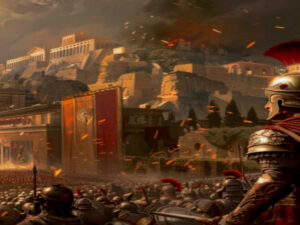
The death of the Roman general Publius Quinctilius Varus is one of the most famous and at the same time most consequential events in Roman military history. When news of the massacre of the three legions in Germania, which went down in history as a Varus battle, came to Rome, this caused an enormous shock. The Roman historian Velius PaterculusDescribes this scene by saying that Varus showed more courage to die than fighting. This means that in the face of death, the general has the courage to choose death instead of being captured in defeat or being cut by enemies. This attitude was underpinned by the description of Dio Cassius, who reported that Varus and hisOfficers who were already badly wounded, killing themselves to escape captivity. The behavior of a camp prefect, Lucius Eggius, who fought heroically and died in the process, was particularly shocking. In contrast, another, Ceconius, chose to hand over because he feared death in battle. Even more serious was the behavior of anotherOfficer, Numonius Vala, who, although otherwise a calm and righteous man, abandoned the foot soldiers to escape with the cavalry. But he, too, ultimately became a victim of his fate.
The collapse of a state: the end of the insect swarm
The fatal news of the death of Varus not only triggered terror and uncertainty among the Roman troops, but also showed how fragile a hierarchically organized community can be when the central figure is lost. In the case of insect states, this is particularly clear: The state, which is dependent on the Central Queen, will immediately disintegrate whenis killed. The organization and survival of the community depends to a large extent on the presence and protection of the Queen. The example of the Varus illustrates a similar dynamic: The death of a leader can mean the end of an entire organization, especially if there is no clear succession or strategies for continuation. The behavior of the Germans after the attack onThe legions clarify how the community responds to the loss: The head of Varus was presented to the Germans, who separated him and passed on to their leader Arminius. This gesture was a symbolic message to all those involved – in Rome, to the Germanic tribes and to the world: here is the end of a Roman tyrant, here the rule of a general whorepresented Roman Emperor.
The character of Arminius: Strategic Master vs Rome
Arminius, the leader of the Germanic tribes, was aware of the importance of his deed. When he got his hands on Varus’s head, he showed no impulsive revenge, but a well thought-out strategy. Instead of simply nailing his head to a tree in a holy grove, as was later the case with other heads, he ordered him to send him to Marbod, the Marbod king of the Marbod. wanted with thathe not only send a message to Rome, but also to the ally: “These are the Romans to whom you remained neutral, although you were only saved from the legions with our help.” This gesture was intended to make Marbod clear that the Germanic tribes could form a common front if they only had the courage to do so.
The connection with the Dalmatian war: why in year 9?
The decision to attack in 9 AD is explained by the political and military framework of the time. At this point, the Dalmatian war was still raging, in which the Romans had to withdraw considerable forces from the Rhine in order to be active in Dalmatia in the military. Only a few days after the end of this war, the news reached the capital Rome that thethree legions had been destroyed. This means that the Varus Battle was already defeated before the Dalmatian War was finally ended. This closeness to time is no coincidence, but shows how the Germanic tribes used the weakness of the Romans for their advantage. They waited the right moment to strike while the Roman troops weakened by the warwere. The Germans took the opportunity to rise against the Roman superiority in a phase in which the Roman strategy was shaken by internal conflicts and military burdens.
The planning of the attack: patience, secrecy and strategic timing
The attack was not a sudden act of impulsive violence, but the result of years of planning, patience and secret agreements. The Germanic tribes first had to contact the smallest group, in so-called things, to win their allies and weigh up the possibilities. Since the Germans had no bureaucratic structures like the Romans, they were on oraltraditions and religious rituals to coordinate their actions. These meetings were extremely time consuming because they had to comply with certain religious regulations and rituals to ask the gods for assistance. It was a challenge to develop the right strategy in these small groups that convinced everyone involved. Only after long preparations andCareful soundings was the time for the attack really favorable. The Germans also had to weigh up how long they could delay the conflict without gambling away their chances.
Timeline: From the first contact to the decisive attack
It can be estimated that the Germans took several years to create the conditions for a successful attack. During this time they watched the Roman troops, strengthened their allies and waited for the right moment. In the summer of the year 6, the Romans launched an offensive against the tribe of the Marbod king of the Marbod, but had to do so after a fewbreak off weeks. This was followed by a phase in which the Germanic tribes consolidated their forces, conducted negotiations and forges strategic alliances. In the fall, winter and spring of the following year, they prepared for the decisive blow. Already in the summer of the 9th year, Arminius knew who was on his side and who hesitated. Negotiations with Marbodwere difficult, but in the end a coalition came into being that could be dangerous for the Romans. It can be assumed that Arminius knew exactly who he could rely on and who was still showing uncertainties. His strategic planning was characterized by patience and foresight to choose the perfect time for the attack.
Marbod: The wise ruler between Rome and Germania
Marbod, who had been leading the first Germanic tribe for several years, was a complex figure. He was an intelligent, cautious ruler who knew the strength of Roman power and was aware that an open war against Rome was hard to win. In the year 6 he had witnessed how the Roman troops conquered a fortified position in Bohemia with enormous powerstried. When Arminius sent the head of Varus, Marbod was only able to make one decision: to stand on the side of the Germans to ensure his survival, or to remain neutral. His strategy at the time was to stay out of the conflict and respect the Roman supremacy. Over the years he had tried to find a balance, but this wasextremely fragile. His approach to limit himself to coexistence with ROM was a risky decision that could only work under certain conditions. Marbod was a skilled diplomat, but his calculation was only successful if the Roman forces were not too strong. The Roman strategists relied on superiority, diplomacy and intrigue principles,the Marbod could find difficult to see through.
The symbolic sign: the head of Varus and the message of Rome and Germania
The handing over of Varus to the Marbod king of Marbod was more than just a symbolic gesture of victory. It was a clear message to Rome: “Here ends the rule of a Roman general.” At the same time, it should encourage the Germanic tribes to unite and fight together against the Roman dominance. Arminius knew that words alone were not enough, butDeeds and symbols have a greater effect. The head of Varus was sent to the Roman Emperor to underline the message: The Germans are not willing subjects, but an indomitable resistance. This gesture symbolized the break with Roman dominance and stood for the independence of the Germanic communities. It was a reference to the ability of theGermans, even in the face of the Roman power to defend their freedom and not to be intimidated.
Strategies, courage and the big picture
The events surrounding Varus, Arminius and the Germanic tribes make it clear that success in conflicts depends not only on courageous actions, but above all on clever strategic calculation, patience and the right timing. It’s about the bigger whole – the freedom, the independence and the survival of entire communities. Killing a leader does not automatically solve thebreakdown of an organization when the community learns the right lessons and acts strategically. On the contrary: The death of a leader can give the impetus for a new beginning if the bereaved correctly assess the situation and react accordingly. The story shows: They are those who act with vision, discipline and strategic skills that ultimatelyDetermining the course of history – and not just the heroes who have the courage in a moment.

 Screenshot youtube.com