The moon race: why it is both resources and potential future technologies
Screenshot youtube.com
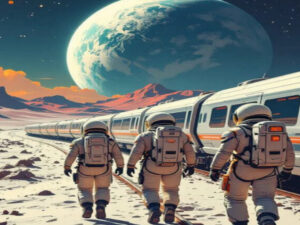
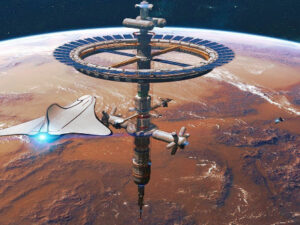
China has decided to create a permanent station at the Moon’s South Pole. This ambitious project also includes the construction of a nuclear power plant and could serve as a basis for future research missions in space. In 2021, China and Russia signed an agreement to establish a joint lunar station. It is planned to add five heavy-duty rockets to the moonDispatch to transport the required material for a robot-supported moon base.
Nuclear power plant on the moon
The project is implemented in two stages. In the first phase, an unmanned base is built near the moon south pole. The Chief Architect of the Chinese Space Project explained that this base will initially support unmanned missions. The second phase provides for the creation of a network on the moon that has the South Pole with the equator andconnects the back of the moon. Together, China and Russia intend to install a nuclear power plant on the moon. In addition, a high-speed communication network between the moon and the earth is to be set up. The lunar base could become an international joint project that will significantly shape future space research. China’s ambitiousPlans for a lunar station clarify the country’s desire to take a leading position in space exploration. At the same time, the base could be used for other purposes.
Potential mining of helium-3 on the moon
The moon could prove to be a key resource for the rare helium isotope helium-3, which is extremely rare and expensive on Earth. While the earth’s crust contains only minimal amounts of this valuable isotope, moon rock is assumed to be up to 100 times higher. Helium-3 is created by solar winds, which threw the isotope towards the ground, but prevents this fromEarth’s magnetic field is a significant accumulation on our planet. In contrast, the moon, without a protective magnetic field, offers an ideal environment for enriching this resource potential.
Applications of Helium-3 are diverse and promising
The applications of Helium-3 are diverse and promising. In cryotechnics, it allows temperatures close to absolute zero, while research on quantum computers and superconductors could be decisive. In addition, Helium-3 is already being used in modern MRI examinations. The use as ” might be particularly revolutionary “propellent“For future nuclear fusion reactors, since the fusion with this isotope would potentially release much more energy than conventional methods. The mining of Helium-3 on the moon could not only make existing technologies superfluous, but also make a significant contribution to the sustainable energy future.

 Screenshot youtube.com