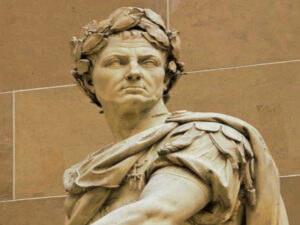
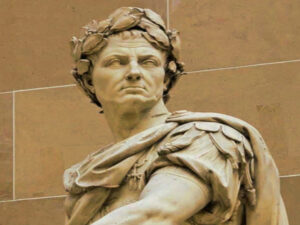
The rise of Caesar: From Civil War to the sole ruler in the Roman Empire
The Civil War in the Roman Empire marked a crucial turning point in Roman history. With his outcome, he paved the way for Gaius Iulius Caesar’s unlimited autocracy, which he manifested in 46 BC through the official, albeit constitutional, controversial introduction of the so-called dictatorship. This position had long since been in the Roman RepublicForgetness is advised, a relic from the past that was previously revived in vain by Sulla. But Caesars took over this office clearly showed that he had defeated all political opponents and now held sole control over power in the state. But at the same time it was unclear how Caesar intended to deal with this untouchable power, which is nowlay his hands. At the point where the dictatorship first revived in Roman history, a deep gap in the existing constitutional framework of the republic was gaping. This gap was no surprise, after all, after the fall of the last king and the founding of the Republic towards the end of the 6th century BC, the Romans had a deep dislike for monarchical ruledeveloped. The Roman system was designed to be another multi-layered form of rule, carried by an aristocratic elite.
Roman nobility: An elite with strict ethics of performance
Instead of a monarchy, political power in Rome was controlled by a conspired stratum called nobility. This was closed and elite outward, but only reluctantly let climbers like Marcus Tullius Cicero into their ranks. Within this circle, there was strict competition ethics, in which performance and honor were the most important standards. the membersThe nobility came from families who had produced at least one consul – the so-called nobili genere. This privileged sex formed an elite, which achieved success primarily through climbing magistrates. These offices, which were called honores, were considered the most important honorary offices on the way to the highest office, the consulate. The way up was clearPre-drawn: Each magistrate was a step on the career ladder that eventually led to the Empire’s inheritance law – the highest form of power, supreme command over large armies against foreign enemies. Only the highest magistrates, i.e. consuls, praetors, proconsuls and proprätors, could obtain an empire. The latter were magistrates whose empire was extended by the Senate tomaintain their power over longer periods of time.
The Roman Magistrate’s Career: From Pirates to Galli Wars
The career was marked by significant campaigns and military successes. Thus, in 67 BC, Pompeius received command against the pirates in the Mediterranean, a threat that endangered the trade and security of the empire. Caesar, in turn, waged the war against Mithradates in the east in 64 BC and between 58 and 50 BC the famous Gallic war, which began his careersignificantly pre-drive. Crassus, who took part in the war against the Parthians in 53 BC, also played an important role in the political structure. With the so-called Triumvirate, a political alliance between Caesar, Pompey and Crassus, and at the latest after Caesar’s victory over Pompeius in 48 BC, such campaigns became a means to promote one’s own career. for themRoman nobility, these probation opportunities were above all an opportunity to make a public profile, gain influence and ultimately pave the way to the highest office. Caesar showed generosity to his opponents: He granted amnesty, had many of their punishments served and showed himself in the politics of grace. People like Cicero or Marcus Junius Brutus, theSubjected to him, Caesar’s mildness – the so-called Clementia – experienced – and was thus able to secure their position. But not everyone was so gracious. Young Cato of Utica, who vehemently opposed Caesar, renounced Caesar’s favor and decided to end his life in the narrowness of the city.
The limitations of honor and the importance of personal favor
Within this system, the honor was only to be acquired within a narrow framework that Caesar himself set. The achievements that were previously recognized by the community of nobility have now been personally evaluated by Caesar. The highest position was reserved for the dictator anyway – the office of the first man, the sole ruler. For others, the only option left wasto increase favor and personal support. That meant: It was no longer about merits, but about the favor of the ruler. For a free man, this was a barely acceptable perspective, because one’s own power was only dependent on the favor of an individual.
Caesar’s self-crowning: the final takeover
When Caesar made himself a lifetime dictator in early 44 BC, many senators realized that a return to the old Republican order was impossible. Caesar had come to stay – and also to pass on his power to a suitable successor. But this scenario caused fear among many in the Roman upper class: It threatened a monarchyThe back door. As early as 45 BC, senators and some knights began to forge a conspiracy against Caesar. This group was composed extremely heterogeneously, consisting of vehement opponents of the dictator who were from the ranks of those who had fought Pompeius, and longtime supporters of Caesar, who were now disappointed in him. Gaius Cassius Longinus becameleading head of movement. He had previously served Pompeius, but then moved to Caesar’s camp and climbed through Caesar. Cassius was the only senator who was brave enough in 45/44 BC to vote against Caesar’s honor that the Senate House had granted him.
Marcus Brutus: The dichotomy of a friend
A central figure of the conspiracy was Marcus Brutus. Although Caesar recently entrusted him with the office of Praetor and entrusted him with the province of Gallia Cisalpina, Brutus was not a convinced opponent. He was a thoughtful idealist, deeply rooted in Stoic philosophy, and traced his family tree back to the legendary Brutus, who once overthrew the monarchy. broodywas involved in the plot by his wife Porcia, the daughter of Catos, and by distant relatives such as Decimus Junius Brutus. Other close followers of Caesar, such as Gaius Trebonius, Lucius Tillius Cimber, Lucius Minucius Basilus and Gaius and Publius servilius Casca, were also part of the conspirators. Despite their steep careers, they joined on March 15, 44 BC – the Ides of March -plan to kill Caesar. This day was chosen because Caesar wanted to start the war against the Parthians on this day, a successful homecoming would have made his position in Rome untouchable. But the opportunity to murder him during a senate session in the Pompeius Theater in Marsfeld was the cheapest. Caesar felt safe, had released his bodyguard and believedno danger to exist.
The assassination: The last day of Caesar
On March 15, 44 BC, everything was ready. Caesar was invited to attend the Senate meetings in the Pompeius Theater. The dictator was convinced that nothing could happen to him. The victim shiver, Spurinna, had already warned him in advance, the guts of an animal pointed to danger – but Caesar did not take these signs seriously. During the session, Gaius Cassius Cimber walked onto himBut instead of making a request, he grabbed Caesar on both shoulders. He called out, “That’s violence!”, but at that moment the conspirators rushed to him. Casca stabbed his dagger in the back while others scrambled with knives. Caesar tried to injure one of the attackers, Gaius Casca, with his writing pen, but the majority of the attackers were toobig. He covered his head with his toga, received the first stab and died silently and motionless. The last thing Caesar is said to have said about Marcus Brutus is: “You too my child?” – A tragic sign of his solidarity. With Caesar’s death, a power vacuum emerged that screamed immediately after filling. The killers fled the theatre, put on Phrygian pointed caps as slaves did in theirbear release, and called Cicero’s name. But the Romans did not feel liberated, but deeply unsettled. The conspirators encountered rejection and even hatred, and barricaded themselves on the Capitol.
Political chaos after Caesar’s assassination
With Caesar’s death, power in Rome was not automatically cleared. The killers had pursued the goal of restoring the republic, but they had only triggered the quake. The power vacuum was only partially filled and the question of who should take control in the future remained open. First, Marcus Antonius, Caesar’s longtime follower, was a consul and thus legallySeen the highest man in the state. He was an experienced politician who had tried to secure the position. Cassius also wanted to take him out, but Marcus Brutus, Caesar’s closest confidante, spoke out against it and saved him from death. Marcus Aemilius Lepidus, then the equestrian colonel and deputy Caesar, was also present in Rome and planned toattack. Antonius, on the other hand, tried to maintain a neutral attitude in order to consolidate his position in Rome. The day after Caesar’s assassination, Antonius grabbed the state treasure stored in the Temple of the OPS on the forum and brought him under his control. A little later he convinced Caesar’s widow Calpurnia, and also his personal assets and the papers of the deceasedto hand out. On March 17, the Senate held a meeting at which Antonius convinced the senators to leave Caesar’s orders and decree into force in order to maintain cohesion.
The rise of the Caesarians and the threatening civil war
With the state funeral on March 20, in which Antonius spoke, the mood among the people was further sharpened. He presented the bloodstained Toga Caesar and called the crowd to condemn the killers. The audience reacted with outrage, the conspirators were hunted and fled Rome. But the question of who should permanently fill the power vacuum remained open. The Death of Caesarmeant only the beginning of a longer power struggle. On the same day, Gaius Octavius, Caesar’s adopted son and only 18 years old, was appointed sole heir and adopted by Caesar himself. This event was to lay the foundation for the final power struggle between Octavius and Marcus Antonius. Thirteen years later, in 30 BC, the final clash was finally ensued:Octavius, later called Augustus, and Antonius faced each other to gain sole dominion over the Roman Empire. Until then, Caesar’s deputies had repeatedly fought each other, only to be replaced again and again. The decisive battle of Philippi in 42 BC against the followers of the Caesarm killers ended with theDefeat Cassius’ and Brutus’. The great rhetorician and politician Cicero, who had once described the men who had conspired against Caesar as brave but naïve, was already dead in this fight. He had made the mistake of underestimating the young Caesar and Antony and overestimating himself. After Caesar’s death, Cicero believed that he would once again play a significant role in theroman politics. He did everything he could to establish a new, aristocratic republic in which the competition of the elites would once again take centre stage. But Antony and the young Caesar, who was later called Augustus, did not play this game. Cicero tried to discredit Antony through numerous speeches and brand him as an enemy of the state, but thiscouldn’t be stopped. Finally, when both Antony and the young Caesar were put on proscription lists, Cicero fell victim to the henchmen. He was murdered at Formiae on December 7, 43 BC, his head and hands – symbols of a speaker – were publicly displayed and presented as cruel trophies. Thus ended the chapter of a political era that was markedof intrigue, betrayal, and ultimately the rise of an imperative ruler in Rome.