The Roman Army in 15 AD: Germanicus, Tiberius and the Challenges on the Rhine
Screenshot youtube.com
In 15 AD, the Roman forces are in a turbulent phase, characterized by political upheavals, military tensions and internal conflicts within the legions. After the death of the first Roman Emperor Augustus in 14 AD and the beginning of Tiberius’ rule, the soldiers and commanders face considerable challenges. While in Rome theReorganized political power relations, an important conflict breaks out on the Rhine, in which the young and talented Germanicus plays a central role. This article sheds light on the main events, the political background and the causes and consequences of the internal unrest within the Roman forces during this time.
The death of Augustus and the political reorganization in Rome
On August 19th, 14 AD, the life of the famous Augustus, who had shaped the Roman world for decades, ended. His death marked not only the end of an era, but also the beginning of a new political era under Tiberius, who quickly took power after Augustus’ death. Historically, Velleius Paterculus reported that at this moment Augustus, who waswas viewed heavenly, returned to heaven. The transition was characterized by uncertainties, power games and the uncertainty as to who would succeed. Tiberius, who previously played an important role in the government, waited at first, similar to a modern politician who only becomes active when the situation forces him to do so. But in reality he had everything necessaryprepared to take control, and so it was only a matter of time before he openly expanded his power. Shortly after Augustus’ death, Tiberius was already active on the Germanic front to ensure stability in the border regions. His goal was to consolidate the Roman borders towards the Germans and to neutralize any threats at an early stage. but hisPrevious measures, which primarily focused on intimidation and demonstration of power, hardly brought any significant military success. There was a tense atmosphere in which the political and military leaders were waiting for the next step, while the troops on the Rhine were confronted with different challenges.
The unrest in the legions after the death of Augustus
The Emperor’s death caused a wave of restlessness and displeasure within the legions. The military units were severely affected by the funeral services and the associated cancellations of regular military activities. According to Tacitus, this situation led to the soldiers becoming more and more willful, getting involved in bickering and quarrels. theDisciplinary administrators had to realize that the mood in the camps was becoming more and more unstable, while rumors and bad talk made the rounds. Tacitus describes that this dissatisfaction had tempted the soldiers to despise discipline and order, to get involved in intrigues and finally to seek distraction through intoxication and debauchery. The situation was similar intheir dynamics of the behavioral patterns of other non-Roman armies, who also relied on permanent chaos to protect the soldiers from unwanted thought. In contrast, the Roman legion was now characterized by strict discipline. But here, too, a crisis was emerging, which was exacerbated by the political tensions and the unrest in the troops.These unrests were not only an expression of a single moment of weakness, but also reflected deeper problems rooted in the military organization and the social climate of the time.
Germanicus and the challenges on the Rhine front
On the Rhine, a completely different situation was the focus: Here Germanicus led the Roman forces. The young general, born in 15 BC, was only a little older than the famous Germanic leader Arminius, who was born in 15 BC. At this point, Germanicus was at an age when his father Drusus died in a fall from the horse. sinceGermanicus has always been a fighting spirit that wanted to cross the Rhine to fulfill his father’s legacy. His motivation was strongly influenced by the desire to secure and expand Roman power in Germania. Under the instructions of Augustus, Germanicus was entrusted with a special responsibility: He was considered a beacon of hope for the future of the RomanExpansion to the borders of the empire. Expectations of him were high, and it was generally believed that he had the potential to strengthen Roman rule in Germania. But these hopes were in the conflict with Tiberius’ political interests, who positioned himself in the role of the commander-in-chief and later as emperor. The relationship between theBoth were characterized by a certain rivalry, which further exacerbated the political situation.
The Mutiny of Legions and Germanicus’ Response
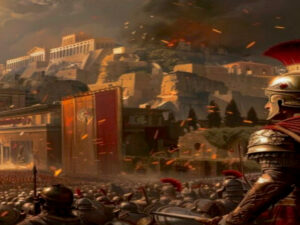
A severe crisis ensued in this tense atmosphere: unrest broke out within the legions, which developed into an open mutiny. Many soldiers, influenced by the uncertainties in Rome and the political intrigues, began to rebel against their officers. Germanicus, known for its integrity and ambition, was encouraged by the troops tohighest dignity in the Roman state. But he remained loyal to his loyalty to Tiberius and tried to restore order. His command report describes the operations with extreme hardship: He had the rebellious soldiers punished to make an example and tried to restore the discipline in the ranks. But the situation escalated and the soldiersgot into a bloody conflict, in which everyone tried to outdo the other person through violence and bloodshed. Tacitus describes this scene as a kind of “civil war within the legions” in which former comrades were fighting each other. The camps turned into battlefields, projectiles flew through the air, screams echoed over the camps, and theWounds and bloodshed were omnipresent. The causes of this chaos were hidden, only by chance decided who survived. Many experienced officers and soldiers were killed in this bloodbath while the unrest continued to move. When Germanicus finally moved into the camp, it was clear to him that these events did not mean “healing”, but rather abitter defeat. With tears in his eyes, he looked at the events and realized that the troops had been thrown into the abyss by their own conflicts. This event was a harrowing example of how political instability, psychological stress and years of violence were able to drag the soldiers into the abyss.
Causes and deeper reasons of the unrest
The core of these unrest lay deeply anchored in the psychological and social behavioral patterns of the soldiers. They had been trained to kill with the bare weapon for years, their existence was characterized by war, loot and punishment. The daily experience of violence and bloodshed had changed her psyche in the long term. It was comparable to an addiction: at first it was killingdifficult, but over time the soldiers developed a dependence on the bloodlust, which is comparable to feelings of intoxication. This habitual violence led to the inhibition threshold of killing other people sank. Comparable to people who brutalize in concentration camps or criminal structures, it shows here how the first murdersexceeds the psychological limit that can then never be completely overcome. Initially, killing was a difficult decision for the soldiers, but over time it became routine, habit and eventually addiction. These behavioral patterns are not a product of mental illness alone, but a consequence of human drives, learned behavior and socialframework conditions. People who have ever entered this spiral tend to continue their habits because the satisfaction of violence is always sought – be it through drugs, killing or other extreme behaviors.
The continuity of human behavior over time
Looking at the processes on the Rhine line, it becomes clear that these behavioral patterns are not a pure phenomenon of the past. It would be a mistake to dismiss events only as exotic, long-conquered phenomena. Rather, they reflect basic human drives and behaviors that are still present in various forms today. the outer onesFramework conditions and the stage design may have changed, but the roles of the people in this drama have remained the same at their core. The way people are cast in a spell through systematic manipulation, emotional stimulators and targeted provocations to control collective behavior shows the continuity of human nature. The means and strategies ofManipulation has hardly changed over the centuries. It is always the same mechanisms that are used to specifically reinforce emotions such as fear, hatred or solidarity and thus direct people’s behavior. These insights let us see with astonishment how deep the roots of human drives and social dynamics are and how little these are in the course of thechanged history.

 Screenshot youtube.com