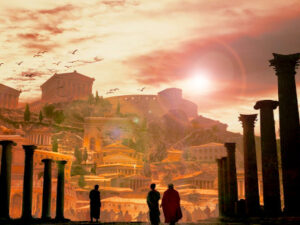
The spread of early Christianity in the Roman Empire
Screenshot youtube.com
The emergence and spread of Christianity in the first centuries after the turn of the century is one of the most important processes in ancient history and fundamentally changed the religious landscape of the Mediterranean. In a world dominated by the Roman Empire and where different cultures, religions and philosophical currents collided, developeda small Jewish sect to a movement of world-historical importance. The way this new faith community spread, what methods it applied and which social groups it met, sheds light on the social structures of antiquity. The following consideration examines the beginnings of the Christian mission, its geographical and socialDissemination and the external conditions that made this process possible or made difficult. It becomes clear that the spread of Christianity was not a linear success, but was shaped by internal tensions, external resistance and complex historical factors. This development took place over several centuries and left lasting traces in cultural historyof humanity.
The Mission’s Command and its Historical Classification
The Gospel of Matthew, written in Syria after the year seventy, concludes with a mandate to spread the teaching worldwide and to attract new followers. However, this request already represents a later stage of development and does not correspond to the attitude of the first early Christian communities in Palestine. Rather, these had no on the missionary of the whole worldaligned goal and understood each other differently than later generations. They saw themselves as an inner-Jewish reform movement with full compliance with Jewish cultic and ethical obligations in all areas of life.
The original restriction to the Jewish people
This included observing the Jewish law, the Torah, in all areas of life and religious practices. The message that Jesus had already come to the expected Messiah was initially for the house of Israel and its relatives. This situation is clearly reflected in the words of Jesus, which were only preserved in the Gospel of Matthew and describe a limited mission. thatFollowers were advised not to go on the way to the heathen and not to enter any town of the Samaritans.
The mission to the lost sheep of Israel
Rather, they should go to the lost sheep from the House of Israel and work there and proclaim the message. According to this tradition, Jesus himself answered that he was only sent to the lost sheep of the house of Israel. The mission idea was therefore inherent in Christianity from the start and important for the early community. but not originally an spread overThe Jewish society is planned or intended by the first followers.
The opening to the Hellenistic world
The successes among the Jews were very low and disappointing for the supporters of the new teaching and its message. In contrast, Christianity found interest and rapid spread among many people, especially in the non-Jewish Hellenistic world. A limitation alone to Jews-faithful to the gate was not possible and practicable in a world characterized by Hellenism. This world wascharacterized by lively spiritual exchange and cultural mixing of different peoples.
Jewish pilgrims as mediators of the new teaching
Jewish pilgrims from the diaspora gathered in Jerusalem on the high days of the festival and brought new ideas home with them. The new Jewish sect could not remain hidden even with Hellenistic diaspora Jews and reached many people. They spread their knowledge among Jews and non-Jews in the Reich and thus contributed to the spread. this new situationHad first been introduced in the Christian community of the Syrian metropolis of Antiocheia.
The beginning of the Heidenmission from Antiocheia
There was a consensus between Christian Jews and non-Jews and sought common basis for living together. The first targeted Heiden mission also came from Antiocheia and spread the message across traditional borders. The apostle Paul was also decisively shaped by this church and influenced in his thinking. of whichThe Apostolic Scriptures provide a good picture of problems arising from such requirements for their own Christian search for identity.
The decisions of the Apostle Council and their consequences
These writings show the tensions and riots between the different conceptions of the Jew Christians in the early church who were faithful to the gate. The Thora-free Jewish Christians and the Gentile Christians also had different ideas and practices in their communities. About the agreement at the Apostle Council in Jerusalem in Forty-Eight or Forty Nine Report usThe Apostolic Traditions. The Jewish Christians of Jerusalem were mainly represented by the master brother James, Peter and John.
The motivations for the Christian mission
The Antiochene community was represented by Barnabas and Paul and brought their positions to and for discussion. As a result, the Gentile Christians were issued and released to comply with the cult regulations of the Torah. However, they were not enacted or released to adhere to the moral Jewish principles and remained binding. When visiting James andPeter in Antiocheia, however, a split in the community came to this question.
The diversity of mission methods in early Christianity
Paul now went his own way and pursued his mission independently of Jerusalem and the authorities there. In his letters, Paul reported in a bitter tone about these developments and conflicts and the tensions that resulted from them. What are the motivations for the mission and what drove the early Christians and gave them strength. It is the mediation of the salvation offer,of whose uniqueness one was deeply convinced and that one wanted to share.
The tradition of nameless missionaries
It is controversial in research whether the statements in the Gospels reflect the original motivation or later arose. Or whether they can only be assigned to a later stage of development when an explanation was sought for the delay in the coming of the kingdom of God. In any case, this motif played a role very early on and influenced the actions of the missionaries andtheir decisions. The spread of the message of the kingdom of God should serve as a witness to all peoples before the end would come.
The strategic orientation of the Pauline Mission
In the beginning there was neither a generally accepted goal of the Christian mission nor a uniform method for everyone. The Gospel of Mark lets us recognize prophetic migratory preachers in Palestine who came and traveled with simple means. Jesus called the twelve to him, sent them out in pairs and gave them power over the impure spirits and demons. You shouldn’tTake on the way except a stick, no bread, no satchel, no money in your belt.
The Western Orientation and End of the Pauline Mission
Only with sandals on your feet should you travel and not wear two shirts for your hikes. Where they had returned to a house, they should stay until they left the place and moved on. And where you didn’t take them in in a place and didn’t want to hear them, they should go away and shake the dust off their feet. Missionary Names and Other Mission Methodstell us the Apostolic Scriptures and Letters.
Concentration on urban centers
But a large part of the missionaries remain nameless and unknown to us and acts secretly for the cause. We have by far the best information about the apostle Paul for various reasons and sources. On the one hand, his letters address private, organizational, practical problems and give an insight into the communities. On the other hand, Lukas, the author of theActs of the Apostles, from the Pauline Circle and knew the connections.
The urban character of early Christianity
In his letter to the Christian Church in Rome, Paul wrote about his strategy and plans for the future. He had enforced the message of Christ from Jerusalem all around and spread among the peoples. Paul put his honor into not proclaiming Christ where his name was already mentioned. Because he didn’t want to build on someone else’s foundation andRe-work and edit field already edited.
The social foundations of community building
He had often been prevented from coming to the Romans and visiting them on his travels. But now it no longer kept him in the local areas and he was striving for the west and new areas. For many years he had been tempted to come to Rome to get to Spain. Paul had undertaken three major missionary journeys, which took him from Antiocheia to Cyprusand onwards.
The role of episcopal seats and asceticism
Further journeys took him to Asia Minor, Macedonia, Illyria, and the Peloponnese and other regions. Now he turned to the western half of the empire, until he wanted to advance to its western border. He could no longer realize this intention, as he was probably executed in Rome in the early 1960s. His objective was astonishingly far-sighted and included largeParts of the known empire and its provinces.
The Change of Mission after the Constantine Turn
Although it did not extend beyond the borders of the Roman Empire to the barbarian peoples and foreign tribes. But it was a comprehensive plan that set Paul apart from many other missionaries and set him apart in his reach. In the question of whether this strategy had already developed in the congregation of Antiocheia, Paul’s own experiences seem decisive to me.Excluded from Paul’s plan were Egypt, North Africa, the East, and the northern parts of the empire.
The source situation for the geographical spread
The reason is probably to be found in the fact that other missionaries were already working there and working the field. Paul sought new territory and wanted to open up new areas for the message and found new churches. His mission was oriented towards the great, important cities of the empire and their possibilities. They were either commercial centres or hubs of major roads orPort cities for commerce.
The regional distribution of Christianisation
Provincial administrative centers were also among his goals and preferred places for preaching. Only Ephesus, Thessalonica, Philippi and Corinth are mentioned here as examples of his work. Paul as a city dweller, born in Tarsus in Cilicia, had little interest in the countryside and concentrated on the cities. As the holder of Roman citizenship and tentmaker ofIn his professional life, he hardly knew the problems of the country.
The weak spread in the west of the empire
He therefore naturally concentrated his activity on the large cities and their possibilities and structures. In these, he created a local staff that was responsible for the further care of the communities. This staff should also ensure the spread in the region and continue the work after his departure. He himself pursued a large-scaleSpread the gospel and wanted to reach as many people as possible.
The social distribution in the various layers
When the whole world had heard of the gospel, in his opinion, the time of Christ’s return had come. Hence Paul’s haste and large-area principle and his mission and strategy. He had success primarily among pagan or purely pagan families inclined towards Judaism. They formed the core for both the collection and the furtherSpreading the church and its faith.
The relationship between city and country in the Roman Empire
Nothing fundamental about this mission principle has changed and remained throughout the pre-Constantine period. Consequently, in this epoch, the urban character of Christianity and its followers predominated in the cities. But Christianity also penetrated the countryside from the cities in different ways depending on the regions. Witness inscriptions and literary evidencethis rural spread in different areas of the empire.
The social problems of the urban population
But the country was only granted a subordinate role in the mission on the part of the Church. The influential episcopal seats and congregations were located in the cities and were effective from there. It was not until the ascetics retreated to desert or rural areas since the third century that Christianity had a much more intense influence on the country.the mission remained a task of the individual Christian and was not institutionalized as an office.
The accusations of the pagan opponents
It was not understood as a task of the ecclesiastical institution or organized by those responsible. In the Didache, we still encounter the offices of the apostles and prophets as travelling preachers in early times. Such functions were later absorbed by the episcopate and integrated and managed into the church structure. But in the first centuries there was noinstitutionalized missionary as a permanent ministry in the Church.
The erroneous assumption of a revolutionary movement
Only since the Constantine turn in the fourth century did the character of the Christian mission change fundamentally. Now bishops and emperors showed interest in the spread of Christianity in the Roman provinces. People and tribes living outside the empire have now also been promoting and recruiting. Mission was now also with cultural and politicalintentions and served other purposes.
The difficulties of social exploration
We are not nearly as well informed about the further spread of Christianity as about the Pauline mission. We must deduce the growth of the movement from casual remarks in Christian literary testimonies. Martyrdom records, lists of bishops and bishop signatures under synodal protocols also provide indications of the distribution. In addition, Paporyri andInscriptions and archaeological certificates Important information on distribution.
The social differentiation among the slaves
Individual passages in non-Christian literature also help with the reconstruction of the spread and give insights. The evaluation of this material is associated with many problems and requires careful interpretation of the finds. The news about it has been handed down more by accident and has not been systematically documented. This applies to both the geographical distribution andfor the time progression of the spread.
Paul’s attitude towards slavery
However, the spread of Christianity had to have reached such a degree in the first half of the third century. that two specially directed, kingdoms of persecution were initiated and took place. The persecution under Emperor Valerian in the years two hundred and fifty-seven and eight was such a measure. The worst persecution of three hundred threeto three hundredths or thirteen among the emperors of the tetrarchy followed.
The role of widows and single women
In a three-century one, Emperor Galerius had to admit in an edict that the persecution had failed. The church consolidation was already too far advanced to stop it. However, strong regional differences must be taken into account and taken into account when assessing the spread. Adolf von Harnack named the following for the end of the third centurystate of Christianization.
The ambivalent attitude towards wealth
He distinguished four categories of the intensity of the spread in the Roman Empire and its provinces. At the beginning of the fourth century, almost half of the population was Christian in Asia Minor, Thrace, Cyprus, Edessa and Armenia. Armenia did not belong to the empire and the first state church was arising from two hundred eighty or ninety. A significant proportionThe population has known Christianity in Antiocheia and Coelesyria.
The social ethics criticism of wealth
Alexandreia and the Thebais, Rome and parts of Lower and Central Italy were also included. Africa proconsularis and Numidia, southern Spain, Achaia, Thessaly, Macedonia were also strongly Christianized. The new religion also found many supporters and supporters on the south coast of Gaul and in the Rhone Valley. Christianity found less distribution in Palestine, Phoenicia, Arabiaand Mesopotamia.
The moderate attitude towards possessions
During this time, Christianity is sparsely or hardly found in much of the western half of the empire. If you realize the starting position of the early churches and compare the situation with it at the end of the third century, one can speak of an astonishing expansion. However, all attempts, the size of the communities and the ratio of the numbers to thewanting to determine non-Christians. In large numbers, we find pagans even after the Roman state recognized Christianity in the fourth century.
The legitimacy of wealth through Klemens
Despite all the anti-heathan laws of Christian emperors and despite the forced conversions in the sixth century, heaths remained. The spread of Christianity in the various social classes is at least as important as the study of geographical spread. The cities were the bearers of the Hellenistic mixed culture and shaped cultural life in therich Whereas the country in the individual provinces was still strongly oriented towards the regional pre-Hellenistic and pre-Roman cultures.
The highest ranks and their distance to Christianity
The concentration on the cities thus offered Christianity a similar cultural framework that encompassed the whole realm. This made it possible to spread quickly and facilitated communication between the communities. The cities were also the pillars of the Roman administration, the Roman system and the Roman rule. Therefore, the emperors had more and more rights for the cities andgranted exemptions.
The persecution of Christians in the military and the military service question
This was usually done at the expense of the farmers, although agriculture was the economic basis of the empire. In the countryside, for example, there was no sympathy for the power of cities and their privileges. These offered a very complex social structure with great differences between rich and poor. Most of the population in the major cities of the Imperium Romanum lived inthe greatest poverty in slums.
The external conditions of the spread
They were exposed to the risks of collapsing tenement houses, fires and diseases caused by poor sanitary conditions. Beggars were a typical appearance in the streets of ancient cities and daily life. To a large extent, they were recruited from problem cases such as the elderly, the sick and the crippled. Another sizeable part of the urbanThe poor were provided by widows and orphans.
Cultural superiority and its limits
These had lost the head of the family and stood there in society without protection. Nevertheless, the opinion that Christianity was primarily a movement of slaves and the lowest strata of the cities is outdated. Social inferiority, which at that time was equated with moral inferiority, was accused of Christians by their opponents. In his dialogueOctavius summarized these accusations to Minucius Felix and put them in the mouth of a pagan dialogue partner.
The Administration and Tolerance of the Roman Empire
From the lowest yeast of the people there gather the uneducated and the gullible women. They fell for everything anyway because of the influence of their gender and could be influenced. It is an obscure, shy society, silent in public, chatty in corners. Self-pitying, they look pityingly at the priests of thetraditional religions.
The loss of religious protection
Even half-naked, they despise offices and dignities and reject the established order. Christian writers have vehemently opposed such accusations and defended their community. They opposed both the accusation of stupidity and that of social humiliation. From the erroneous assumption that early Christianity was anchored in the lowest strata of the people,another hypothesis emerged.
The enhancement of vernacular languages
It was assumed that its rapid spread could be explained by the fact that Christianity had benefited from revolutionary moods in Roman society. This assumption also misleads and misunderstands the character of the early Christian movement. Christianity did not lend itself well as a leader in social disputes and conflicts. It didn’t have a revolutionaryCharacter and did not seek overturns.
The importance of transport routes for the mission
Nor did it represent any concepts that were intended or wanted to change the social structures of society. Unfortunately, for none of the Christian communities of the first three centuries is an even remotely accurate survey of their social structure possible. This applies even to the major cities of Rome, Alexandria, Antiocheia and Carthage, about which we are still best informed. For Carthagewe have the largest range of archaeological and literary information around the year two hundred.
Mobility as a factor of propagation
An examination of the relevant sources has shown that the majority of Christian communities remain in the dark in social history. However, the lowest social classes and the slaves seem to have constituted only a minority of the large church. The masses were recruited from the middle classes, craftsmen and traders. Unfortunately, due to the lack of sources,heretical communities in social terms.
The example of Aberkios and Christian hospitality
Die Sklaven in den Städten bildeten unter sozialen Gesichtspunkten eine sehr differenzierte Gruppe. Ihr Los war mit dem der Sklaven auf dem Lande nicht zu vergleichen und oft weniger hart. Sie gehörten zu den Schichten, die sich dem römischen System mit Optimismus unterordneten. Das System ermöglichte ihnen die Freilassung und den sozialen Aufstieg unter bestimmten Bedingungen.
Die Ablehnung des Christentums durch Juden und Heiden
Das Christentum setzte sich im allgemeinen nicht für die Veränderung ihrer rechtlichen Position ein oder forderte dies. Paulus hatte im ersten Brief an die Korinther als Grundsatz formuliert, dass man in dem Stand bleiben solle, in dem man berufen wurde. Bist du als Sklave berufen, lass es dir nicht leid sein, so lautete sein Rat an die Gemeinden. Selbst wenn du die Möglichkeit hast, frei zuwerden, so bleibe gleichwohl um so lieber in deinem Stande.
Die Enttäuschung der jüdischen Erwartungen
Dieser Standpunkt wird dann auch in den späteren Schriften des Neuen Testaments beibehalten und vertreten. Der erste Petrusbrief betont, dass man sich auch launischen Herren unterzuordnen habe und geduldig sein solle. Immerhin boten die christlichen Gemeinden Sklaven und Freigelassenen soziale Nähe und das Gefühl menschlicher Wertschätzung. Einen nicht unbeträchtlichen Teil der Gemeinden mögenWitwen und Waisen gebildet haben.
Das Ärgernis des gekreuzigten Christus
Diese waren im römischen Reich rechtlich und praktisch besonders unterprivilegiert und dem größten Elend ausgeliefert. Auch war an der Zahl der Christen der Anteil alleinstehender Frauen hoch und bemerkenswert in den Gemeinden. Diese versahen entweder in den christlichen Gemeinden karitative Dienste oder wurden versorgt und fanden Achtung. Daraus erklärt sich der verächtliche Vorwurf vonheidnischer Seite, leichtgläubige Weiber gäben bei den Christen den Ton an.
Die Vorwürfe der unmoralischen Praktiken
Wie den Briefen des Paulus und der Apostelgeschichte des Lukas zu entnehmen ist, gab es schon in frühester Zeit zahlreiche wohlhabende Gemeindeglieder. Doch blieb die Beurteilung des Reichtums ein großes Problem und wurde unterschiedlich bewertet. Strikte Ablehnung vertraten asketische Richtungen, die auf radikale Armut setzten. Sie konnten sich auf ein Evangelienzitat berufen, dass ein Kamelcome through a needle eye rather than a rich man in the kingdom of God.
The absurd accusations against the Christians
Even more implacable was the assessment found in the James letter, which was written towards the end of the first century. The rich should howl and wail about the needs that are facing them. Her wealth had become lazy, her clothes were eaten away by moths, her gold and silver rusted. This rust will serve as a testimony against them and eat their flesh like fire.
The allegations of ritual crimes
This is how they feel about the treasures they have collected in the last few days. The reward they have withheld from the workers who have harvested their fields, scream out loud. The cry of the harvest workers reached the ears of Mr. Zebaoth. They would have slept and smashed on earth, would have had to eat whatever their hearts wanted.
The origin of prejudices and rumors
They would have condemned and killed the righteous, who could not resist them. A different attitude resembled the stoic ideal of self-sufficiency and moderate use. Paul expressed that while everything is allowed, not everything is good. He won’t let anything be controlled by anything, according to his attitude and conviction.
The suspicion of magic and magic
On such a basis, the idea developed that the Christian should do good with wealth. This is already expressed in the pastoral letters and recommended to the believers. The rich should do good, become rich in good deeds, give up and share. This should help you accumulate a valuable credit, a nice foundation for the future.
The donkey-headed deity in Gnostic sects
So they could win real life and prepare for the afterlife. At the beginning of the third century, the Christian Alexandrian philosopher Klemens summarized this interpretation of wealth. His writing, which realm can be saved, was of great impact and distribution. She brought the discussion about the problem to a certain conclusion and clarified the position.
The complex history of early Christian spread
The wealth received limited legitimacy and was no longer generally rejected by the church. It’s about its use and not the property itself. Not the possessor in and of himself should be excluded from the kingdom of God. but any sinner who does not repent, be rich or poor, is excluded. For the supreme estates of the empire, the incentive tobe, extremely low and unattractive.
The permanent heritage of early Christianity
The disadvantages, such as the loss of social prestige and privileges, outweighed the disadvantages. So very few and mostly female members of such families are to be identified as Christians. Only from the third century onwards did these classes and the Christians come into contact with more frequent contacts. There were also Christians among the soldiers and in the military, which raised special questions.
The importance for later church history
Some martyrdom reports from soldiers have been preserved and give insight into this situation. Diocletian began the last persecution of Christians with a cleansing of the army of Christian elements. War service remained controversial on the Christian side and was evaluated differently. The negative direction referred to the word of Jesus in the Gospel of Matthew, addressed to Peter.
The lasting importance for the history of religion
Whoever reaches for the sword will perish by the sword, according to the admonition and warning. The others could refer to the saying of John the Baptist, which only the Gospel of Luke tells. Soldiers should not abuse or blackmail anyone and be content with their pay. Harnack named Harnack on external conditions that enabled and favored the rapid spread of Christianityseveral factors.
The historical importance of the early mission
An empire, a world language, a transport network, a culture, a common development into monotheism and a common longing for Saviours. The first aspects mentioned by Harnack also point to the limits of the mission horizon. The mission extended to the Roman Empire’s territory and was equated with ecumenism. Outside were the areas ofBarbarians who were considered uncivilized.
The cultural prerequisites for the spread
Christians had largely adopted this view of a superior culture. Outside the empire, the Christian message could only become known through traders in the first three centuries. Roman prisoners of war or individuals also carried the message to distant areas. The Empire’s infrastructure provided the best conditions for the spreada new religion.
The infrastructural foundations of the empire
It encircled the whole Mediterranean and reached in the northwest as far as Britain. The Mediterranean Sea had no separating function, but a connecting function and made it easier for exchange. The perfect administration, which is equally comprehensive, is to be emphasized. The tolerance of the Roman authorities towards foreign religions and cults was also significant.
Religious tolerance and its limits
This was considered insofar as they did not affiliate the traditional Roman values or were considered immoral. Judaism had the status of a permitted religion and enjoyed special protection. In its shadow, Christianity could act first as one of the Jewish sects. Only when the Jews clearly distanced themselves from Christianity did this lose the status of a special Jewish group.
The linguistic and cultural framework conditions
Christianity thus also lost the protection that Jewish status had provided. It was now considered something new that violated the tried and tested, traditional. The one culture called by Harnack was the Hellenistic, whose carriers were the cities. The language of this culture was Greek, also in the western realm of the empire.
The development of the vernacular in the church
Whereas the language of the administration and the military remained Latin and was used for official purposes. In rural areas, on the other hand, the original vernaculars were kept and continued to speak. Some of them experienced an upgrade from the second century, especially in the church space. so the Syrian and the Coptic gained importance for theChristian proclamation.
The distance to Hellenistic culture
It should also be noted that, unlike the later mission in the barbarian country, Christianity was different. In the first three centuries, when it spreads in the Imperium Romanum, it did not appear as a bearer of a superior culture. It was partly more of a movement that kept itself at a distance from some aspects of the existing Hellenistic culture. The transport network wasExcellent and penetrated the whole empire for use for trade, military, administration and private travellers.
The use of trade routes for the mission
The cities were on these roads and the message spread along these routes. Paul took advantage of such roads and focused on trading hubs in his missionary work. He also paid attention to cities that were the heads of administration. However, faster than on the roads you reached your destination on the shipping route.
The Christian community on the move
So also by Paulus Schiffsreisen have been handed down and testify to the use of the sea routes. Compared to our circumstances, traveling was still difficult and dangerous. But the desire to travel and the mobility of the population was surprisingly great and contributed to the spread. There is also a reason why Christian doctrine spread rapidly.
Hospitality as a Mission Factor
Soon after the crucifixion of Christ, she reached the capital of Rome. It was conducive to Christianity that it also enabled the long-travelled faith sisters and brothers from abroad to receive. Contacts and protection in the communities on the trip and at the destination were offered. Everywhere the traveler met familiar circumstances and was able to focus on theleave community.
The rejection of the Jewish community
Several inscriptions testify to us this aspect of Christian hospitality and networking. The earliest Christian tomb inscription around the year is one hundred and ninety most famous. It comes from a rich, traveled man named Aberkios. He was on his travels in Rome and saw Syria’s plain and all cities up Nisibis.
The pagan prejudices against the Christians
After crossing the Euphrates, he found fellow believers everywhere. And they prepared a feed everywhere, the fish from the spring, the extremely large one, the pure one. whom a pure virgin had caught, and she gave it with excellent wine. She gave it as a mixed wine with bread, which probably indicates the Eucharist and hospitable admission.
The allegations of ritual crimes
Das Bild wäre einseitig, wenn wir nur die christlichen Erfolge im Blick hätten. Das Christentum stieß auch auf Skepsis und stärkste Ablehnung und Widerstand. Entscheidende Gründe nannte schon Paulus in seinem ersten Brief an die Korinther. Während die Juden Bestätigungen fordern und die Griechen nach Weisheit verlangen, verkündigen wir den gekreuzigten Christus.
Die Diffamierung der christlichen Gemeinschaft
Dies sei ein Skandal für die Juden und Unsinn für die Griechen. Die Mehrzahl der Juden konnte eine Vorstellung von einem gekreuzigten, toten Messias nicht überzeugen. Da halfen auch die Stammbäume nichts, die die Herkunft Jesu aus dem Geschlecht Davids nachzuweisen versuchten. Die Zweifel der Juden wurden dadurch gemehrt, dass sich die aktuellen Erwartungen der Endzeit nicht erfüllten.
The complex history of early Christian spread
Die Urgemeinde und Paulus pflegten diese Erwartungen, doch sie blieben aus. Für die Heiden war Jesus eines schimpflichen Todes gestorben und das war problematisch. Die Kreuzigung galt als die schändlichste Strafe und war mit Schande verbunden. Sie wurde nur gegenüber Sklaven, den niedrigsten Schichten der Gesellschaft verhängt.
The permanent heritage of early Christianity
Auch für schwerste Delikte wie Aufruhr, Hochverrat, Desertion, also politische Verbrechen, und Raub wurde sie angewandt. Paulus hob mehrfach das Anstoßerregende dieser Strafe für seine Zeitgenossen hervor. Weitere schwerwiegende Gründe für die Ablehnung der Christen waren Vorurteile und Vorwürfe. Man warf ihnen vor, sie wichen von den moralischen Gesetzen und Regeln der Gesellschaft ab.
The importance for later church history
Minucius Felix hat sieben solcher Vorwürfe zusammengestellt und überliefert. An geheimen Zeichen und Merkmalen erkennen sie einander und lieben sich schon, fast ehe sie sich noch kennen. Unterschiedslos vollziehen sie miteinander eine Art Ritual der Lüste und leben in unmoralischer Gemeinschaft. Sie nennen einander Brüder und Schwestern, so dass die bei ihnen übliche Unzucht durch den Gebraucheines so heiligen Wortes sogar zum Inzest wird.
The lasting importance for the history of religion
Dass sie den Kopf eines gemeinen Tieres, eines Esels, aus ich weiß nicht was für einem Wahn heraus als heiligen Gegenstand verehren. Dass sie die Genitalien ihres Oberpriesters anbeten, also symbolisch die Zeugungskraft ihres Schöpfers verehren. Im Mittelpunkt ihrer Zeremonien stehe ein für seine Verbrechen mit dem Tode bestrafter Mensch samt den Kreuzeshölzern. Dann wird damit diesenverlorenen, verbrecherischen Menschen eben das als Heiligtum zugeschrieben, was zu ihnen passt.
The historical importance of the early mission
Sie verehren, was ihnen selbst gebührt, so der Vorwurf der heidnischen Gegner. Um die ahnungslosen Initianden zu täuschen, bedeckt man ein Kind mit Teig und legt es dem vor, der in ihre Mysterien eingeweiht wird. Der Neophyt lässt sich, durch die Teighülle getäuscht, zu Stichen verleiten, bei denen er nichts Arges vermutet. So tötet er das Kind mit Wunden, die dem Auge verborgen bleiben undnicht sichtbar sind.
The cultural prerequisites for the spread
Das Blut dieses Kindes lecken sie gierig auf und reißen sich noch um die zerstückelten Glieder. Das also ist das Opfer, mit dem sie sich verbrüdern, durch die Mitwisserschaft an diesem Verbrechen. Sie verbürgen sich gegenseitig Stillschweigen über diese schrecklichen Taten. An Festtagen kommen sie zum Gelage zusammen, mit all ihren Kindern, Schwestern und Müttern.
The infrastructural foundations of the empire
Menschen beiderlei Geschlechts und jeglichen Alters sind dabei und feiern gemeinsam. Dann, nach vielen Gängen, wenn die Gesellschaft erhitzt ist und in der Trunkenheit die Glut unreiner Begierde erwacht, geschieht Schreckliches. Ein Hund, der an den Leuchter gebunden ist, wird durch vorgeworfene Bissen zu heftigen Sprüngen angereizt. Ist so das Licht, das alles an den Tag bringen könnte,umgestoßen und ausgelöscht, dann stürzen sie sich schamlos im Schutz der Dunkelheit in unerhörter Gier in die Umschlingungen.
Religious tolerance and its limits
These are some of the abuse that had already been put forward against the Jews. They grew out of the shyness of the strange and unknown. Of course, the tendency of Christians to separate themselves from society favored the spread of such phantasies. Finally, special Christian currents that represented libertinist views also may have been a reason for thehave been the emergence of rumors.
The linguistic and cultural framework conditions
The list of Minucius Felix lacks the serious accusation of magic and magic. Such practices were considered criminal offenses, even if they were very popular. The fact that such a suspicion was expressed against the Christians should be due to the reports of Jesus’ miracles. He was therefore considered a magician and written magical powers to himto
The development of the vernacular in the church
Alleged magical practices of certain Christian-Gnostic groups may have contributed to this suspicion. The donkey was considered a particularly despised animal in the ancient world because of its love urge. His worship was already subordinate to the Jews in order to deny them and make ridiculous. This mockery was also transferred to the Christians and served thedefamation.
The distance to Hellenistic culture
But the idea of a donkey-headed world creator also seems to have been widespread in Christian-Gnostic sects. This may have contributed to the accusation of adolescent worship against the Christians. The complex history of early Christian spread thus shows a multi-layered picture. Achievements and Resistances, Internal Conflicts and Outer Conditionsshaped the path of the young religion.
The use of trade routes for the mission
The way Christianity developed in the first centuries lays the foundation for its later world-historical importance. The study of these processes helps to better understand the dynamics of religious movements in ancient times. The legacy of these early churches has an effect up to the present and shapes the Christian tradition. The spread ofChristianity remains a fascinating chapter in the history of religion.

 Screenshot youtube.com