The war as an innovation driver: From antiquity to medieval weapons technology
War has always been considered the father of all things, as one of the driving forces for innovation that have made mankind progressively. Without the challenges that wars brought, numerous inventions would either never have been developed or would have prevailed much later. Therefore, after completing this chapter, it makes extremely senseto go into the issue again in detail and to shed light on his important role in technical and strategic progress. The Roman war theorist Vegetius, who lived in the late fourth century AD, already gave the military leaders a clear recommendation: You should not engage in open field battles with equal opponents. Instead, he advisedto use sneaky strategies, use the surprise effect, win the initiative through deception and use freedom of movement and time to your own advantage. In short: The key to success was to focus on asymmetric warfare, rather than open and direct confrontation. It should be noted that information has always been an importantform a resource to gain an asymmetrical superiority. As has already been shown, data and secret knowledge are crucial for creating an advantage. At the same time, the balance in war can also be disturbed by the use of weapons. The greater the technological superiority of a side and the better it succeeds in keeping its arsenal secret from the opponent,The greater the advantage she gains from it.
The urge for secret weapons: The example of the Hannibal War and ancient innovations
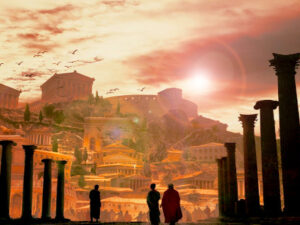
The search for secret, hidden weapons and strategies takes us back to ancient times, more precisely to the era of the Hannibal War, which took place in the Second Punic War. A significant chapter of this period takes place in Sicily, where the city of Syracuse under the rule of King Hieron had long cultivated a close alliance with Rome under the rule of King Hieron. After Hieron’s death in 215 BC beganHis successor to strive for a connection with Carthage, which led to Sicily becoming the scene of violent warfare conflicts again. The Romans sent one of their most capable generals, Marcus Claudius Marcellus, who was also popularly known as “The Sword of Rome”. His mission was to subdue the insurgent city and to resist the local resistancebreak. But this plan was anything but easy, because Syracuse was protected by mighty walls and housed one of the smartest minds of his time: the famous mathematician, physicist and inventor Archimedes. He had developed a series of technical devices whose main goal was to make life as difficult as possible for the Roman besiegers.
Archimedes’ innovative defense systems against the Romans
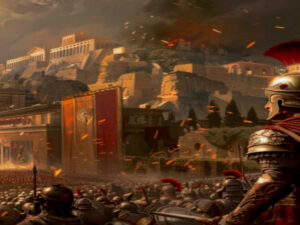
The Romans tried to break through the city walls of Syracuse with their siege machines. They resorted to known means: Catapults and slings, who threw stones and arrows into town to weaken the defenders. Already in the Peloponnesian War, more than 200 years ago, the Athenians had used similar siege techniques and were thusfailed. Archimedes, however, set the guns so that the target distance could be infinitely adjusted to avoid blind spots. As a result, the Roman siege machines were less effective and the defenders were able to better coordinate their attacks. Marcellus also tried to attack the port city directly by using specially designed barges for thestorm on the fortifications were built. But the Syracuses used large cranes with gripper arms, which lifted the heavy ships out of the water as if they were nutshells. Plutarch, Marcellus’ biographer, describes this scenario as a “terrible spectacle” in which the ships’ crew was thrown in all directions when the cranes took off the shipsraised. It was a technical masterpiece that made the Roman attacks considerably more difficult.
Archimedes’ legendary miracle weapons and their tragic end
In view of the losses that Syracuse suffered from the mathematician’s innovative devices, Marcellus is said to have called out in frustration: “Let’s finally stop fighting this geometric Briareus, who uses our ships like cups to draw water from the sea.” Briareus, a giant of Greek mythology, symbolized the indomitable power of inventionsArchimedes. Despite the impressive defensive art of the Syracuses, the Romans ultimately managed to conquer the city. For the inventive inventor, this episode ended tragically: A Roman soldier shot him while Archimedes was drawing sketches in the sand. His last words should have been: “Don’t disturb my circles”, a reference to his geometric studies andinventions. It was he who had defended Syracuse with his deadly miracle weapons for so long. The story also reports that the Byzantine historians Johannes Zonaras and Johannes Tzetzes tell of another legendary weapon of Archimedes’ – a so-called “mirror cannon” with which he allegedly bundled rays of sunshine to set Roman ships on fire. thatPrinciple of the concave mirror was known to ancient physicists, but the existence of such a weapon is controversial. It is questionable whether Archimedes was able to produce a sufficiently large mirror cannon to actually ignite ships. Polybios, the most reliable historian at the Second Punic War, does not mention such burning mirrors. It remains unclear whether thisLegend is based on excessive reporting or reflects actual technical possibilities.
Ancient secret weapons in comparison: Romans and Greeks
In contrast to the speculative miracles from Syracuse, the history of the First Punic War also reports a so-called secret weapon that helped the Romans to win. Polybios, a major Greek historian, writes that the Romans were still inexperienced at sea at the time and had trouble standing up to the superior Carthaginian fleet. butIn 260 BC, the Roman consul Gaius Duilius succeeded in winning a surprising victory with a fleet at Mylai. After Polybios, the Romans recreated their ships according to a captured Carthaginian model, but a special device on the bow of their ships, called “Corvus”, was decisive for the success – a kind of enter bridge with a thornat the top. This bridge could enter the enemy ship’s planks while lowering it, allowing the Roman soldiers to land and conquer the enemy ship. The Romans wanted to shift the fight to the country and take advantage of the sea war technique. But what if everything is just a legend? There is a possibility that the “Corvus” is more of aHistoriographical invention is to portray the Romans as clumsy beginners in the naval war. Polybios might want to give the impression that the Romans only prevailed through sudden technical innovation to cover up their inexperience in the ship’s ship fighting. If the “Corvus” even existed, it quickly disappeared from thehistory books. The legend of the Roman naval war is probably overdone and is more for the mythologization of Roman victory.
Roman Innovations: Artillery Teaching Fear
In addition to the well-known throwing machines and “miracle guns”, the Romans also developed impressive further developments in the field of artillery. Although catapults and torsional guns – the so-called “Onagers” and later “Scorpiones” – were not Roman inventions, the Romans significantly perfected the mechanics of these weapons. Torsion guns were mechanical devices in which theForce was created by twisting a rope bundle of horsehair. When firing, the stored energy was suddenly released by transferring it to a slider via tendons and frames, which threw the bullet – mostly a bolt or arrow – towards the opponent. The Ballista, a kind of large crossbow, was one of the most important weapons in this category. she couldFire stones, lead balls and, in rarer cases, arrows at the enemy troops. These mechanical weapons were impressive in their effectiveness and contributed significantly to the Romans’ military superiority. They showed that ancient warfare was not limited to muscle power and simple devices, but increasingly focused on technical innovations thatwar fundamentally changed.