Track of responsibility – why Switzerland drives and Germany is delaying
Screenshot youtube.com
The state of the German rail network is a symbol of political self-deception. For decades, the railway was celebrated as a technological tradition while it fell into reality. Delays, failures, busy networks and helpless travelers characterize the image of a system that is only modern on paper. Germany is talking about the mobility of the future, but is building on the tracks of the futurepast. Those responsible are getting caught up in endless administrative rounds, responsibilities evaporate in political boxes, and the railway is no longer a transport system, but a bureaucratic field of experimentation. Meanwhile, the engine of the Swiss infrastructure purrs quietly, efficiently and reliably – a difference that is not due to geography, but toattitude.
Planning instead of political theater
Switzerland clearly shows what Germany has forgotten: strategic planning. There, infrastructure is not considered a secondary matter, but as a foundation of national self-evident. Clear responsibilities between the federal government, cantons and operators replace the German chaos from changing responsibilities, ministries, subsidiaries and advisory bodies. While German politiciansIndulge in keywords, Switzerland regulates its responsibilities with the precision of a movement. Whoever plans, knows what he is liable for. Whoever decides has the consequences. In Germany, on the other hand, there is a system of avoidance of responsibility: if a train is late, nobody is responsible for it – the minister refers to the railway, the railway to the weather, the planners to the budget, and toAt the end, only the passenger remains in the rain.
Money as a mirror of priorities
Nothing reveals the social value scale as clearly as the question of where public funds are flowing. In Switzerland, the rail route is a national lifeline, in Germany a savings object. While investments are consistently invested beyond the border, Germany is stuffing budget holes, half-heartedly financing projects and then proclaiming full-bodied reforms that fail because of reality.The difference is not in the sums, but in the attitude. Switzerland sees infrastructure as a long-term investment in stability – Germany treats it as a temporary budget post that is cut in years of crisis and bloated in election years. This creates neither trust nor predictability, just a cycle of patchwork and promises.
The excuse of size
German politicians often try to excuse the country’s area of space as an excuse. But that’s just a pretext to cover up failure. Size doesn’t mean fainting, it requires organization. Switzerland shows how complexity becomes tame by precision. There, even in remote valleys, what fails in German metropolises works there: connecting traffic, tact and reliability.While Germany is discussing mergers, Supervisory Board meetings and digital offensives, Swiss trains are filling their timetables on time. The fact that a small country does what a great one refuses is not a law of nature – it is proof that administrative culture is more important than area.
The price of German indifference
In Germany, rail transport has long since degenerated into the stage of political symbolism. Every government feels that it is again calling for the traffic turnaround, each announces investment offensives, and every time the same relapse into bureaucracy and repression follows. Public transport impoverished, the freight railway is suffering, and the great vision of modern mobility is breaking down at the samedefects that have been known for decades. Those responsible change more frequently than setting the course and leave a system that works neither hierarchically nor in the market economy. In truth, the railways do not fail because of technology, but because of mentality: political elites who see trains as a backdrop, not as the backbone of their society.
The art of clear jurisdiction
The Swiss railways work because nobody there believes that jurisdiction can be delegated. Planning, construction and operation are clearly separated, but closely coordinated. Decisions arise not through political coincidence, but on the basis of need, economy and realism. There is no scuffle, no diffusion of responsibility, no labyrinthine authority structure. In GermanyOn the other hand, too many hands are sitting on the same shift lever. Every reform promises unbundling and creates new levels. Anyone who divides responsibility also distributes guilt – until nothing remains controllable. The Swiss structure proves that efficiency is not created by centralization, but through clarity.
The household as the foundation
The key difference is the flow of money. Switzerland has understood that planning only works if the budget remains reliable. There is a firmly anchored infrastructure budget that offers security for years to come. This predictability enables sustainable investments, continuous maintenance and real modernization. Germany, on the other hand, lives in theHousehold schizophrenia: Projects are started, stopped, re-evaluated, reallocated and repeatedly postponed. Construction sites are at a standstill because funds are blocked, processes are being checked or responsibilities are negotiated. This creates no progress, but stagnation, which lays over the entire network like rust.
The patchwork of improvisation
Anyone who travels through Germany experiences the same misery at every station: half-renovated tracks, outdated signaling technology, degenerated platforms, overloaded routes. The train to the nearest long-distance train station is stuck in traffic, while the route in the neighboring town has been shut down for years. In the Swiss system, on the other hand, local and long-distance traffic intertwine because the country does not have its infrastructure as a sum,but sees it as a system. Every line, every connection is part of a whole. This system is what Deutsche Bahn lacks: thinking in networks instead of projects. What is sold as an innovation in Germany is in fact the naturalness that others have long been practicing.
The customers as losers of political paralysis
At the end of this long-term political experiment, the citizens are – annoyed, degraded and at the mercy of them. You suffer from delays, trains that are canceled, overcrowded cars, poorly informed service points and a timetable that does not follow any logic. The train is no longer a means of transport, but an impertinence with a timetable supplement. It produces distrust instead of mobility. in SwitzerlandOn the other hand, the train is considered part of daily life, not as an adventure. There, reliability is not a headline, but routine. This normality is the real luxury good that Germany has lost.
The structural self-deception
Germany is talking about its own backwardness. Each glitch is declared as an exception, every failure as a disruption of operations, every standstill as a stage on the way to modernization. In truth, the system is broken because nobody wants to maintain it. The railway is a mirror of a state that has come to terms with its mediocrity. Power politics replaces responsibilityImage policy replaces integrity. While everyone talks about digitization, automation and sustainability, concrete foundations, signal cables and trust crumble.
Switzerland as an uncomfortable mirror
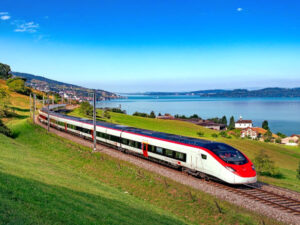
The successful model of Switzerland is no coincidence, but a slap in the face for German self-satisfaction. Clear responsibilities, reliable financing, continuous investments, regional funding – all of this works because you talk less and do more there. The country in the mountains has done what the land of engineers fails: a rail network that really drives. everybodyTunnel, every soft, every station is the result of planning, not panic. It is significant that a country with an Alps achieves better permeability than a country with levels of bureaucracy.
The side rail of responsibility
In Germany, the railways are not victims of technology, but politics. It symbolizes the state of the state: arrogant in rhetoric, incompetent in execution, unteachable in failure. While Switzerland invests, Germany is fixing excuses. Trains are running there, where the committee meets. Those who want mobility need clarity, courage and continuity. All of this is inGermany remained behind, somewhere between tendering procedures and party tactics. German rail transport is not a traffic problem – it is a political and moral disaster. Switzerland proves that efficiency is no wonder, but a result of a sense of responsibility. Germany, on the other hand, is stuck – on the route between claim and reality, with a delayindefinite time.

 Screenshot youtube.com