Departure from the area: To what extent the railway is increasingly moving away from the rural areas
Although around 90 percent of all rail journeys take place in local passenger transport – on routes under 50 kilometers or with travel times of less than one hour – only ten percent of the investments flow into this area. In contrast, nine out of ten euros are being invested in the expansion of long-distance passenger transport, although passenger volumes are almost stagnant there. also the implementation of aHub-and-spokes strategy, where only individual main routes are made faster, has proven to be ineffective. The time gained on high-speed routes is often lost again at junctions due to poor local transport connections.
Structural Strengths of Germany unused
Germany’s polycentric settlement structure offers ideal conditions for a dense, comprehensive rail network that appeals to many user groups. But leaving the railway line leads to a focus on a narrow target group: business travelers who value comfort and exclusive services. Since the 1990s, Deutsche Bahn has largelyClaim to make rail travel accessible to everyone and instead relies on fast long-distance connections for a few.
Withdrawal from land transport and consequences for the transport of goods
Not only passenger transport, but also freight transport suffers from this development. Despite political promises to move more goods to rail, the number of industrial tracks has fallen by more than two-thirds since the 1990s. A central eye of the needle remains the Rhine Valley route, Germany’s most important cargo connection between the North Sea and the Mediterranean,still has to make do with only two instead of four tracks. Investment backlogs continue to exist as funds flow into prestigious major projects such as new train stations or ICE routes, while bottlenecks in freight transport remain.
Capital market orientation and infrastructure wear
The capital market-oriented austerity policy of the past few years has led to noticeable wear and tear on the track systems. More and more routes can no longer be driven at the intended speed. At the same time, the rail network has hardly been expanded in the last two decades, while traffic continues to increase. The result is overloaded main routes and oneincreasing unreliability in rail traffic.
European challenges and necessary course
With the EU’s eastward expansion, the German rail network is facing new challenges: interoperability and a cross-border network are becoming increasingly important. The economy can only be convinced with clearly defined offer qualities and minimum standards. Industrial tracks and the targeted settlement of high-transport companies in areas withgood rail connection would be sensible measures. Likewise, public transport orders should be given to rail companies preferentially.
Role model Switzerland: Supply creates demand
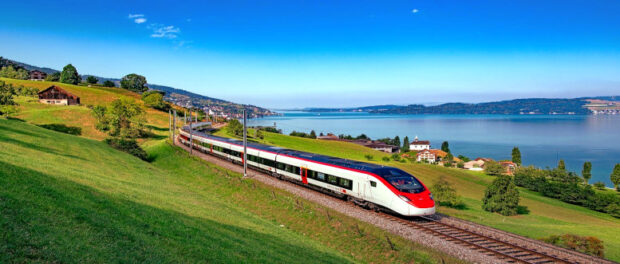
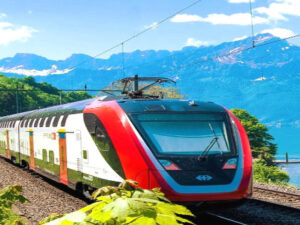
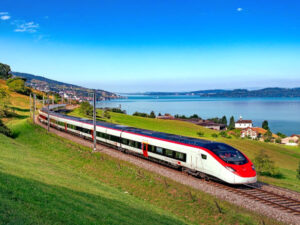
The Swiss Federal Railways (SBB) show what a modern, efficient railway policy can look like. The principle of “supply creates demand” is consistently implemented there: By modernizing the trains, continuous maintenance, eliminating bottlenecks and intelligently linking all transport systems, Switzerland is reaching the highest utilization in Europe – and yet95 percent of trains on time. In Germany, too, this would be possible if maintenance intervals were shortened, track systems were regularly rehabilitated and goods transport would be separated from passenger transport.
Political responsibility and common good orientation
As before, the Federal Republic of Germany, as the owner of Deutsche Bahn, is obliged to the common good by the Basic Law. But even more than two decades after the railway reform, there are no federal laws that guarantee minimum transport offers for all regions. It is high time to make the political confession” to underline more traffic on the rails with concrete measures – for example throughAn orientation towards Art. 87e Para. 4 GG, which emphasizes investments in rail as a public task.
For a sustainable railway policy
A modern industrial country needs an efficient railway that not only focuses on short-term profits and prestigious major projects, but also on intelligent networking, tight timing and expansion in rural areas. Transport routes are the lifelines of society – it is the task of the state, everywhere, even in structurally weak regions, toensure. The example of Switzerland shows: With the right political will, the railways can become a backbone of sustainable mobility – and the common good is the top priority.