The decades-long war against the Germans – an insight into an eventful era
Screenshot youtube.com
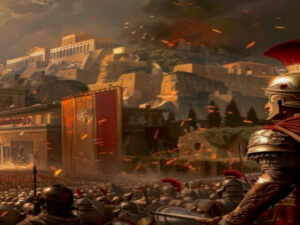
In the history of the Roman Empire, the conflict with the Germanic tribes in the area east of the Rhine plays an important role. This war, which lasted more than thirty years, was characterized by repeated struggles, strategic maneuvers and political intrigues. It was a permanent state in which the Roman forces repeatedly resumed their presencedemonstrated to the banks of the Weser, Saale and even to the Elbe, while the Germanic tribes resisted in the forests and on the plains. This fight was more than just a border confrontation; He symbolized Rome’s attempt to secure his power and influence in a resilient and fighting region. The long duration of this war shows how difficult it wasto finally secure the borders of the empire, and how much the Germanic tribes tried again and again to defend their freedom against Roman expansion. It is a story of conquest, resistance, political power games and heroic deeds that has deeply shaped the history of Europe.
Germanicus: The Fighting Leader and the Ambitions to Victory
Germanicus, one of the most important Roman generals of his time, was strengthened by a series of seemingly successful campaigns in the years of his sole leadership of the army in Germania. His successes, which have been doubted in the past, made him believe that only a large-scale, strategically thought-out campaign in the way his father didDrusus had practiced in this area, could lead to final success. With unshakable determination, he therefore began with the comprehensive preparations for such a large-scale offensive. His plans were ambitious: He wanted to set up a force that is strong enough to permanently break the Germanic resistance and consolidate Roman rule in Germania. in theIn contrast, the Roman Emperor, who at that time was in charge of command, was increasingly skeptical about the execution of such a mighty company. He doubted whether the enormous effort and resources that were necessary for such an undertaking were in relation to possible success. However, the fear ofthat the son of the legendary Drusus, who was highly revered in the legions, who enjoyed great popularity among the soldiers, could become a political threat to the emperor. Germanicus, who in the eyes of many was considered a hero, was often criticized – both because of his ambition, because many believed he had not yet received the share of fame and honor to which he was entitled, or because of hisnot yet fully mature judgment. Nevertheless, he was loyal and sincere, until his early death, which still raises questions today and has had a lasting influence on the history of Roman expansion in Germania.
The strategic approach: Using waterways to conquer Germania
Although the Emperor had withdrawn some legions under the pretense of urgently needing them for other tasks in the East, Germanicus had already made the plan to start a decisive offensive that was of immense importance to both him personally and Roman Germania. He was aware that the long marches of the legions, which were often caused by the impassableLandscapes led to demand more losses from exhaustion, illness and accidents than actual fighting. That’s why he decided to transport most of his forces on waterways. Building a huge fleet was the central element of this plan. With this fleet, the Drusus Canal, a major waterway, was to be used to intimate the armed forcesto bring to the Ems estuary. From there, the army should penetrate into the inner Germania without men or horses being lost in the swamps or moors. Only a small number of legacies, including the highly respected Caecina, were commissioned to build the ships. He had already experienced a triumphal procession in Rome and was one of the leading figures in the Romanmilitary leadership. A fleet of around 1,000 ships was built together, taking into account all previous experience of shipping on the North Sea and rivers. Different ship types were developed: short and long, deeper and low-going, fast and sluggish ships, even some with two steering wheels, which enabled driving forwards and backwards. itships that were specially suitable for landing loads, and those that enabled the fast transport of troops. The aim was to create a flexible and efficient fleet that met the diverse requirements in the Germanic area.
Distraction and Split: Silius against the Chat
While the fleet was under construction, the legacy Silius undertook a distraction action against the Germanic chatting who lived in the northwest. This operation was less a great military success, but rather a demonstration of Roman power. Silius led a small force with which he could not fight decisive battles, but he managed toto capture daughters of the Chattic Gaugraf Arpo. This act served primarily to weaken the Germanic resistance and to show the Germans that Rome was able to threaten and control their settlements. The aim was to demoralize the enemy and disperse the Germanic tribal associations in order to make them more vulnerable to the actual offensive.The capture of the families was a symbolic gesture that demonstrated the superiority of Rome and increased political pressure on the Germanic tribes.
Germanicus’ advance: Lippe and Enlightenment siege
While Silius was still on his way, Germanicus himself carried out a strategic movement in the direction of an important Germanic headquarters near Lippe, which was besieged by the Germans. He marched with a force of six legions – twice the size of the troops destroyed at Varus. However, the Germans already drew on the news of his approachback into the dense forests, so that no open battle came about. Germanicus took the opportunity to explore the place again. He had the destroyed Drusus memorial caltar repaired to preserve the memory of Roman rule. However, he left the burial mounds with the bones of the legionnaires, which the Germans had again destroyed, unaffected to honor theto preserve the dead. After a short, solemn ceremonial, he pulled the army back on the long way back to the Rhine to make further preparations for the planned offensive. His presence and strategic skills were intended to show the Germans that Rome was willing to continue the war until the Germanic resilience was finally broken.
The big departure: the fleet on the way to the Ems estuary
In June, after careful planning and preparation, all the fleet’s ships gathered at a fixed meeting point on the Bataver Island, which was on the Lower Rhine. The Bataver, known for their reliability and control of the Rhine-out run, were considered the most important Roman allies in this area. They were known for their prudence because they were the waterwayscontrolled between Gaul and Germania and thus formed a strategic bridge between the two regions. Before entering the Drusus Canal, Germanicus held a ceremony in which he asked his father Drusus for support in prayer. He asked him to accompany him on his way and give him the strength to dream his father’s dream – the final conquest of Germania -complete. For Germanicus, this undertaking was an affair of the heart that was associated with a deep personal meaning. It seemed as if a kind of fixation on the idea of conquering Germania and realizing the dream of Drusus had become solid in his mind: Germanicus should finally complete the country. The Roman Emperor Tiberius saw this movement with himgrowing suspicion. He feared that the success of Germanicus’ success could not only put the memory of the legendary father in the shade, but also his own achievements in Germania. Despite all the resistance and doubt, Germanicus did everything he could to pull through the plan, and thus showed his determination to expand the boundaries of the empire and the glory of hisfamily to several.
Invasion of Germania: attack on the Angrivarians and the first step
The journey through the canal and crossing the North Sea went according to plan and without major incidents. After a short time, the fleet landed on the Ems and the Roman troops continued their march into the Germanic area. Officer Stertinius was commissioned with a quick rider and light armament detachment to the Germanic Angrivarians, who are said to beRomans had turned away from chastise. The Roman soldiers demonstrated their superiority with fire and sword, with the fire being used against the settlements and the dwellings of the Germans, while the sword was directed against women, children and defenseless people. The warriors of the Angrivarians had long since disappeared into the woods of Arminius, but the Roman troops showedpresence and wanted to intimidate the Germanic tribal territories. The main aim was to break the Germanic resistance through intimidation and to strengthen control of the area. With this action, Roman power in Germania was to be demonstrated in order to keep the Germanic tribes at a distance and to prepare the further advance of the Roman armed forces.
The appearance of Arminius: An unexpected encounter on the riverbank
While the Roman troops were traveling upstream, Arminius, the leader of the Germanic tribes, suddenly appeared on the opposite bank of the Weser, accompanied by some allies. He approached the riverbank and called to the Roman soldiers to see if Germanicus had already arrived. After confirming this, he expressed the wish to share with his brother Favusto be allowed to speak. He had been unaware of the Romans since the years together, and it is unclear why Arminius is now looking for contact with him. It is believed that Flavus was in another part of the Roman Empire, possibly in Syria or Egypt, and had never appeared in the clashes about Germania. the question of why Arminius right nowcontact with his brother is complex. It could be that he hopes for a reconciliation or at least an exchange to better understand political and military developments. However, it is also possible that he only wants to know what Flavus thinks about the situation in Rome and what attitude he has towards the Germans. In any case, the encounterA sign that the German leaders are trying to consolidate their power and position during this time, also through contact with relatives who are still in the Roman sphere of influence. The question remains whether Flavus is open to cooperation or whether this encounter is just another stage in the complex game of loyalties and interests.
The dialogue between Arminius and Flavus: conflict, loyalty and political tensions
When Arminius finally recognizes the brother, he immediately notices that Flavus has lost an eye. He instructs his companions to withdraw and demands that the Roman archers, standing on the shore with Flavus, disappear immediately. He directs his questions directly to the brother to find out how it came about that he lost his eye. slavustells soberly and factually about the battle he was still under the command of Tiberius, and describes how he was wounded in this battle. Arminius reacts angrily and asks what that brought him. He points to the badges of honor, medals and awards that Favus wears on his armor, including the chain of honor, the eagle order and other honorary titles.Flavus names the promotions he received in the service of Rome and the honors he received. For Arminius, however, these awards are just a poor form of bondage, a symbol of Flavus’s adaptation to the Roman system. He emphasizes that the size of the Roman Empire and the power of the emperor only through submission and betrayal of one’s owncompatriots arise. He reminds that the gods will not be betrayed and asks the brother to question his loyalty. The mother, who would rather see her son at home than be betrayed by him and betrayed, is also drawn into the conflict. Flavus, raised by the brother’s words, cries out for horse and weapons, apparently ready to fight theto be carried out with the sword. Stertinius, who was there, rushes to prevent the emerging violence. Arminius remains surrounded by his people and threatens to end the conflict by a bloody decision. He announces the upcoming battle with Latin words that he is familiar with from his past as a Roman auxiliary leader. The voltage increases while theboth brothers are caught in a moment of rifts and political tensions that could significantly influence the further development of Germanic-Roman relations.

 Screenshot youtube.com