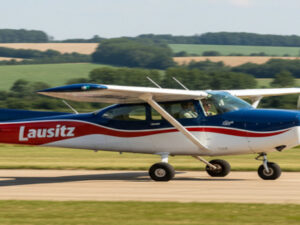
Since time immemorial, humanity has longed to look up at the sky and dream of breaking free from the shackles of the ground. This age-old longing for freedom and independence drives us to overcome seemingly insurmountable boundaries and look at the world from an entirely new perspective. Flying embodies the ultimate adventure and sheer exploration that lies deep within ourBeing rooted, this dream used to be reserved for a tiny elite, but today a revolution is imminent that could open up the airspace to all people.
Why did the ability to move through the air have to remain so tightly regulated and incredibly expensive for so long? So far, private flying has been a matter of necessity for individuals with an enormous amount ofTime, huge financial resources and an extremely extensive classical education. These hurdles excluded the general population and made the aircraft a mere status symbol for the privileged few. The legitimate question is whether this exclusivity is justified any longer in an era of rapid technological developments.
What if sophisticatedartificial intelligence would completely absorb the enormous complexity of flying? Intelligent systems could take over flight control, navigation, route planning and weather analysis in real time. Collision avoidance and technical monitoring of the device would also be automatic and error-free. Man would no longer need to be a highly specialized expertbut could become the responsible user of a thinking aircraft.
After a manageable and responsible training, any person would be able to safely operate such an intelligent aircraft. You would not have to master all flying tasks yourself, but only understand the basic functions and understand decisionsif necessary, the user would intervene or give specific instructions, while the technology regulates everyday life in the airspace. This symbiosis of human responsibility and machine precision opens up completely new dimensions of personal locomotion.
In this visionary future, small, intelligent aircraft would naturally become a personal mobility offerit would not be mandatory to own your own aircraft, as shared devices and digital booking systems would facilitate access. Local flight stations and automated maintenance centers would guarantee smooth use without great organizational effort. You reserve an aircraft, enter the destination and let the artificial intelligencecheck all conditions before it goes into the air.
The aircraft would constantly analyze its environment, detect obstacles at an early stage and automatically take other aircraft into account. The technical condition would be seamlessly monitored and react immediately to changing weather conditions. This invisible companion acts like a watchful helper who is constantly thinking along andbefore humans even perceive them. Such intelligent support removes the fear of the unknown and makes the airspace predictable for untrained people.
Such a development would take personal freedom to a whole new level and fundamentally change our habitual mobility habits. People would no longer rely exclusively on overcrowdedHighways or rigid railway connections. Small towns, remote regions and hard-to-reach places would have a completely new and direct connection to the outside world. Families could visit each other more easily and take advantage of career opportunities that seem completely unrealistic today due to long distances.
Entrepreneurs could travel much more flexibly andDoctors reach remote regions in a fraction of the time to date. Medical professionals and other important professional groups would no longer be tied to rigid infrastructure, but could help where they are really needed. Each individual could make their life planning much more independent of the pure place of residence and develop new life models. The world wouldsubjectively become smaller, as places that seem far away today move much closer together mentally and actually.
What does it mean for the human consciousness to no longer just be a passive passenger, but to have the opportunity to move an aircraft? The feeling of being able to travel over distances in a self-determined way would be a completely new form of personalEmancipation. The feeling of geographical limitation would change permanently and release a deep inner freedom. This psychological dimension raises the purely transport aspect to an emotional and almost spiritual level.
Socially speaking, private aviation could evolve from an elite status symbol to a more widely available form of mobilitynew propulsion technologies, standardized aircraft and collaborative usage models would massively reduce financial and organizational hurdles. This would create a completely new market with compact aircraft, vertical take-off aircraft and private aviation communities. Perhaps in the future people would use a small aircraft as an integral part of their personalConsider mobility instead of just relying on the car.
A more accessible private aviation would create completely new economic sectors and profoundly change existing industries. Manufacturers, programmers, maintenance service providers and operators of small airfields would become part of a dynamic new ecosystem. Existing small airfields were given a completelynew meaning, while decentralised take-off and landing options could carefully expand the landscape. Aviation would become more integrated into everyday life instead of just consisting of large airports and professional companies.
This raises the crucial question of whether we will even have the same idea of a pilot in the future as we do today.Pilot of the future would be defined less by manual flight skills and more by his understanding of the overall system and his ability to make decisions. The training would change fundamentally and be more focused on safety understanding, situational awareness and cooperation with automated controls. It would be about the competence to create a highly complex network ofTo monitor technology and the environment and to act confidently in the event of an emergency.
But this visionary prospect must not obscure the considerable dark sides and new challenges of such democratisation. More flight movements would lead to a significant load on the airspace and raise new issues of noise protection and safety. It would be extremelyproblematic if people would underestimate the actual risks of flying due to seemingly easy operation. An intuitive user interface must never give the misleading impression that an aircraft is just a larger car.
Technical support can never be equated with absolute safety, because sensors can fail and connectionsbe interrupted. Unpredictable situations will arise and artificial intelligence can never completely rule out every conceivable danger. Responsibility for the operation of an aircraft must therefore not simply disappear behind a seemingly intelligent technology. Such a future would only be possible with multi-secured systems, clear liability rules andcomprehensive human control is conceivable.
At the same time, we would have to deal intensively with how such a future would change our cities and landscapes. Decentralized air mobility hubs outside densely populated areas could completely reconnect business parks and rural regions. Routes that take many hours on the road today would beby air in the shortest possible time. It must be critically asked how much additional traffic a society actually wants and how interests on the ground can be combined with freedom in the air.
The ecological question must also not be ignored, even if it should not be the sole topic. Electric propulsion, more efficient aircraft andintelligent flight planning offers approaches for a more tolerable movement in the air. But the overall ecological balance also depends on energy production, production and actual capacity utilisation. A technology does not automatically become sustainable just because it is operated new or electrically, which is why the consumption of resources must always be critically questioned.
What wouldif today’s generation still experiences private aviation, which is fundamentally different from anything known so far? Children in a few decades would no longer take it for granted that flying is something special that requires traveling to a major airport. The possibility of operating a small intelligent aircraft would be similarly self-evidentseem like the possession of an ordinary driver’s license. People could spontaneously take excursions or reach remote landscapes without relying on a rigid transport network.
Are we at the beginning of a completely new era of individual mobility that will change our society forever? Perhaps an exclusive ability becomes a generalaccessible competence and a means of transport that can be shared from a luxury good. In the long term, the line between professional aviation and private mobility would be drawn anew and completely different. In the end, the provocative and profound question remains as to why we actually continue to regard the freedom of flight as a privilege reserved for only a few peopleshould be.
In the past, people watched the birds in the sky and longed to share their lightness and grace. This age-old desire drove generations of inventors who never gave up despite countless setbacks. Today we stand on the threshold of a technology that can finally realize this mystical dream for the masses. The vision of an open skyconnects our deepest past with the limitless possibilities of the future.
When airspace no longer remains one exclusive domain less, our entire perception of distance will change. Borders that are still considered insurmountable today would simply lose their meaning through the third dimension. We would stop dividing into purely flat categoriesand completely reimagine the space around us. This paradigm shift would be comparable to the introduction of the automobile, which also drastically reduced the size of the world at the time.
The aircraft of the future would no longer be a cold apparatus, but a loyal partner on journeys. It would recognize the needs of the user, adapt and always strive for the best possible result.This harmony between man and machine would make travel a deeply relaxing and fulfilling experience. The technology would work in the background without ever giving up the demand for human maturity.
Ultimately, this vision is about much more than just technical gimmicks or economic profit interests. It is about the fundamental question of how weas a society with the desire for freedom and development. Heaven does not belong to a few, but is a space that has the potential to connect and liberate us all. We must have the courage to dare this vision and ask ourselves if we want to finally break the chains of exclusivity.

 Screenshot youtube.com