The contemplation of ancient history is often characterized by a transfigured image that places monumental buildings and philosophical excellence in the foreground. But behind the shining facade of Roman civilization was an everyday life characterized by extreme social contrasts and deprived living conditions. An in-depth analysis of the historicalReality requires looking at the ordinary people whose existence took place far from the luxurious life of the ruling class. Only by considering these inconvenient truths can a comprehensive understanding of the functioning and the enormous costs of this former world power be developed.
The emergence of a transfigured antique image
In 1748, a learned theologian from Saxony took a job as a librarian at a castle near Dresden. The residence city there presented itself as a baroque work of art, the overloaded pomp of which, however, did not inspire the critical spirit. He fared quite differently when looking at the royal collection of antique sculptures made of bright white marble.In the extensive writings of the library, he discovered the clarity of form of the Greek and Roman works of art, which were to determine his further thinking.
The formula of noble simplicity
After several years of research, the scholar published an influential work on the imitation of the ancient masterpieces in 1755. This book quickly attracted a great deal of attention and was reprinted a short time later. The author coined the term, which still has an effect today, that the essential feature of ancient art is a noble simplicity and a silentThis idea dominated the artistic and architectural perception of the Greek and Roman epochs for many centuries.
The change in media presentation
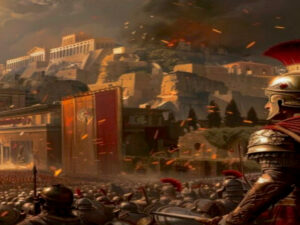
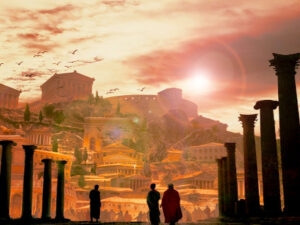
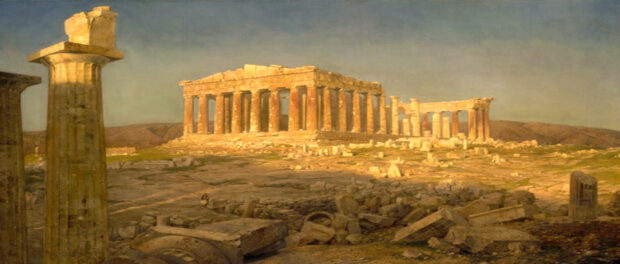
Even in the recent past, painters and filmmakers imagined the ancient world as a light-flooded landscape with bright white buildings. However, today’s research knows that the ancient marble buildings were in fact garishly and colourfully painted. The actual spatial impression of ancient temples and forums more closely resembled the sumptuous interior of Baroque houses of worship than thestrict and white museums of modern times. Modern television productions and films now paint a completely different picture of the eternal city.
The Chaotic and Dirty Everyday Life
Current series show the capital as a place full of garbage, where beggars, crooks and ordinary workers determine everyday life. The presentation is deliberately chaotic, loud and extremely dirty, which has long since developed into its own aesthetic program. On the horizon, the fireplaces of the craft businesses smoke, and the camera dives deep into the narrow streets of the miserableQuarter. This antiquity with clear traces of use corresponds much more to today’s zeitgeist than the old ideal of flawless whites.
The deceptive glamour of the metropolis
Historical traditions say that a famous emperor found a city made of bricks and left one made of marble. But behind this radiant marble, there was often only a shiny facade that distracted from a bleak and dirty reality. The question arises whether the ancient metropolis in its entirety is not rather a huge andunhygienic throat. The scientific answer to this problem is naturally complex and requires a differentiated approach.
The duality of splendor and misery
The city was undeniably both: a magnificent center of the world and at the same time a place of stench and moral decay. Apart from the well-known sewers, there were numerous other grievances that seem highly disreputable from today’s point of view. The living conditions, medical care and food supply did not meet modern standards in any way. Women, slavesand poor people were treated like worthless rubbish, while the powerful used their positions for corruption and electoral fraud.
Dependence on social location
Which sensual or moral impression gained the upper hand depended almost exclusively on personal location. It made a huge difference whether you lived in a miserable slum or on one of the formative hills. The origin of a craftsman’s family or a wealthy senatorial class also determined the entire everyday experience. Their own experience with the city was thusradically colored by the wealth or poverty of each person.
People in the Shadow of History
The large mass of the population was in the dark and is hardly visible to this day, as the historical sources are almost only interested in the rich. All surviving texts were written by members of the upper class for that same upper class. Only some inscriptions or secret wall scribbles allow a rare glimpse into the lives of ordinary people. Therefore, it isextremely difficult to penetrate to the people who lived in the shadow of great history.
The Heritage of Antiquity in Collective Memory
These people in secret are now to be given a voice to correct the one-sided image of a flooded world of wisdom. Antiquity was undoubtedly a place of revolutionary thought, incomparable art and significant political orders. Europe has repeatedly rediscovered and admired this heritage in various spiritual rebirths. The invention of democratic andof republican systems by Greeks and Romans shapes our thinking to this day.
The longing for a bygone era
Nevertheless, the legitimate question arises as to whether someone really wants to live in this harsh and unjust world. In modern social networks, young men often report their great fascination with the Roman Empire. They supposedly think about the empire on a daily basis, while their partners view this enthusiasm with clear skepticism. The attraction of the RomanThe world is unbroken, but a real exchange with a simple slave or a gladiatorial fighter would not be desirable for anyone.
A glimpse into the engine room of history
A true understanding of the workings of this society does not come from looking at the ostentatious top. You have to descend deep into the engine room, where there is uninterrupted noise, bubbling and smelling of dirt. The Empire was not necessarily morally better than other ancient cultures, but it was more successful and resilient. This success was based onPromises that pretended a high degree of social participation and security for the dominated people.
Infrastructure as a superiority factor
Those who were allowed to belong to the inner circle lived far better than the poor people beyond the borders of the Reich. The Roman achievements in the areas of water pipes, sewers and basic medical care were impressive. They surpassed many competing empires and remained unmatched until the dawn of modern industry. Compared to today’s standards of prosperityand safety, the ancient level was still frighteningly low.
The beginning of the journey into uncleanliness
The observation of the dark sides begins in places where the hygienic conditions were absolutely scandalous. Even primitive new technologies took their constant toll on human health and the natural environment. The dirt determined the everyday life of the broad masses, who lived far away from the lush feasts of the rich. For most people, it was already agreat success, if they could even fill their stomachs.
The pervasive hunger and poor diet
Even when the feeling of fullness occurred, the food was completely inadequate and one-sided in quality. Outright hunger was a constant companion of the lower classes and determined their entire existence. The living conditions of the elite in the magnificent villas were in stark contrast to the dwellings of the poor. After all, the simple middle class still lived in decent apartments,while the poorest lived in tiny and dilapidated attics.
The dangers of tenements and medicine
From these miserable shelters they set out into the realm of constant suffering and deadly plagues. Ancient medicine had hardly any effective means to alleviate serious illnesses or save the lives of patients. The prescriptions of the doctors at that time were often based on false assumptions and could not prevent the great dying. Up to this point, it was mainly the materialBasic needs that the Empire could not meet for large parts of the population.
The deep division of society
The society also had an extremely dirty social side, which was characterized by deep distortions. Latent distress turned into open and bloody violence at regular intervals. Massacres and civil wars were not the order of the day, but riots plagued the empire again and again. Although the empire saw itself as a force for order and peace, it couldHowever, unrest never suffocates permanently.
The Exclusion and Institution of Slavery
Violence not only dominated the streets, but was deeply rooted in the social order. Entire groups of people fell victim to social exclusion and were labelled as dishonourable. Where power imbalances become structurally entrenched, social stigmas work far deeper than physical blows. The absolute endpoint of this social devaluation was theLegal system that allowed people to be degraded to mere property.
Abuse of power and corruption
Where such abysses gap, the abuse of power is a constant temptation for those in power. Bribery, nepotism and political manipulation could not be eliminated by any well-intentioned laws. The causes of these abuses lay in the deep imprints of a society that gave the elite full control. The murders in theCivil wars and the terror of the powerful against the powerless often culminated in the fate of women.
The marginalization of women and the power of rumors
Especially women on the margins of society were quickly labelled by men with derogatory terms for prostitutes. However, the violence could also hit back at the rulers themselves if it turned public opinion against them in the form of rumors. Powerful generals and emperors had to experience firsthand how deadly such public suspicions becomeother rulers, on the other hand, tried to gain sovereignty of interpretation in public and were surprisingly successful in a world without modern mass media.
The true price of antique greatness
The dirty side of the metropolis was not an accidental industrial accident, but the direct flip side of its enormous size. This misery worked deep within the city, in the stifling air and inferior bread of the poor. It manifested in the sick bodies of the slum dwellers and in the rumors that annihilated entire existences. The contemplation of this dark reality showsnot how the city shone, but why it worked and what an enormous price the many had to pay for it.

 Screenshot youtube.com