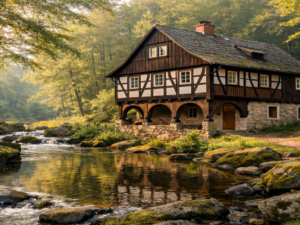
The important history of the place on Mönchsgasse in Bautzen and its role in teacher training
Screenshot youtube.com
The location on the corner Mönchsgasse in Bautzen, which is now used as a residential building, has a long and eventful past that is deeply rooted in the history of the city and its cultural development. This place, which used to be of particular importance for regional educational and cultural history, has fulfilled various functions over the centuries and was a witnessnumerous social changes. His history is characterized by important personalities, social change and the striving for education, cultural identity and democratic co-shaping. The building, which today only serves as a reminder of this glorious past, was once a center of educational innovation and cultural movement. in thisArticles will shed light on the extensive history of this place to visualize the importance of the region’s development and the Sorbian community and to highlight the lasting significance of its past for the present.
The historical location and its original meaning
The place on Mönchsgasse, which is now used as a residential building, was formerly known as the place behind the Monchen, which refers to the nearby Franciscan monastery and shows the close connection to the religious and cultural traditions of the city of Bautzen. Until 1988, the so-called Brüsewitz’sche Haus, a building that over time was caused by the decay and theprogressive neglect could no longer be obtained. The history of this place is inextricably linked to the development of the city, because it has been an important point for education and social life over the centuries. The long use as a place of learning and cultural encounters gives this place a special meaning, which is far beyond thestructural aspects. This historical connection makes it clear how strongly the social and cultural development of a city is characterized by individual places that take on different functions and meanings over time.
The first teacher training in Bautzen and its importance
As early as 1817, the history of one of the region’s most important educational institutions began at this location: The first teacher training seminar was set up in Bautzen, which played a central role in the training of teachers for Upper Lusatia until the end of the century. This seminar was more than just a training center; It was a place of exchangeinnovation and cultural understanding. Here teachers met each other from a wide variety of social backgrounds and worked together to improve education in the region. The furnishings were a lighthouse of educational innovation, which, through its progressive approaches and the open cooperation between Sorbs and Germans, regardless of theirdenomination, impressed. The training at this place not only shaped the technical skills, but also the awareness of the cultural diversity and the social challenges of the region.
The personalities and the social background of the teachers
Among the teachers who received their training at this seminar were important personalities who later played an important role in the social development of the region. They included well-known names such as Karl August Katzer, Johann Wehle, Johann Georg Melde, Johannes Bartke, Michael Rostock and Johann Traugott Mutschink. Most of these teachers came frompoor conditions, which gave them a special connection to the social and intellectual living conditions of the working population in the villages. This social background had a significant impact on her pedagogical work, because they were able to understand the realities of their students’ lives and respond to them accordingly. The seminar enjoyed an excellent reputation, not only because ofhis pedagogical innovations, but also through the commitment of his director Dreßler, who made a significant contribution to the positive perception with his democratic and political actions. The seminar became a place that stood for progress in teacher education and the democratization of society, which was widely recognized.
The influence on the Sorbian culture and national movements
A major aspect of training at this place was promoting the Sorbian language and culture, which was actively supported by some teachers. Personalities such as Andreas Seiler, Johann Ernst Schmaler, Johann Peter Jordan and Andreas Lubensky were intensively committed to the development of the Sorbian language, which they saw as the cornerstones of Sorbian identity and culture.These efforts helped to strengthen the cultural awareness of the Sorbian population and to preserve cultural diversity in the region. During their training, the young educators were given the awareness of the importance of their cultural roots, which later made them leaders in the Sorbian movement. Especially in times of the bourgeoisRevolution of 1848/49 and during the so-called “national rebirth” of the Sorbs, these teachers were instrumental in the preservation and promotion of the Sorbian language. Her work helped to keep the Sorbs alive and create a basis for later political resistance to assimilation.
Social influence and permanent heritage
The teachers who were trained at this seminar were more than just educators; They were social actors who were instrumental in shaping the cultural and political life of their time. They strongly identified with the values of democracy, cultural diversity and the preservation of Sorbian identity. The awareness that they have in their trainingwas mediated, shaped her actions in a lasting way and led to them becoming leading forces in the Sorbian movement. This commitment and cultural work made a significant contribution to consolidating the Sorbian language and culture in the region and protecting them from being forgotten. The importance of this place and its history goes far beyond the structural remains. he wasA place of learning, cultural development and democratic co-shaping that has had a decisive influence on the development of the Sorbian community. The legacy of this time still has an effect today and reminds how important education and cultural awareness are for social progress. The history of this place is a living testimony to the power ofCommunity and the value of education in preserving cultural identity and democratic values.

 Screenshot youtube.com