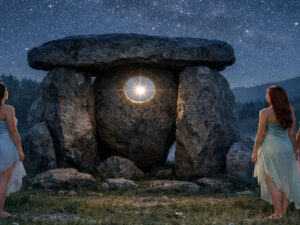
Over four centuries in the footsteps of forgotten sun cults
Screenshot youtube.com
The idea of a former sun worship in Lusatia often appears far from any historical reality. But numerous natural rock formations and old traditions point to a long-forgotten spiritual practice. These ancient places of worship were used by the residents of the region for generations before worldviews were fundamentalwalked. What was once considered a divine appearance lost its immediate meaning over time and disappeared from the collective memory. Only a few traces left the landscape and are still waiting for a careful interpretation. Already in the early seventeenth century, a local spiritual observation from today’s border area to Bohemia was noted. hedescribed encounters with an elderly person who regularly made a pilgrimage to a distinctive rock formation. This place obviously served as a retreat for personal devotions that were far ahead of the official church introduction. The practice described was combined with a deep connection to nature and the rhythm of the stars. Such reports mark the beginning of acenturies of pre-Christian past of space. From then on, the records were considered spiritual waypoints for subsequent scholars.
The first written references to forgotten cults
The landscape of the Lusatia offers ideal conditions for the preservation of historical traces due to its unusual rock composition. Massive granite blocks and resistant rock plateaus lasted millennia without any significant erosion. This hard material was already used for tools and monumental structures in the Stone Age. Many of these natural formationsbear names that point to an earlier ritual use. The nature of the subsoil made it possible for even fragile archaeological certificates to be preserved under the surface. Towards the end of the seventeenth century, the first systematic investigations began on a prominent rock massif in the southern part of the region. A young academic ledindependent abrasions and came across numerous ceramic vessels. These finds were scattered on the plateau and indicated intensive use as a burial site. The excavated pieces showed clear features of the Middle Bronze Age and testify to a long settlement history. In addition, foreign coins came to light, which made far-reaching trade contacts in ancient timesprove. Such discoveries confirmed the assumption that the place was frequented by different cultures for centuries. The scientific documentation of these finds laid the foundation for methodological research in the region.
geological conditions as natural archives
Over the course of the eighteenth century, other scholars expanded the knowledge of the ritual use of certain mountain peaks. A linguist translated local field names and recognized references to ancient question places. Other observers interpreted artificially-looking depressions in the rock as remnants of victim platforms. These interpretations were supported by oral traditions,the customs linked to the solstice. Later investigations used modern astronomical methods to check the orientation of the rock openings. The results showed precise references to the sun’s ascent and set points on certain calendar days. generations of scientists documented the cultural sequence of strata of thearea. Initially, speculative interpretations dominated, which were strongly based on mythological comparisons. However, over time, stricter archaeological standards and interdisciplinary working methods became established. Scientific analyzes supplemented the historical evaluations and provided precise dating for found artifacts. This continuous work formed an independentResearch line that extends to the present.
From Oracle Sites to Astronomical Surveying
The old stones and their hidden secrets remain silent witnesses of a lost world of faith. Modern researchers are working on carefully deciphering these traces and placing them in the historical context. Every new document and every well-founded finding contributes to making the cultural heritage of Lusatia more visible. This is how past and present combines in oneperpetual Process of scientific refurbishment. The early documentation of religious customs initially focused on the oral traditions of the local population. Spiritual and village teachers collected legends and legends that referred to sacred trees and stone altars. These records were later systematically evaluated by academic circles andcompared to existing historical sources. The focus was on the reconstruction of pre-Christian rituals and their gradual disappearance. The combination of language analysis and terrain studies resulted in the first maps that marked potential places of worship. This pioneering work created the basis for all subsequent archaeological projects.
The development of a long-standing research tradition
In the nineteenth century, the approach of purely descriptive reports changed toward cultural studies. Museums began to create collections systematically and to arrange the objects found in chronological terms. At the same time, the first scientific societies emerged that were explicitly dedicated to the prehistory of the region. thisInstitutions promoted exchange between experts and enabled larger excavation campaigns. The published annual reports contained detailed drawings, measurement data and well-founded interpretations. The discovery of solar observation sites on natural rock formations marked a turning point in regional research. Experts recognized that certain breakthroughs andedges were precisely aligned with astronomical events. This finding led to intensive surveys that fully exploited the technical possibilities of the time. The results refuted long prevailing assumptions about random rock formations and confirmed targeted human intervention. At the same time, comparative studies with European places of worshipcarried out to highlight regional peculiarities. The published papers found a wide resonance and inspired further expeditions. To this day, these early astronomical investigations are considered milestones in archaeoastronomical research.
Preservation of a forgotten cultural history
Dealing with the excavated artifacts has undergone constant change over time. At first, many objects were simply collected and kept in private collections. Later, professional preservation methods were established, which ensured the long-term preservation of the finds. Digital documentation techniques eventually revolutionized the workflow and enabledThree-dimensional reconstructions. These modern methods allow to restore destroyed structures virtually and analyze their original function. The scientific knowledge gain thus benefits from continuous technological development. The cultural significance of ancient sites extends far beyond purely archaeological issues.It touches fundamental aspects of human identity and collective memory. Many local communities still cultivate customs that go back to old sun cults without knowing their historical roots. This living tradition combines the present with a distant past and creates an awareness of regional continuity. The scientific reappraisal helpsto make these hidden threads visible and to prevent forgetting. A complete exploration of Lusatia remains a continuous task that requires constant attention. New methods and fresh perspectives regularly open up previously unknown connections. The cooperation of different disciplines ensures a comprehensive view of the historicalcircumstances. This creates an increasingly precise picture of a forgotten cultural history that will connect generations.

 Screenshot youtube.com