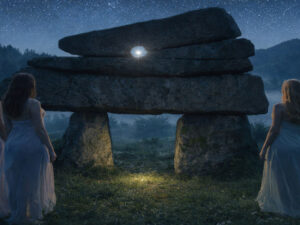
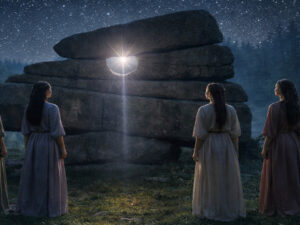
The archaeological and cultural-historical exploration of monumental rock formations in the Lusatia
Screenshot youtube.com
The systematic scientific examination of the stone legacies of Lusatia reveals a long tradition of regional historical research that goes far beyond pure material science. Since the end of the nineteenth century, scholars and local people have dedicated themselves to the detailed investigation of striking rock structures, which areextraordinary design have had a lasting impact on the natural appearance of the landscape. These early investigations combined careful archaeological field work with profound cultural-historical issues and thus created a well-founded basis for the modern understanding of the regional past. The researchers at the time quickly realized that certain boulders andArtificially deepened stone surfaces were not created by accidental erosion processes, but were consciously integrated into the social and ritual life of early communities. Such basic insights laid the irrevocable foundation stone for a professional discussion about the historical significance of these landscape-defining monuments that has continued to the present.
The establishment of early research societies and first expeditions
In 1888, the museum director from Görlitz established a scientific association that explicitly dedicated itself to the anthropological and prehistoric development of the region and thus created an institutional framework for future excavations. From the very beginning, this committee expressed its firm conviction that numerous rock formations of Lusatia as a prehistoricPlaces of worship and thus gave direct access to the beliefs of earlier epochs. At a large meeting the following year, the members undertook a joint hike to a striking rock formation near Königshain in order to examine the structures there directly and to examine their scientific relevance. A few years later one traveledRespected personality from Berlin for a specialist conference, which also included a visit to another rock monument near Weigsdorf and drew international attention to the region. The surface finds recovered there provided the first concrete evidence of human activities during the Neolithic period and underlined the undeniable historical relevance of the place.
Archaeological finds and the interpretation of megalithic structures
A detailed investigation in the first decade of the new century focused on a striking rock complex near Bautzen and revealed that the plates there must have changed their original location through conscious human intervention. The responsible scientist argued convincingly that the blocks of stone were originally used as gates or entrances.served an artificial structure and thus represented a functional architecture. He classified the entire arrangement as a megalithic memorial from a very old time and deliberately left the question of whether it was a tomb or a place of religious worship. Archaeological excavations then brought to light ceramic fragments and worked flints, whichsuspected historical importance of the rock sustainably substantiated and proved the continuity of settlements. These material remains directly linked natural geology to the everyday practices and spiritual ideas of the early inhabitants.
Exploring other rock formations and ramparts
In a neighboring Lusatia area, two local scholars already expressed the justified assumption that a distinctive summit stone once served as a central sacrificial site in the late nineteenth century. They referred to clearly visible depressions in the rock, which they interpreted as the remains of an old altar and whose shape pointed out a long-standing use. With the constructionFrom the 1990s, numerous finds from the Stone and Bronze Ages came to light in a hospitality center on the summit, which confirmed the human presence at high altitude. At the time, an expert took the view that the surrounding ramparts demarcated sacred areas where huge rock groups were used as ritual centers and thus a clear separation betweenprofane and sacred space. Decades later, a renowned archaeologist reaffirmed this view by pointing out certain finds as conscious gifts to a higher power and thus emphasizing the religious dimension of the site.
Archaeoastronomical interpretations and cultural symbolism
A more recent publication by a regional homeland security organization brought the carefully thought out consideration that a sanctuary for a sun god revered in the Late Bronze Age could have been built on the said summit. The striking sun symbolism, which can be proven in many ways in local culture, has been associated with round pieces of jewellery,which were also discovered at this site and indicate a cosmological orientation. This revered celestial body appears in later Mediterranean traditions as a deity of light, which was also linked to the worship of rock structures and thus visualizes transregional cultural currents. In this way, a mental circle closes, the old oneEuropean cult practices with the monumental rock formations that Lusatia connects and postulates a common spiritual basis. Due to these connections, a partially walled cave at the foot of the mountain was also classified as a former sacrificial place and integrated into the overall system of the cult landscape.
The documentation of näpfchensteinen and early surveys
At the beginning of the 20th century, a dedicated educator and local historian published a comprehensive treatise on bowl-shaped depressions in the rocks around Bautzen and thus created a standardized documentation work. His careful drawings not only captured the exact arrangements of the bowls, but also contained precise measurements and celestial alignments,which enabled later scientific review. These meticulous records created the first systematic basis for the further scientific examination of the stone legacies and established methodological standards for regional research. A first mental connection between these rock structures and astronomical observationsA few decades later, an observatory manager in Leipzig made it, which compared the geometric arrangement of the depressions with known star constellations. He suspected that certain deepening groups depicted concrete constellations on a distinctive rock formation near Königshain and thus served as early heavenly maps.
The Expeditions to the Sky Orientation and Star Interpretation
The astronomer identified the belt of a well-known constellation and bright companion stars in at least fourteen wells and saw in it a conscious cartographic representation of the night sky, which went far beyond random erosion patterns. He interpreted a particularly large, leaf-shaped basin on the same rock as a solsticular calendar, whose drainage channel exactly at the sunrisewas aligned to the summer solstice and thus marked agricultural cycles. These interpretations directly linked local geology to the annual sky cycles and underlined the deep astronomical knowledge of the early residents, which they used to plan their lifestyle. The researcher then undertook an extensive one with several colleagues and studentsDrive through the region to document other comparable stones and map the distribution of the phenomenon. They inspected numerous sites and created photographic records that showed indentations highlighted with white color and thus ensured the visual legibility of the structures for posterity.
Political instrumentation and post-war reluctance
The investigations at that time fell into a historical phase in which state authorities used archaeological finds specifically for ideological purposes and placed scientific results at the service of political narratives. The rulers hoped by exploring old places of cult to find supposed evidence of the intellectual supremacy of certain population groups and thusto legitimize your own claims to power. The interpretation of the heavens played a central role in these efforts, since it was considered evidence of a highly developed, independent science that allegedly stood out from other cultural traditions. However, with the outbreak of the global war, this research came to a sudden stop and, after the regime’s defeat, did notresumed, as the political framework conditions changed fundamentally. In the local work of the following decades, other priorities were set, since the search for places of worship and astronomical relics was perceived as not urgent and other social priorities were in the foreground.
The social revaluation and forgetting the topic
In wide scientific circles, cult place research has increasingly gained the reputation of a romantically transfigured enthusiasm that had experienced its heyday in the early nineteenth century and has since been considered outdated. Such views were subsequently misused for nationalist exaggerations and racist worldviews, which permanently discredited the subject andfactual discussion over decades. Although dealing with the topic was never officially prohibited, it largely disappeared from public and academic consciousness, as institutional support was lacking and the interest of the general public died out. The valuable findings from Lusatia, which is a significant chapter in the regionalrepresent cultural history, fell into a long sleep and were hardly noticed by future generations. Only on the occasion of an anniversary of the local observatory did former helpers remember the exciting hikes of the past and recognized the untapped potential of the old records.
The revival of interest and documentary security
In the same year, the concrete memory of earlier publications prompted those responsible for the facility to organize several tours for young people and those inquisitive and thus attract a new public for the topic. At these events, the exact locations, dimensions and shapes of the discovered stones were carefully outlined and photographic.to create a reliable data basis for future analyzes. The resulting documents later handed over the participants to the responsible offices in the preservation of monuments in order to preserve the cultural heritage in the long term and to protect them from further decay or destruction. A responsible district officer reported in the mid-1980s with the announcement thatthat he has compiled extensive material and is preparing a publication that was to systematically deal with the state of research. He expressly emphasized that the astronomical interpretation of the shell stones cannot be excluded in his work and is still considered a legitimate scientific hypothesis.
Critical questioning and scientific classification
In the mid-1990s, an observatory manager from Görlitz wrote an extensive article that dealt critically with the alleged constellation representations and presented alternative explanation models in detail. He came to the conclusion that historical explanations are often more convincing than the purely astronomical interpretations and that many structurescould be of more practical or handcrafted origin. This assessment triggered an intensive discussion as to whether the early researchers actually succumbed to an illusion or whether they were merely precursors of a later differentiated discipline. The question of whether the supposed temples and altars of Lusatia merely represented romantic constructions remainedunanswered for a long time and challenged further interdisciplinary investigations. Many scientists tended to dismiss the suspected cultural connections to the European megalithics as pure speculation and called for stricter empirical evidence.
The cultural identity of Lusatia and the Sorbian history
The historical development of Lusatia is inextricably linked to the present and cultural self-image of the Sorbian community based there, which has had a formative part in regional history for many centuries. This people preserve an independent language, traditional customs and a deeply rooted awareness of their own origins, which areoral traditions, annual festivals and manual techniques manifested. The rock formations and ancient places of worship in the region form an important part of the collective memory, which was passed on over generations and symbolizes the connection to the natural environment. Sorbian history impressively shows how a community has its cultural identitydespite changing political powers and external influences, and always asserted an independent cultural autonomy. This continuity makes it clear that the stone monuments not only represent archaeological relics, but live witnesses of a continuing cultural presence that continues to work to the present.
The combination of natural space and historical roots
The Lusatian landscape with its striking boulders and deeply incised valleys has always offered a stage for human creation and spiritual confrontation that links different epochs. The Sorbian population has always regarded these natural conditions as an integral part of their living environment and has used them in myths, songs and annual customswhich created a deep emotional bond with home. This close relationship to the native earth strengthened the inner cohesion and created a sense of belonging that continues to the present and has a lasting influence on the regional identity. Against this background, historical research on the shell stones and cult sites is gaining additional importance, as itshow how different cultures used and interpreted the same landscape and influenced each other in the process. The joint consideration of these traces enables a deeper understanding of the complex history of the region and underlines the need for an integrative view of history.
The continuing importance and open research questions
The ongoing examination of these stone testimonies proves that historical truths can rarely be clarified unambiguously and conclusively and are always in dialogue with new findings. Each new generation of researchers brings with them different methods, different questions and different cultural perspectives that complement or challenge existing interpretations andthus enriching the scientific discourse. Lusatia thus remains a living archive that must be continuously re-read and reinterpreted and whose importance increases with each new find. The original questions about astronomical use, ritual meaning and cultural networking retain their fascination and keep pushing science toreview new hypotheses and refine existing models. Ultimately, the occupation with these monuments represents the constant human need to understand one’s own past and to transfer it to the present in order to draw lessons for the future.

 Screenshot youtube.com