Social separation in modern housing: From villa districts to closed residential complexes
Screenshot youtube.com
In recent decades, the way people live in urban areas has changed profoundly. While in the past it was mainly close, lively neighborhoods that shaped the image of the city, in which community, mutual support and a lively togetherness determined everyday life, today often dominate large villa districts and exclusive, closedresidential complexes. These developments are the result of social, economic and cultural changes that rearrange the social structure and, as a result, lead to increased separation of social classes and to isolation from the outside world. The result is an increasing division within urban society, in which the boundaries between publicand private spaces, between community and isolation become more and more visible. This text would like to examine the background and characteristics of these forms of living in more detail, analyze their social effects and show how they influence living together in urban areas. It becomes clear how the social separation manifests itself through these living conceptsand how this development affects social interaction.
The social decay in the villa districts and the increasing isolation of the wealthy
When walking through a typical villa district, it is immediately apparent that there is hardly any talk of a lively neighborhood. The spacious plots of land, which are far apart, and the imposing buildings, often separated from each other by high walls, fences or barrier systems, give the impression of distance and demarcation. These physical barriers serveespecially the protection of privacy, but at the same time lead to social isolation. The impression is created that the residents live in their own, shielded world, in which there is hardly any contact with the neighbors. The distances between the houses, which are often several meters or even kilometers, prevent spontaneous encounters, which significantly affects the feeling of the communityreduced. The external shields, through walls, fences or security systems, reinforce the image of demarcation and help to deepen the social gap between the residents and the outside world. The residents live in a kind of private shelter that hardly offers any contact points with the neighborhood structures. This form of living promotes a social cold thatshows itself more and more clearly in most villa districts and the sense of community is weakened while individual privacy is maintained.
Traditional Neighborhoods: Places of Social Cohabitation and Support
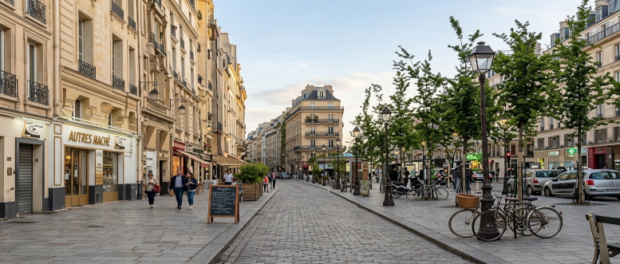
In contrast to today’s villa districts, in earlier urban neighborhoods it was often the narrow spatial conditions that determined social life. Here the houses were built close together, and daily interaction, getting to know each other and mutual support shaped community life. A social bond formed that gave peopleconveyed security, familiarity and a sense of belonging. Joint activities, festivals and neighborhood meetings were everyday components of urban life, and the neighborhood became a place where people helped and relied on each other. The proximity of the area promoted exchange and created a social network that provides stability and cohesionguaranteed. In such neighborhoods, the boundaries between public and private spaces were less pronounced, which strengthened the sense of community. However, with the change to large villas and the increasing isolation, this form of social interaction has been lost more and more. Today’s villa districts are rather places of privacy and protection, but at the expense of thecommunity life and social connection, which leads to a general weakening of social cohesion.
Gated Communities: The luxurious form of closed residential complexes
In contrast to the extensive villa districts, in which there is hardly any community to be seen, so-called closed residential complexes, the so-called gated communities, have become established in recent decades. These systems are characterized by their special form of demarcation, protection and comfort. They are mostly by fences, walls, checkpoints andMonitoring systems are secured and only accessible to residents and authorized persons. The gated communities form a kind of closed society in which the residents do not live completely isolated, but access is strictly controlled. These plants were built in the 19th century in the course of industrialization to meet the security needs of the wealthyto meet the population. The first known examples were built in the United States, where they still play a significant role today. They are characterized by high fences, security services and an infrastructure tailored to the needs of the residents. The goal is to offer the residents the highest level of security, comfort and privacy while at the same timeCreate an exclusive living environment where you can feel protected from the influences of the outside world.
Historical development and global distribution of closed residential complexes
The emergence of the gated communities can be traced back to the 19th century, when industrialization changed the cities and fears of crime and social unrest grew. The first known gated community was built in 1857 in Llewellyn Park in New Jersey. This complex was on 13 hectares of spacious villas with high fences, security guards and ownsecurity precautions and served as a place of retreat for the wealthy people of the time. Since then, such systems have spread worldwide and can be found in many countries today. Especially in countries with a high crime rate, such as South Africa, gated communities have become a matter of course, as they are intended to ensure protection against violence and crime.In China, almost all new residential areas are planned as closed facilities to guarantee the residents security and privacy. In Eastern Europe, too, especially after the collapse of socialism, the number of upper classes that would like to differentiate itself from public space through the construction and use of gated communities is growing. In Germany there are examples like thatPlant in Potsdam, which is secured by fences, cameras and a security service, or the so-called Carlot in Berlin, which leads directly to the apartments by an elevator. This development shows that the desire for protection, security and demarcation has increased worldwide – a trend deeply rooted in social anxieties and needs and further social splittingdeepened.
Social change: withdrawal into private and social isolation
With the increasing trend of separating in isolated plants, social life in the cities is changing fundamentally. The residents of such residential complexes are increasingly living in a parallel world in which contacts with the outside world are reduced to a minimum. The infrastructure is primarily focused on the comfort and safety of the residents, public places, meeting pointsAnd social institutions are hardly considered or are hardly used. Places such as marketplaces, parks or community houses used to be central places of exchange and social interaction, but today they are often only open to the public or are hardly frequented by the isolation. The social interaction is limited to the private space, whatIn the long term, social cohesion will become weaker. People are increasingly withdrawing into their own world, which deepens the social gap between the different strata and groups and weakens the community as a whole. The increasing security orientation, which focuses on protection and demarcation, is reinforcing this development because itDetaches ties further and dismantled the urban landscape into ever smaller, hardly connected areas. The result is a society in which mutual trust is reduced and social solidarity is dwindling, while the city becomes a place that offers fewer and fewer places of common life.
Historical examples of shielding: places of exclusivity and secrecy
In the past, there were already places that were hardly open to the public due to their topographical location, construction and security measures. A significant example is the island of Vilm before Rügen, which was suspended from 1959 by heads of state and officials. She was no longer listed on maps from 1967 to show her exclusivity and secrecykeep. These places served the upper class and the rulers as retreats that remained hidden from the public eye and were only reserved for a few. They were almost invisible by fences, security guards and the geographical location, which gave additional protection to their importance for the social hierarchy. The extreme form of foreclosure symbolized theSeparating the powerful from the masses and the desire to protect certain habitats from public insight. These historical examples make it clear that the tendency to demarcation and to protect against social participation is not a new phenomenon, but has manifested itself in a variety of forms over the centuries. Modern gated communities are in a certain waywise a continuation of this development, only with technological advances and global spread. The boundaries between public and private spaces are becoming increasingly blurred, while society as a whole is more disintegrating into separate spheres, which puts a considerable strain on social cohesion and deepens social division.

 Screenshot youtube.com