The awakening of the ancient metropolis in the shadow of the volcano
Screenshot youtube.com
Looking into the past today reveals a fascinating window into a world long gone, whose fate was preserved for eternity in a single fateful moment. The burial of a flourishing ancient metropolis under embers and heavy pumice not only preserved stone witnesses, but also the razor-thin imprint of thehuman existence of that era. Anyone who sets out to search for traces in this stone archive is immersed in a labyrinth of everyday activities, cultural diversity and dramatic social upheavals. The awakening of the ruin site in the morning light makes the shadows of history soft and makes the vibrant life of yesteryear tangible again.Symbiosis of archaeological substance and human destiny forms the core of our consideration of everyday life and the end of this extraordinary settlement.
The awakening of the landscape in the first morning light
The first ray of sunshine silently splits the air and hits the summit of Vesuvius, with the light always laying first on the highest point of the remains of the ancient Somma crater. The semicircular bare rock looks for a moment like a cracked mouth, whose rocky teeth look bleached and form the mouth of a lurking beast. The light falls on the bottom of the oldCrater, caress the bare plain and forests to finally continue its path over the slopes. Like a hand, it gently pulls back the veil of darkness that has enveloped the landscape throughout the night and rushes down the slope towards the ancient metropolis. It reaches the first small village below the volcano to descend further to the homesteads, where theGrapevines, the plowed fields and the horses grazing in the pastures gradually emerge from the darkness.
The illumination of the city and the awakening of everyday life
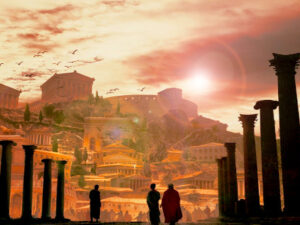
Finally, the light illuminates the center of the settlement, caressing the rooftops and filling the alleys with new life, with the reddish glow of the terracotta tiles bathing the city in a warm glow in the morning. The metropolis peels out of the embrace of the night and greets the morning as residents leave their homes and head out onto the streets. At first glance, theArea is not particularly extensive, but the actual extent includes a huge area, which grows significantly if all open squares, cemeteries and large estates in the immediate vicinity are added. The researchers have by no means uncovered everything, because a considerable part is still buried under the volcanic hail of stones that engulfs the city with its people,the frescoes and the riches. This hidden treasure chest can be guessed at by walking along the main arteries and wondering what masterpieces and surprises await their discovery there.
Preserving the existing and the technology of the future
Of course, visitors wonder if this part of the city can ever be excavated and what treasures it still holds. The answer to this question is quite simple, because first of all, what has already been brought to light must be saved, preserved and preserved. The areas still covered are residential areas in which no special buildings are to be expectedand the novelty value would therefore be rather low. However, we may also just have to be patient, as we do not yet know what instruments future generations will devise for the exploration of such areas. Today’s ground-based radars already make it possible to see buried objects without having to dig them up, even if the technology is so complicated that laymen withcan’t do anything with the image material at first.
The protection of the sediment and the view into the depths
So it may well be that at some point we will visit these still buried sites by taking a virtual picture from the earth’s surface with the help of sensors. Then the sedimentary rock would continue to protect the finds, walls and frescoes, as it has done for centuries, and they would not be exposed to the decomposing air. The visitor couldactually see them as they were left before the deadly ashes covered them all. The uncovered area gives the visitor an impression of life in Roman times, while the underground area showed how the tragedy actually happened. The strategic location on a lava shield in the Gulf allowed the control of navigation, while the mouth of the localRiver formed an important artery into the interior of the country.
The fertile earth and early settlements
The ancient volcano made the land around the settlement fertile, so that agriculture found extraordinarily good conditions there and a place with so many advantages could not remain uninhabited for long. In fact, the first settlements on the river date back to the Bronze Age, but a massive eruption killed all Gulf dwellers and swept away homes and villages.Iron Age, the area is repopulated, with the inhabitants actively trading with Greek outposts on the nearby islands. Towards the end of this period, there were the first permanent settlements, from which remains of walls and temples have been preserved for us, which were consecrated to higher deities. The settlement was organized, the later ancient city center was formed, andat the time of the final eruption, the city was already many centuries old.
The Mystery of the Founding and the Changing Powers
But who founded the city is not clear, and we simply do not know who first came up with the idea of building this metropolis, the most famous in the empire after Rome. Perhaps it was the Etruscans who ruled inland and encouraged the local population to fortify a city as a position against their Greek enemies. Or it was the Greeks who did theSea, whereby another people could also have mediated, which enabled trade between the warring great powers. The settlement would then have been a kind of special administrative zone or free port, so to speak, but the truth remains hidden in the darkness of history. However, we know that after the defeat of the Etruscans against the Greeks, the city entered a phase ofDecline, which is regarded by many scholars as proof of the close connection to the Etruscans.
The Rise of the Samnites and Cultural Change
In this period falls the attack of the belligerent Samnites, who rushed down from the hills and conquered the valley with all its settlements, making the city part of the first political unification of the Italian peoples. From then on, the language of the Samnites was spoken in the streets, and their habits, laws and religion determined life, even if the majority of the people there were Oskerthis period did not last long, for Rome had become the dominant force on the peninsula, seeking to clash with the Samnites. After a total of several wars, the Romans subdued the Samnites and completely wiped out their culture, so that the city now became part of the Roman world. It was one of the allied cities, but the new Roman settlerssoon set the tone and let the survivors feel their superiority.
Roman colonization and social upheaval
You can almost see the colonized cities of later centuries in front of you, because the Romans had greetings engraved on the doorsteps of their houses to make it clear that Roman customs prevailed there. Over time, the city became more and more Roman, as the capital was only a manageable distance away and the cultural influence grew steadily. The city also experienced in the RomanSphere of influence difficult times, for example when a famous general from Carthage attacked the empire and destroyed nearby settlements. For some reason, this conqueror spared the city, perhaps because it was very cleverly neutral and took in refugees from the destroyed settlements. The city housed the displaced people, underlining their reputation asCrucible of the Italian peoples, which united a wide variety of cultures.
The conflict with Rome and the Roman colony
A second time, the city came into conflict with Rome when, together with others, it rebelled against the rulers because it claimed full citizenship for its inhabitants. It was realistically assumed that Rome would attack, and so the city walls and the numerous towers that protected them were reinforced. The cityscape that has changed so much is the one that can still be seen today,after the city had to withstand the onslaught of Sula’s troops. At the gates you can still see the impact of the stone balls that the throwing machines hurled before the city finally surrendered. The dictator gave the city, which was now a Roman colony, a new name that fortunately did not prevail, and the rebellion cost the city dearly.
The settlement of the veterans and the structural expansion
The city had to accommodate numerous veterans, which once again increased the heterogeneity of the population and made the metropolis a real melting pot of antiquity. When these veterans were settled within the city walls, the settlement finally took on Roman character, and magnificent buildings were built for eternity. At that time, the amphitheatre for theGladiator fights, the thermal baths at the Forum, the Temple of Venus and many other Roman-style buildings that shaped the cityscape. But we have not yet clarified one question, namely where the name of the city actually comes from, as the mists of the past once again obscure our view. In this case, we are helped by research that supports various hypotheses about the linguistic origin of theDiscussed on behalf of.
The linguistic roots and the mythological interpretations
The name could be derived, for example, from a Greek word meaning to send, because in fact the city was a transshipment point from which countless goods went inland and across the sea. In ancient times, on the other hand, it was assumed that a famous demigod founded the city on his triumphant return from his duties, from which the name is said to have developed.This explanation, which gives the city a certain reputation from a mythological point of view, is today rejected by scientists from all over the world. More likely, the name is derived from a local language, with a local number word for the number of villages could have been the godfather. Unfortunately, there has never been the slightest trace of such an accumulation ofSettlements, so that the descent from an Italian family is also a possible source in the room.
The Geometric Order and Historic Neighborhoods
Let’s resume our morning promenade and hurry to the main street, which a Roman would have called the upper Decumanus at the time. We notice that the streets are very straight and the shops are also regularly laid out, so that the whole thing looks like a chessboard and is not reminiscent at all of the tangle we found at the beginning of our walk.has the impression that the different quarters were created in different eras, which is actually the case and already led to a historic city centre in Roman times. The city center consists of winding, narrow streets that lead to the historic center, which was created in the oldest phase of the city’s history. At that time, the roads led around any existing obstaclesand clung to the slope before later conquerors created new quarters with a regular layout.
The growth of the city and Roman architecture
The clash with enemy armies once again created new quarters in the eastern part, where the fugitive inhabitants of the destroyed neighboring cities were housed. However, this friendly reception could not eliminate the smoldering rivalry between the residents, which later led to bloody uprisings during the gladiatorial games. Then when the veterans of the dictator appeared,the city was already quite fixed in its layout, but there were still brutal expropriations and a redesign of ownership. The face of the city itself did not change so much due to the Roman influence, but it was particularly noticeable in the changed silhouette. Far more large buildings were built than in the past, people thought and built large, and theThe result can be seen today when walking in the streets.
The city’s axes and public infrastructure
A quick glance at the map makes it clear that the city has a strictly geometric layout, with all streets symmetrically laid out. In the north-south direction, one main axis ran, in the east-west direction the other, and this spatial orientation was further underlined by a sacred rite. Ultimately, this urban design scheme is based on the geometric layout of amilitary tent camp, which is often found in the core of today’s cities. The large street that runs vertically through the city is now named after another city, while there are two streets in the east-west direction. If you remember for the tour that the city is laid out around these few streets, you can not get lost so quickly, evenwhen the tangle of alleys and houses is treacherous.
The diversity of trade and the number of inhabitants
There are numerous temples, many walkeries, a myriad of bakeries and a large number of small restaurants that dominate daily life. There were fast food outlets, restaurants, pubs and other shops, two theatres, an amphitheatre, a large sports hall, a forum and a market. Apart from the city wall with its enormous length, one wonders how many inhabitantsthat ancient Pompeii actually counted. That is not entirely certain, but at the time of the eruption it is said that there were a huge number of people moving through the alleys. And what do we know about them that we encounter on our morning stroll through the reconstructed streets?

 Screenshot youtube.com