The birth of the coined money: An epochal turning point of human civilization
Screenshot youtube.com
Before the great turn of money, there was a world in which the exchange of goods was a tedious, often lengthy ritual, characterized by insecurity, distrust and lengthy negotiations. People traded in trade items that were different by region, culture and community, and each transaction was accompanied by a sense of caution. Gold was not a mereMeans of exchange, but a precious raw material that had to be treated with great care. It was weighed, tested, measured with special scales and carefully checked by experienced traders to avoid fraud and counterfeiting. This world was characterized by incessant distrust, reinforced by the need to test, compare and delimit valuesbecame. Trade was not an easy exchange, but a complex ritual that was characterized by discussions, weighing up and mutual distrust. People lived in a society where trust, personal relationships and compliance with rituals formed the basis for exchange. But the boundaries of this order became visible again and again when goods, values or theconfidence in the currency were shaken. Over time, humanity began to look for a solution to facilitate exchange, reduce uncertainties and put confidence on a common basis. This desire for standardization and control ultimately led to a revolution that would change the world forever. It was a moment when theHuman civilization took a decisive step forward, away from uncertainty, towards a new order based on visible, fixed rules and obligations. This change marked the beginning of a new age in which money was understood not only as a medium of exchange, but also as a symbol of trust, power and social stability. it wasThe birth of a system that created the foundations for the complex economic structures we know today and that changed human society in a way that was hard to imagine.
Gold as a raw material, as a test stone and as a symbol of power
In that early world, gold was not just money, but a precious raw material that had to be treated with great care. It was weighed, compared to precise weights and tested for purity by complex testing methods. Traders and money changers controlled each individual gold bar or coin to prevent fraud and trust in the value of the goldsecure. The gold was handled in the form of lumps or slices, which became an acceptable medium of exchange only by complex process. This world was characterized by an incessant distrust, reinforced by the need to test, compare and control values. Each transaction was a ritual, accompanied by discussions, considerations and controlsmade the process of transferring value into a slow, sometimes tedious act. Here lay the power of gold, but also its weakness, because it was a raw material that was difficult to transport, store and control. These challenges led to the gold itself becoming a symbol of power and authority that played a central role in society. itEmbodied not only material wealth, but also the ability to exercise control and gain influence. The gold became the visible expression of rule, stability and social order. It created a hierarchy in which those who owned gold could also rise in their social position. However, this system was of uncertainty andConflicts, since gold could be stolen, forged or manipulated again and again. Nevertheless, it remained the most important symbol of value, power and trust that shaped and shaped human civilization over millennia. This world based on gold was a world of great opportunities, but also of great risks, where the raw material was gold both blessing and curse, and in theThe focus was always on the search for stability and security.
The first attempts to standardize money and create trust
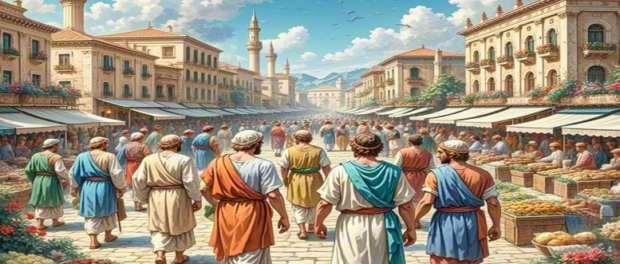
When people began to solidify gold, the idea came up to standardize the raw material in the form of slices or coins. These coins were weighed, tested and marked to document their purity and value. But the variety of currencies from different regions soon led to significant problems, because different coins meantUncertainty, friction and frequent misunderstandings in the trade. Traders had to constantly compare, check and weigh up to see the actual value of a coin. The language of trade became increasingly multicultural, as goods, coins and means of payment from all over the world flowed into cities such as Sardes, which developed into a crucible of competing currencies. Every coin wasA mystery whose value had to be deciphered by controls, discussions and comparisons. The uncertainty in trading was great, and confidence in the system was the decisive factor in allowing for exchange. It was an era in which the pursuit of standardization and control had a profound impact on economic life. People were looking for a solution thatSimplify trade, minimize uncertainties and stabilize value. It became clear that a pure weighting and examination alone would not be enough to cope with the complexity of the human economy. It took a new idea, a common language of value that everyone could accept. These considerations eventually led to a fundamentalInnovation that should change the world: the coins of the state that had official recognition and control and thus strengthened the trust in the money.
The Rise of the Lydian Coin: Power, Trust and Centralization
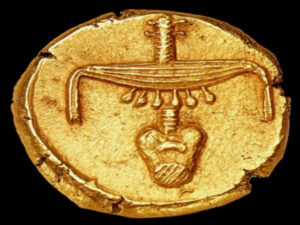
The decisive turning point in the history of money came with the Lydian king’s decision to monopolize the coinage. At first he minted coins only for the state, but soon goldsmiths and traders also began to produce their own currencies based on weight and purity. Sardes became a hub where coins from all over the world melted and newwere shaped, resulting in a large number of currencies and standards. This diversity led to uncertainty, because every coin contained a multitude of meanings and values. Traders had to constantly compare, check and weigh up to see the real value of a coin. The Lydian king then took a radical action: He introduced a state coin system in which eachCoin carried a stamp that embodied authority, trust and power. The king’s lion’s head became a symbol of the binding validity of the currency and combined money with the sovereignty of the state. This innovation was revolutionary, as it created a clear, central authority that strengthened trust in the monetary system and facilitated trade. The monopoly for the money becameExpression of state power and the basis of a new order that fundamentally changed the world. This system led to money being no longer just material, but becoming a symbol of state sovereignty based on trust, control and stability. The power of the state was manifested by control of the monetary system, and people’s trust inThe currency became the basis of economic and social stability that existed over centuries. It was a revolution in the history of money that paved the way for a central, state-controlled monetary system and laid the foundations for the modern monetary system.
Money as an expression of power, control and social order
With the introduction of the official Lydian coin, money became an instrument inseparably linked to the power of the state. It was no longer just a medium of exchange, but a symbol of authority that concentrated control of the economic and social life in the hands of the rulers. Coinage became a source of centralized power with whichrulers could secure, consolidate and make visible their rule. The coins bore the king’s image, the symbol of his sovereignty, his insignia and his power. They were an expression of the political order that became visible through the money. Within the borders of the empire, the state determined which currencies were valid controlled the fake and ensured thesystem stability. The money became a tool of political control, strengthened the trust in the community and at the same time the limits of power were defined. It combined economic function with social symbolism and created a new form of social organization based on central control, acceptance and common order. This development led to oneIn-depth transformation of society, in which money served not only as a medium of exchange, but as a symbol of power and stability. It was an instrument that combined domination, order and community, and that laid the foundations for all later monetary systems. The money became an expression of the social hierarchy that made the balance of power visible andsecured the stability of the political order.
The smaller coins: from independence to broad participation
Under the rule of the Lydian king, smaller coins developed, which made trade on a broader basis and made it easier for the general population to participate. These smaller units, which reflected the value of a day’s work or a small part of a crop, made trade more accessible to the general population and created a new oneperspective on money. Traders, craftsmen, ordinary workers and farmers could now pay with coins based on their actual value rather than weighted large raw material bars or inaccurate. This development led to an economy that worked from below, characterized by a diverse involvement in trade and a stronger anchoring in the everyday life of thepeople. Small entrepreneurs, shopkeepers, market stalls and craftsmen received a voice in economic life that was previously reserved for the powerful. The coins became a tool of self-determination and independence that gave people more control over their economic possibilities. They opened ways to a broader social participationand strengthened social mobility. The smaller coins gave people a new freedom to measure and exchange their work, their products and their time. It was a revolution in thinking about money that was now viewed not only as a symbol of power, but also as a tool of self-determination and social participation. This development laid the foundation for thediverse monetary systems that today form the basis of a global, market-oriented world.
The cultural and social revolution through the money monopoly
The central control of monetary imprinting led to a profound change in social structures and values. Money was no longer just a means of exchange, but a symbol of order, stability and common social order. The state’s monopoly on money created a community based on trust in the currency and authority of its guardians.It was a culture of belief in the power of the state that manifested itself in acceptance, in trust and public control. The money became the bearer of social values, an expression of the political order and a tool of social control. It created a clear separation between those who controlled the system and those who used it. This revolution inThe Money History is a story of power, trust and transformation that still has an impact today and whose traces are visible in every currency we use. The society was organized, stabilized and defined in its hierarchy by the money. It was a revolution that laid the foundations for the modern understanding of money, law and society, and thatstructures on which our present communities are built.
The origin of a global monetary order: From Lydian Coin to World Currency
Lydian innovation quickly spread and formed the basis for an ever closer connection between the world and trade. Greeks, Romans and later European empires took over the system, adapted it and further developed it. The central principle remained: Money was a symbol of state power, an expression of control and trust. It became the foundation of great empires,depended on stability, unity and mutual trust. For centuries, the principle of the standardized coin was preserved and formed the basis for the development of modern currencies. This story shows how a single innovation has transformed the world economy fundamentally and how money has become a global instrument that sets the boundaries of countries, continentsand cultures exceeded. It is a story of power, creativity and human inventiveness that still has an impact today and shapes the way the world views, uses and shapes money. The Lydian coin was not only a technical advance, but a cultural milestone that laid the foundation for the modern financial system in which trust, control andState sovereignty are the central principles. This development has led the world into an era in which money is not just a means of transaction, but a symbol of political order, social identity and global cooperation.

 Screenshot youtube.com