The early Christian community between heavenly expectation and social anchoring
Screenshot youtube.com
The emergence of the early Christian community can be understood as a complex historical phenomenon that took place in the field of tension between a deeply rooted Jewish-prophetic tradition and the cultural conditions of the Roman Empire. In the first decades after the work of the historical founder, the movement was mainly of a passionateExpectation, which was directed at the immediate arrival of the divine dominion. This eschatological orientation meant that believers only saw their present existence as a temporary station, while their real focus was on a transcendent reality. already in the earliest theological treatises from the outgoingIn the first century, the followers of this faith were explicitly referred to as people who were in a foreign environment and had no earthly homeland. The increasing social rejection, which supporters experienced in many regions, and the recurring court proceedings before local authorities increased this awareness of alienation even moresignificantly.
The historical origins and the eschatological imprint
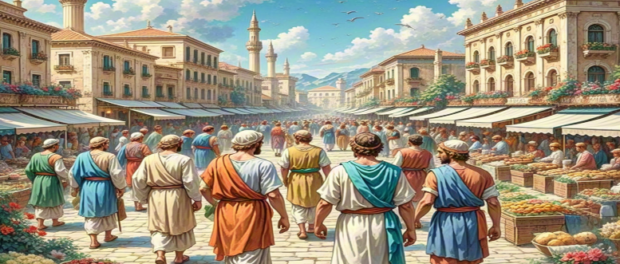
Religious orientated second-century religious orators formulated this attitude with particular sharpness by presenting the present earthly order and the coming divine reality as irreconcilable opposites. From this perspective, the requirement was that it was impossible to connect with the two areas at the same time and that a complete detachment ofof this world existence becomes necessary. Defense writings that were written around the year two hundreds described in detail the everyday tensions that the community in their environment was exposed to. The followers inhabited the same towns as the rest of the population and were based on clothing, nutrition and everyday habits on the localcustoms, but their communal coexistence was characterized by a remarkable peculiarity. They lived in their birthplaces, but without perceiving the full rights of the resident residents, took part in public life and at the same time endured treatment like foreign ones.
The theological assessment of the existence of this world
Marriages and the birth of offspring corresponded to the general social norms, although the practice of child abandonment, which was widespread in ancient times, was consistently rejected. While food was being shaped together, marital fidelity was maintained with particular severity, and although people lived in mortal form, they oriented their valuesa heavenly order. They followed the applicable laws of the authorities, but surpassed them in their personal lifestyle with a significantly higher moral claim. A comprehensive charity was the focus of her actions, although at the same time they were viewed and persecuted by large parts of society with distrust. Despite the lack of outsideThey were noted about them, and even charitable actions were often interpreted as crimes.
The paradoxical characteristics of urban coexistence
Even those who insulted them experienced blessings, and the hostilities of different population groups often remained incomprehensible to those affected, since there were no concrete errors. The oldest surviving certificates already made it clear that the supporters were by no means excluded from professional life, commercial traffic or family structure.This tendency towards social participation increased continuously as the original hope of an immediate divine intervention receded into the background. Since the early missionaries, the church leaders have been striving to pursue two main objectives in order to stabilize coexistence. On the one hand, the urgentNeed to encourage the community to be particularly respectable in business and private life in order to avoid unnecessary conflicts.
The development of an integrated community structure
No-believers should be noticed through fraudulent practices towards non-Christian business partners, nor should they get the impression that a violent reshaping of the existing social order is being sought. Over the course of the generations, a growing proportion of supporters have integrated so comprehensively into economic life that warnings of excessiveprofit-proven and before interest transactions had to be pronounced. The constant repetition of these admonitions indicates that everyday trade hardly differed from existing practices and that theological specifications were often ignored. There was also no fundamental deviation from the surrounding cultures in the area of marriage and family design. thatChristian understanding of the partnership was largely influenced by stoic teachings, Neo-Pythagorean approaches and Jewish traditions.
The economic interdependence and the moral appeals
The connection between two people was not considered intrinsic, but served primarily to preserve the human community, with sensual desires being considered obstacles to be overcome. Marriage was understood as a concession to human imperfection, which is why only a one-time connection was allowed. Only the completeConstrained existence propagated by ascetic-oriented groups represented an innovation that remained completely alien to the rest of the society. On the other hand, the task of the church leadership was to show clear boundaries that were not allowed to be crossed within the existing order. It was important to raise awareness that two fundamentally different worldviewsmet whose differences could not be harmoniously agreed in the long run.
The family structures and the ascetic alternative
A complete adaptation to the social structures was made impossible by central theological principles and ethical specifications. Therefore, numerous professional groups were considered incompatible with the community, including those involved in prostitution or mediation services, all who were involved in religious cults, andFortune teller and magician. Active participants in competitions, theater performances, active service soldiers and holders of high political offices were also excluded from membership. In the area of state administration in particular, there have been increasing exceptions over time, since in the third century even leading clergymen entrusted themselves with official taskslet. Participation in certain social events was also denied to the supporters, especially religiously influenced celebrations and all rituals associated with sacrificial acts.
The irreconcilable ideological contrasts
Theater performances, chariot races, hunts for animals and fights between people were also consistently avoided due to the associated moral concerns. This conscious renunciation of established forms of expression of everyday Roman culture explains a significant part of the negative reactions on the part of the non-Christian population. Not only did many followers feelEven a deep distance to their surroundings, but they were also actively perceived as disturbing elements by the majority society. This mutual alienation shaped the relationship between the young faith community and the ancient world over many generations. The constant tension between heavenly orientation and earthly anchoring remained a central onecharacteristic of historical development.
The exclusion criteria for certain professional groups
Social conflicts often arose where different values were collided and no common solutions could be found. The deliberate demarcation of traditional festivals and religious customs reinforced the impression of a parallel society that subordinated its own rules. Despite this distance, the community remained firmly into thatinvolved in economic and social structures, which led to a constant process of negotiation. The historical development clearly shows how a firmly rooted institution formed from an initially strongly eschatological group, which preserved its own standards. The ongoing discussion about the right balance between worldly adaptation and theological demarcationdetermined the self-understanding of the early Christians.
The social perception and the persistent tension
Continuous integration into the existing economic cycles required the community to constantly engage with the prevailing trade practices. While some members strictly adhered to the ethical guidelines, others increasingly oriented themselves to the profit-oriented standards of the Roman economy. These inner tensions wereChurch leaders tried to regulate by repeated warning letters that emphasized the ideal of mutual fortune. At the same time, the community had to demonstrate to the outside world that it was not pursuing subversive intentions to avoid unnecessary reprisals. The careful consideration between spiritual purity and practical participation therefore shaped the everydayDecisions of early Christians.
The internal balance between ethics and economy
Similar challenges were reflected in the family area, as the Christian household ideas often collided with the established Roman family models. Although the institutional marriage was recognized, an inner distance to the passionate ideals of ancient society, which were considered exaggerated, were demanded. This attitude meant that Christian marriages were increasinglywere understood as binding communities based on mutual loyalty and shared responsibility. Ascetic groups represented an extreme opposing position, which the majority of the population considered unusual and sometimes strange. Despite these differences, the family remained the central space in which the Christian identity in themanifested in private everyday life.
The transformation of the family life order
The professional restrictions arose from the conviction that certain activities were incompatible with the fundamental belief principles. Those who participated in religious cults, who worked in the entertainment industry or who fulfilled military duties were confronted with the demand to either give up their profession or to leave the community. These regulationswere not understood as arbitrary exclusions, but as necessary protective measures against spiritual interdependence with practices perceived as pagan. In the third century, however, these strict guidelines gradually relaxed when the social position of the community became solid. Even high clergymen now began to have official administrative functionstake over, which marked a significant change in the relationship to the state order.
The professional boundaries and their gradual loosening
Public entertainment culture provided another point of conflict, as many Roman spectacles were directly linked to religious festivals or acts deemed morally reprehensible. The Christian community therefore not only avoided participation, but condemned the associated excesses of violence and the public display of suffering as a sign of a degenerateSociety. This attitude was often interpreted by the non-Christian majority as arrogant contempt for one’s own culture and reinforced the existing reservations. At the same time, the deliberate renunciation of such events served to create one’s own identity and to distinguish it from pleasures perceived as superficial. However, the resulting social isolation has been described asnecessary price for the preservation of spiritual integrity.
The Rejection of Ancient Entertainment Culture
The continued hostility on the part of the Roman population was fed by both religious and social insecurities caused by the growing presence of the community. Many non-Christians saw the conscious distance of the faithful as a threat to the traditional social order and the established religious peace treaties. The Christian practice, allMeeting people in equal measure and partially breaking away from the usual social hierarchies was perceived as a destabilising factor. Despite these tensions, the community managed to consolidate its internal structure and develop an independent cultural identity that endured in the long term. Historical developments clearly show how an initialmarginalised movement grew into a firmly rooted social force.
The Causes of Social Rejection
The long-term process of social anchoring was by no means linear, but was characterized by constant adjustments and internal reform efforts. The theological reflection on the right balance between heavenly expectation and earthly responsibility remained a central topic of Christian self-understanding for centuries. Ultimately, thisdynamic tension, an institution that, while retaining its original eschatological orientation, at the same time integrated itself into the structures of the ancient world. The historical evidence shows that the early community exerted a lasting influence on cultural development through its ethical standards, social networks and conscious demarcation.multi-layered development remains an essential area of research for understanding the historical transformations in the ancient world to this day.
The long-term historical anchoring and its importance
The historical development of the early Christian community thus illustrates a constant negotiation process between spiritual orientation and everyday life practice. By consciously shaping boundaries in professional life, in family cohesion and in dealing with public celebrations, an independent identity was formed that, despite external resistance, was able toThe initial expectation of an immediate divine reign gradually changed into a sustainable ethical orientation that redefined social coexistence. This process of transformation laid the foundation for a cultural force that would significantly shape later European history. The surviving testimonies impressively prove thathow a marginalised movement gave rise to a firmly rooted community whose principles of charity and inner distance from the prevailing order have an effect right up to the present day.

 Screenshot youtube.com