The origin and development of money: A comprehensive insight into the origins and functions
Screenshot youtube.com
The history of human economy is characterized by a long and complex development, ranging from simple bartering to highly developed monetary systems. In the early stages of the human communities, the forms of exchange were still very rudimentary and were primarily based on direct exchange of goods between the individual members. emerged over timeHowever, mechanisms that should facilitate and stabilize barter trade. In the process, so-called medium of exchange gradually developed, which played a central role in simplifying and accelerating mutual trade relations. This development was by no means a linear or conscious innovation, but rather a natural process that is derived from the needs of thepeople out and was driven by practical necessities. The aim of this article is to shed light on the diverse aspects of the creation of money, to explain its original functions and to make the importance of the social and legal framework for its development clear.
The origin of money: From selective goods to general means of exchange
In the earliest times of human history, when the communities were still very small and consisted of a few dozen people, the exchange of goods was still very personal. Each person knew the others, and it was possible to see directly who owes whom to whom or what he had to give in exchange. These close relationships made it possible to use a virtual account bookto trust in which the mutual obligations were recorded. This was mainly the exchange of goods that people needed for their needs, such as meat, fruit or tools. But as the communities grew, with several hundred or even a thousand people, this system became increasingly confusing and difficult to handle. thePeople could not all remember the numerous mutual obligations, and the need to develop a more permanent, stable mechanism to document debt and demands arose.
The development of the first means of exchange and the role of goods
In this phase, certain goods began to acquire special importance because they became particularly popular and widely accepted in different communities. These goods, such as shells, certain metals or natural objects, became the first so-called means of exchange due to their property, easily transportable, durable and sought-after. They served asA kind of universal means of payment that made visible and simplified the mutual obligations in a community. These goods were repeatedly used as a means of payment because in many cases they were valued by the people and considered valuable. Over time, they became a fixture in the exchange process that went beyond individual communitiesretained their meaning. However, these early means of exchange were not real means of payment in the current sense, but rather practical tools to simplify and document the mutual obligations.
The emergence of the first forms of money and the importance of acceptance
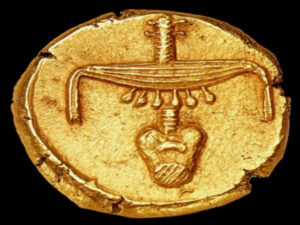
In the further course, more formal and standardized items developed from these means of exchange, which can be described as money. Acceptance played a crucial role in this, because only if a commodity was generally recognized in the community and also accepted outside of its original group, could it reallyfulfill. This recognition is closely related to the confidence in the stability and value of the respective object. The money thus became a social contract that was based on mutual acceptance and was recognized by people as a medium of exchange. These early forms of money were often metal coins or other permanent items that were easy to transport and tostores goods. The stability and the ability to preserve the value for a long time were key characteristics that a medium of exchange had to have to act as money.
Money as a social construction and legal instrument
In the centuries that followed, it became clear that money was not just made of a commodity, but rather a social construction based on a legal framework. It is the community that determines which items are considered money, as it is spent and accepted by certain rules and laws. This legal foundation creates the basis for moneybetween larger, anonymous groups who do not know each other personally. It is necessary that money has a certain standard and acceptance so that it can serve as a medium of exchange without each individual having to examine the obligation in detail. In this phase, the first coin systems were created, in which state or community authorities spent the money andsecured by certain guarantees. This made the money a binding instrument that facilitates the exchange between largely anonymous parties and stabilizes the economic life as a whole.
The transition from exchange to debt relationship and the function of money
An important step in the development of money is the realization that at its core it is always connected to a guilt connection. Originally, money was nothing more than proof of a claim or obligation that should be fulfilled in the future. This claim could be in the form of a promissory note, a specific item or a coin. the specialis that this debt system made it possible to transfer obligations without immediately performing the actual performance. That is, the money became a medium that made it easier to exchange debt among people. The monetary function thus became more and more from a pure means of exchange to a system based on the transfer of entitlements. So could aboutPromissory notes are passed on, which greatly simplified the trade and dissemination of claims. In this context, the basis for the complex monetary systems that we know today was laid.
From transferring debt to modern money economy
Over time, the forms of debt transfer became perfect. More and more sophisticated systems emerged, in which money also acted as a store of value that existed outside of the direct obligations. It has become a means to fulfill long-term and spatially separate obligations. The monetary systems became more and more stable and complex until theyfinally formed the basis for today’s national and international economic systems. However, the central idea always remained that money remains at its core a social construction based on mutual trust and legal agreements. The original principle that money is a form of debt has been preserved to this day and forms the basis for theFunctionality of modern currency systems. Understanding this story helps to understand the complex processes behind the seemingly simple money and to appreciate the importance of the social and legal framework.

 Screenshot youtube.com