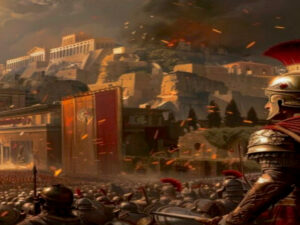
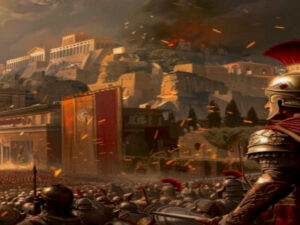
The last desperate attack of the Roman legions in the Germanic ambush
Screenshot youtube.com
In 9 AD, one of the most crucial and bloody chapters in Roman-Germanic history occurred: the Battle of the Teutoburg Forest. This struggle between the Roman legions and the Germanic tribes marked a turning point that stopped Roman expansion to Germania for the time being and redefined the borders of the Roman Empire. It was aEvent that had far-reaching consequences not only militarily, but also culturally and politically. The Roman troops, who at that time formed the world’s largest and probably most disciplined army, fell into an ambush that shattered their tactical superiority and plunged them into a bitter struggle for survival in a confusing, impassable forest area. this eventWas not an ordinary war effort, but a dramatic example of the power of the terrain, the tactics of the guerrillas and the unpredictable nature of the war in unknown terrain. It showed how the Germanic tribes, united under the leadership of Arminius, with cunning, anger of struggle and their knowledge of the country, lured the Roman legions into a trap. The events in the Teutoburg Forestare still a lesson in the importance of terrain, surprise and flexibility in war.
A historical turning point in Roman-Germanic history
The conflict was not an isolated event, but the result of long-standing tensions between the Romans and the Germanic tribes. The Roman expansion in Germania was already underway, but the Germans were a quarrel-mouthed patchwork of tribes that had difficulty uniting under a common leadership. Arminius, a Cheruscan prince and Roman officer, used thisZerrheit to unify the Germans and stop the Roman advance. The year 9 AD marked the culmination of this rebellion, in which the Germans demonstrated their strength, tactics and irrepressible will to defend their homeland. The defeat of the Roman legions in this fight was a shock to the Empire and led to the borders beingGermania remained stable for the time being. Victory in the woods of today’s North Rhine-Westphalia showed the limits of Roman power in the distance and proved that war in impassable terrain cannot be a purely technical struggle, but also a question of knowledge, knowledge of the terrain and guerrilla tactics. This chapter of history has its influence to this day, since it has the meaning ofAdaptability and strategic flexibility in military conflicts. The following explanations shed light on the events in order to better understand the dramatic battle in the Teutoburg Forest and its background. It becomes clear how the Germans, with skill, courage and their knowledge of the country, drove the mighty Roman military leader to the narrowerand one of the most important defeats of the Roman army suffered. After the unsuccessful revocation of the Cherusken leader Segestes, who had tried to deceive and betray the Roman troops in advance, the Roman legions saw themselves in an extremely critical situation. The once powerful and well-organized troops were about to crush in an ambushbecome. Everything indicated that the Germans, led by Arminius and his allies, would circle and destroy the Roman forces in a strategically favorable position. The situation was so desperate that the Roman generals ultimately dared to attack one last, all-important attack – a risky and highly dangerous train that could be reached through the outcome of thefight should decide.
The start of the attack: A final desperate step
After the failure of the Cherusken leader Segesto’s return was evident, the Roman commanders decided to start a final attack with all their might. It was a risk that was hardly calculable, but the situation left no choice. The Roman troops started to move, but the march was anything but orderly. the sluggish entourage,Consisting of soldiers, wagons, horses, women and children, crawled forward in slow, restless movements. On the one hand, this was due to the impassable landscape, on the other hand, that the troops could not use a fixed path, no paved army road, but moved over uneven, wild terrain.
The tactics of ambushes: raids and surprise
At the same time, the Germans brought allies into the country, which transmitted the signals for the attack. These signals almost certainly meant death for the Roman posts and traders who were still scattered around. The Germans put everything on one map and carried out raids in the first days of the movement to disrupt the Roman supply lines and communication. theRaids were surprising, fierce and unexpected – a targeted attempt to smash the Roman units before they could arrange themselves. For the small troop posts on the side of the road, which were unprepared, this meant certain death. Not only the soldiers, but also traders who pushed their vans on the rough paths became victims of the Germanicguerrilla tactics.
Danger from the terrain: the unpredictable terrain
The Germanic attackers knew that the terrain was their biggest weapon. The dense forests, the massive, centuries-old trees and the confused root system formed a natural maze. The grounds were full of gorges, narrow paths and confusing forest passages. The huge tree trunks, the roots that protruded meters from the ground, and the dense network of branchesAnd roots made the Roman troops considerably more difficult. In addition, the autumn storms, storms and downpours helped soften the ground, make the paths impassable and further restrict the mobility of the Roman wagons and soldiers.
The weaknesses of the Roman troops: overwhelming in the rough terrain
Arminius, the leader of the Germans, knew the weaknesses of the Roman forces only too well. He knew that the Romans were hard to beat in a direct battle on open ground with their disciplined formation and technical superiority. The Germans had against the closed front of iron-covered shields, breastplate and helmets – mostly only with lightWeapons and improvised shields made of willow rods – no chance. Therefore, they rely on a tactic in which they specifically used the terrain to unbalance the Roman troops. Only if the Germans managed to drive the Romans into the chaos of the forest or into confusing swamps were they able to successfully carry out their attacks.
The Germanic Fighting Style: Battle in Chaos
The Germans relied on a chaotic, unorthodox fighting style that differed significantly from the Roman discipline. They did not fight in orderly formations, but for pure fighting rage, speed and surprise. Her strategy was to quickly strike in confusing terrain, then escape back into the forest and throw the opponent into confusion. thatThe aim was not to continuously battle in the classic sense, but to achieve sudden, difficult-to-establish raids. This style did not require elaborate planning, but pure passion, courage and the ability to act in chaos.
The trigger for the war: A spark that lit everything
The Germanic tribes have long been involved in tensions and conflicts. But it took a special trigger to persuade them to a large-scale war against the Romans. It was an event so intense that it overshadowed all previous feuds and disputes. This spark ignited the enthusiasm for the fight and united the mostly hesitantGauen behind a common cause. It was no ordinary raid, but a fire that ate everything that separated the old tribal communities. All the Germans were suddenly connected through the common hatred of the Romans.
Segestes and the enthusiasm for the fight
Segestes, the Cheruscan prince, also had to admit that the enthusiasm for the war against the Romans was shaking his men. Despite his role as a leader, he too was seized by the power of the uprising. The tribal elite, which Tacitus describes as the “Stirps Regia” – the royal tribal line – played a central role. This line of tribe was the oldest and most importantWithin the Cheruskers, which also explained the charisma of Arminius. Arminius radiated an irresistible attraction that was not only on his spiritual fire, but above all on his cultural heritage. His ancestors had sacrificed the gods of the tribal community on the altars, and this legacy was deeply rooted in his personality. For Germans who theirHigh valued origin and tradition, Arminius was an embodiment of this ancient power.
The first day: Chaos and confusion in the forest
On the first day of the fight, the Roman troops managed to reach a relatively safe place to set up a camp there. But the joy of the secure position was short-lived. The sudden, unexpected attack by the Germans, the high losses, the confusing terrain and the bad weather – everything contributed to panic the Roman troops. theRoman experience and discipline could only partially tame the chaos. The legionnaires were clearly noticed to feel trapped in an uncontrollable inferno.
The second day: The fight in the woods
The next day, the Roman army worm moved on, weakened but still ready to fight. The site became increasingly forest-free, which initially gave the Romans a short breathing space. But the Germans continued to use their guerrilla tactics, and the chaos increased again. In the narrow forest passages, on slippery ground and at the falling branches, the legions got indifficulties. They tried to defend their camps, but the Germanic raids, which kept throwing themselves out of the thicket into the narrow spaces, made the situation confusing.
The terrain as a crucial enemy
The impassable terrain became the main opponent of the Roman forces. The dense forests, the narrow paths, the unrelenting swamps – all this massively restricted the legion’s freedom of movement. The Germans, who took full advantage of their natural environment, fought with long lances, spears and throwing weapons. The Roman shields, which are used in wet weather conditionsdifficult, could hardly be used effectively. In contrast, the Germans were specialized in their light weapons, with which they could strike particularly effectively in a small space.
The eternal wear and tear: A fight against nature and opponents
The fights in the dense forests and swamps quickly turned into a grueling war of wear and tear. The Roman legions, which relied on discipline, technology and organization, were increasingly at a disadvantage in the confusing terrain. The Germans, driven by their wild fighting rage and their ability to strike in chaos, took advantage of the terrain. They attacked quicklyWithdrew again and left the Romans in confusion and frustration. This constant chaos, the weather conditions and the confusing paths made the struggle an incessant dance between annihilation and survival.
A battle against nature, tactics and your own limits
The course of the battle reveals the unpredictability and harshness of such encounters in rough terrain. The Roman troops, built on technical superiority and strict discipline, repeatedly ran into difficulties due to the terrain, the guerrilla warfare of the Germans and the bad weather conditions. They were found in the dense forest, in swamps andconfusing passages, their freedom of movement restricted and finally almost completely worn out. The Germans, on the other hand, driven by their fierce fighting fury and the courage to chaos, drew the fight again and again into the confusing forest and used the terrain to their advantage.
Lessons from an unequal struggle
This battle shows how unpredictable and chaotic warfare can be in rough terrain. The Roman legions, as technically superior as they were, had to realize that they had hardly any chance of defying the Germanic guerrilla warrior in the dense forest, in swamps and in bad weather. The events were marked by chaos, surprise and the irrepressible power of theNature. It was a struggle that tested the limits of human discipline and organization while emphasizing the importance of terrain and flexibility in war. The lessons from this conflict were to be reflected for centuries in the war tactics and strategies of both sides – a reminder that even the strongest army can only be as good as theConditions in which she fights.

 Screenshot youtube.com