The Cataclysmic Slumber of the Campanian Coast and the Imperial Fleet
Screenshot youtube.com
The historical examination of the ancient Campanian coastline requires a profound understanding of the complex socio-economic and geological mechanisms that shaped the lives of countless inhabitants before the catastrophic disaster. What was originally perceived as a tranquil hub of imperial luxury and military dominance reveals itself upon closer inspection as a highly volatile environment hiding a massive geological threat.
The Maritime Mechanics of the Imperial Vessel
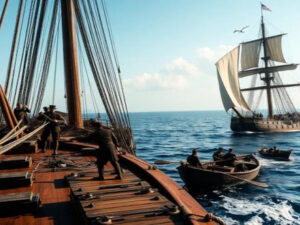
The muscular hands of the experienced helmsman firmly grasp the heavily worn and thick ropes, which are utilized to precisely steer the massive lateral rudders of the vessel. These enormous wooden constructions slice through the deep aquatic expanse like sharp plowshares, keeping the heavy vehicle securely on course even under adverse conditions. During that ancient era, maritime vessels lacked a central steering mechanism, relying instead on lateral blades attached to the stern that functioned like massive vertical paddles and required immense physical strength to operate.
Navigating the Treacherous Coastal Waters
These gigantic steering apparatuses are managed by an individual situated inside a small cabin, which resembles a genuine command bridge and provides essential protection against the harsh marine elements. During this demanding maneuver, which guides the vessel around the rocky promontory, the tightened ropes vibrate in the hands of the helmsman much like the reins of a horse-drawn carriage. The ship briefly rears up as if refusing to turn, but it ultimately obeys the strong guidance and alters its trajectory.
The Sensory Experience of the Sea Voyage
The passengers distinctly feel the pronounced change in direction, especially because the wind now blows from a different angle and the blazing sun hides behind the enormous sail. The steady breeze propels the lightweight vessel forcefully across the aquatic expanse, while the gigantic cape rises majestically on the left side like a stony giant. The high waves crash against its dark rocks, appearing terribly close and exceedingly threatening to all individuals present on the deck.
The Guiding Beacon of the Harbor Entrance
White foam covers the wooden deck with a fine spray mist, while the pungent scent of salt intensely fills the nasal passages of the travelers. This foam is as white as the imposing lighthouse, which rises far above their heads on the high rocky outcrop and serves as a crucial navigational guide. The brilliantly white color and the unusual shape of the structure strongly remind the sailors of the architecture found in distant eastern regions.
The Might of the Imperial Naval Forces
The helmsman steers the vessel from the cabin with incredible skill into the secure harbor, which accommodates the entire imperial fleet. A massive naval vessel, measuring nearly 40 meters in length, pushes forward menacingly, propelled by a dense forest of oars that lift themselves out of the water in unison. Above the loud noise of the waves, the distinct voice of the rowing master rises, dictating the strict rhythm to the exhausted rowers. The bronze ram emerges between the waves, consisting of 3 deadly horizontal blades designed to annihilate the enemy. These were constructed to remain stuck in the hostile ship and tear a much larger wound through a diagonally executed ramming strike.
The Tranquil Duties and Spiritual Practices of the Sailors
The warship returns from an extended reconnaissance mission along the coastline, as the imperial fleet no longer has any enemies in the Mediterranean Sea. The era of great and costly naval battles has passed, and dangerous pirates no longer exist in these waters, leaving the navy to primarily undertake peaceful missions like transporting supplies or government officials. The boat steers between the rocky island strip and the long mole, which close the wide bay like pincers, prompting the boatswain to light a fire on the small onboard altar. He offers sacrifices and recites sacred formulas in a low voice, because ancient sailors were extremely superstitious and thanked the deities for arriving safely and healthily.
The Strategic Layout of the Naval Base and the Renowned Commander
The harbor appears to have been created by nature itself for the imperial fleet, consisting of 2 adjacent, tranquil bays. Our vessel docks in the front bay and heads directly toward a small rocky outcrop that serves as a landing stage, while the main fleet navigates to the other natural basin separated by a narrow bottleneck and a movable wooden bridge. In the houses along the harbor wall lives the admiral and supreme commander of the fleet, the universally esteemed Gaius Plinius Secundus.
The Distinguished Career of the Scholar and the Arrival of the Aristocrat
He is immediately recognizable by his massive stature, his dignified gait, and his polished manners, having recently compiled a vast encyclopedia of human knowledge that remains highly significant. He is 56 years old at that time and served in the legions stationed at the Rhine during his youth, where he learned extensively before his career gained momentum under Emperor Vespasian. The noble passenger leans over the railing and lets her gaze glide along the harbor wall, which is swarming with people, soon spotting the commander as his bodyguard clears the path.
Strict Societal Rules and the Intellectual Exchange over Dinner
A female slave helps the noble lady disembark, because 2 millennia ago it was strictly forbidden to offer an arm to a Roman aristocratic woman, making any physical contact a severe transgression. The admiral brings his guests to his residence, which is likely located within the fortress and provides safety, where they recline on sofas opposite each other and consume a light meal accompanied by delicious regional wine. The host is an inquisitive individual capable of rationally analyzing and understanding any topic, regarded as a pioneer of natural research who considers every written document useful and studies it carefully.
The Ambitious Youth and the Relentless Dedication to Scholarship
The tranquility is interrupted by the appearance of the nephew, who is merely 17 years old at the time and shows immense potential, arriving accompanied by his mother to greet the guests politely. The uncle frequently teases the nephew because the young man covers all distances on foot and refuses to use a comfortable litter, unlike the admiral who works so much that he fundamentally uses a litter to continue his important studies. He is a genuine workhorse who has texts read to him while receiving massages or during dinner, valuing every second and requiring very little sleep to conduct his extensive research successfully.
The Swift Departure and the Deceptive Landscape of the Region
The lady bids farewell and boards a fast ship with 2 rows of rowers, originally used by pirates but adapted by the Romans for military requirements, making it highly maneuverable. The coastline of Campania literally flies past her as the Gulf of Naples is quickly reached, and her gaze wanders over the hill covered with villas, offering a breathtaking view of the sea. However, something peculiar catches the eye, because the famous landmark of the region is nowhere to be discovered, and there is no volcanic structure in sight, which is a massive surprise for modern perception.
The Hidden Geological Threat and the Illusion of the Peaceful Mountain
At the time of the catastrophe, the current volcanic structure was indeed not visible, as the cone did not yet exist, and what destroyed the cities was a much older volcano of which only the semicircular elevation remained. The Romans called the old volcano Vesuvius without noticing how dangerous it truly was, perceiving it as a broad, rather low mountain covered with forests and vineyards that camouflaged itself perfectly. Only a few researchers had recognized that the bare summit and the rocks resembling melted material indicated past activity, making it barely comprehensible from a modern perspective that people depicted the mountain in frescoes without recognizing it as a volcanic threat.
The Actual Crater and the Amphitheater of the Ancient Caldera
A fresco shows a stylized steep mountain covered with vineyards and looking like a pointed needle, while those living in the southeast had the flat, open side of the volcano in front of them, offering no natural barrier. The true origin of the massive eruption was not located at a summit, but down in the flat basin of the caldera, where another smaller cone might have been located surrounded by a forest belt. This area was possibly a natural amphitheater full of wind-protected forests that opened toward the sea, completely hiding the apocalyptic potential that would soon alter the course of history forever.

 Screenshot youtube.com