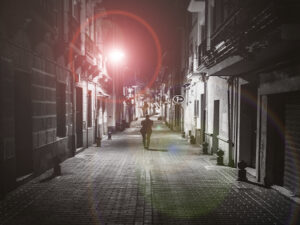
neighborhood: The dangerous fascination of the hidden gaze
Screenshot youtube.com
Human curiosity has a dark side that opens as soon as the gaze is secretly directed at other people. What starts off harmlessly can quickly lead to moral and legal abysses. The step from casually to viewing without the knowledge of those affected marks the transition to a mined field. In this area, sympathy cannot grow andlove never arise. The fascination of secret observation is seductive, but it destroys the foundation of human dignity.
The seemingly harmless beginning of an obsession
It may seem harmless to fall in love with a pretty neighbor or an attractive neighbor. But this is where the dangerous development begins. The friendly, slightly distracted man in a wheelchair, tied to the house for a broken leg, represents a character many know. Out of boredom, he begins to close the people in the apartments oppositelook at. His environment tries to beat this obsession and jokes about the telephoto lens he uses like a portable keyhole. This is exactly where the problem lies, because the person in question becomes a secret observer who sneaks into life without being invited.
The nature of secret observation
The secret observation is similar to the behavior of parasites from the natural world because it takes without giving anything back. The secret observer steals something invisible and yet precious to his victims, namely their privacy. Like aphids that infest trees, or mosquitoes that suck blood, the observer dedicates himself to strangers’ lives without leaving any traces. straightThis tracelessness reinforces the charm of the hidden gaze. The staging may ultimately allow the observer to clear up a crime, but reality is far less merciful for everyone involved.
Destructive obsession in the housing estate
In a literary work, secret observation is not presented as a charming quirk, but as a destructive obsession. The young protagonist lives in a settlement of high-rise buildings and one-storey buildings that was once supposed to connect different social classes. In this environment, however, there is distrust, envy and resentment. The bungalows work from a perspectiveof the balcony like threatening symbols of bygone times. The protagonist gets into the life of an artist couple, which she admires and despises at the same time. She crosses borders, climbs into foreign gardens, stares through windows and follows the couple until social envy and fascination merge into a pathological obsession.
The protected space of your own four walls
Your own four walls serve as a place of retreat and a shelter where you can let yourself go. Here you live your small and big secrets, here you bare yourself literally as well as in a figurative sense. People are completely different in their private space. The seemingly hard man might cuddle with his old teddy bear. The professor sees herselfcheesy movies. The vegan couple secretly eats a breaded schnitzel. This intimacy deserves protection and respect, because it forms the foundation of human dignity and individuality.
The fascination of lit windows
Another literary work describes how fascinating it can be to walk past illuminated windows in winter. The glance at foreign apartments exerts a strong attraction. It is difficult to evade this fascination, because it addresses deep human needs. But this is exactly where the danger begins, because from the glance at the glance it can bebecome an obsessive habit. The line between admiring curiosity and disrespectful intrusion is fluid and is often crossed unnoticed.
The legal consequences of secret observation
Secret observation is not only immoral, but also illegal. A court has found that even the alignment of a surveillance camera to the neighboring property creates an inadmissible suspicious situation. This applies even if no actual recordings are made. The general right of personality is violated as soon as the impression arises that someone canbe observed. This legal assessment underlines the seriousness of the invasion of other people’s privacy. The protection of the personal sphere has a constitutional status and must not be violated lightly.
The selfish component of curiosity
An old saying goes that neighbors observe more closely than foxes. This observation often happens out of curiosity, but also from an egoistic component. The hidden gaze creates a certain form of excitement associated with crossing boundaries. The secret observer acts in secret, his deed has no visible consequences for the victim. straightThis invisibility creates the feeling of a perfect crime. The obsessive observer is not concerned with everyday things, but about their own libido, which is ignited at the crossing of the border.
The transition from fiction to reality
In a short story, a woman breaks her leg and always watches a famous film scene. After that, she sits down at the window and waits as if the fiction is going into reality. This scene shows how thin the line between observation and obsession is. The transition from curiosity to border violation happens insidiously and unnoticed. The fascination can be quicklead to moral crash when control of one’s own impulses is lost. Reality is fundamentally different from the staged entertainment.
Protection of privacy as a human duty
The tension between human curiosity and human dignity must be consciously endured. Privacy is not a luxury, but a fundamental right that needs to be protected. This protection applies to cameras, binoculars and telephoto lenses. But it also applies to the dark impulses that lie dormant in every human being. The respectful treatment of the privacy of others is expressionHuman maturity and moral integrity. Those who cross this border not only destroys trust, but also their own humanity. The conscious renunciation of the secret view is therefore not a restriction, but a gain in human dignity.

 Screenshot youtube.com