The essential characteristics of a general medium of exchange
Screenshot youtube.com
The development of human economic forms has always been linked to the search for reliable methods for the handling of goods exchange. While the direct exchange of goods was initially sufficient, the growing complexity of trade and division of labor quickly required a standardized medium that was generally accepted and could store value over space and time. theHistorical selection of such value bearers was by no means accidental, but was subject to strict practical and economic requirements that resulted from the daily coexistence and the needs of the population. A profound understanding of these basic mechanisms makes it possible to use both past monetary systems and modern developments in value transferto be factually classified.
Practical examples from closed systems
Closed communities such as detention facilities often provide a clear reflection of how quickly alternative means of payment develop when official currencies are missing or banned. When the exchange of tobacco products was prohibited in certain institutions, the residents were urgently looking for a replacement that was both generally recognized and practically manageable.Potted fish canned food proved to be particularly suitable because they had a fixed nominal value and at the same time were hardly in demand as food. The weekly allocation limit made sure that the quantity remained limited but predictable and thus a stable exchange ratio could level off. Such natural adaptation processes make it clear thatwhich properties a good must have in order to act as a reliable standard of value in practice.
Basic requirements for material valuers
The consideration of which materials are suitable as a general medium of exchange initially leads to the realization that only very few substances meet all the necessary conditions. Unlike modern postings on accounts or in digital directories that have existed for millennia in the form of debt books, a physical carrier must have very specific characteristicshave. The first crucial feature is the clear recognizability, since every participant in the trade must be able to ensure that it is the agreed object immediately and without complex inspections. Without this clear possibility of distinction, trust in the exchange would quickly fall apart and commercial traffic would come to a standstill. In addition, the valuer musthave a high resistance to decay and damage, since he must safely bridge the time gap between the acquisition and the later transfer.
Independence from state arbitrariness and consumption
Another crucial aspect concerns the inviolability of the good through external interventions, since sudden devaluation by higher authorities would destroy the entire structure of trust. Modern considerations on taxable value holders that could be linked to personal evaluation systems illustrate the risk of such remote control, which was previously considered formalcurrency devaluation was known. At the same time, the medium of exchange must not be a pure consumer good, since its value would otherwise depend on fluctuating consumer habits and natural wear and tear. A small in-house function is therefore just as important so that demand is not distorted by changing preferences and the object has its role as a stable benchmarkcan keep. Only if this independence from everyday consumption patterns is guaranteed, an object can permanently serve as a reliable unit of calculation.
Handling and interchangeability in everyday life
The practical use in daily trade also requires trouble-free transportability, since sluggish or unwieldy objects would unnecessarily slow down and make commercial traffic more difficult. Likewise, transfer from one person to another must be possible without complicated procedures or official approvals, with the change of ownership of traditional coinseasy handover took place. A third central feature is the perfect similarity of all units, which ensures that each piece can be exchanged for another without individual assessment. This interchangeability saves time and avoids disputes about the exact condition or the nature of the object in question. In addition, the material must be in smallerunits can be dismantled in order to be able to handle low-value transactions without incurring material losses.
Adaptability to different economic factors
A functioning means of payment must be easily adapted to a wide variety of trading volumes so that it can be used for both small errands and extensive asset transfers. If the value of a single unit was so low that huge quantities would have to be transported for simple food, the system would be unusable in everyday life. in theConversely, tiny particles would also be completely unsuitable for ordinary business, as they would hardly be manageable. Therefore, the total amount available must be sufficiently large to cover the need for an entire economy without a lack of exchange opportunities. At the same time, the new creation must not be arbitrary or unlimited, otherwise valuablelabor would be deducted from the production of real goods.
Protection of privacy and historical precursors
The relationship between the existing stock and annual new production plays a crucial role in the long-term value stability of any medium of exchange. Only if the quantity cannot simply be increased does the object retain its exchange character that goes beyond the pure material value. Another essential feature is the preservation of confidentialitybusiness, since only anonymous transactions guarantee maximum personal freedom of action towards monitoring bodies. Without this protection, external coercive measures could specifically hinder or completely prevent certain economic activities. Compliance with all these criteria explains why in the course of human history there was a particularSeafood, precious rocks and various metals as a means of payment.
Standardization and the risk of state appropriation
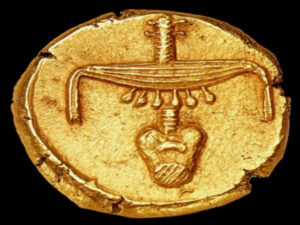
Even highly developed craft products such as specialized weapon heads in early cultures sometimes fulfilled all the necessary requirements and served as a recognized value holder. The later introduction of minted coins brought with it a welcome unification, which significantly accelerated trade and further improved the verifiability. At the same time, this openedStandardization, however, a considerable risk, since government agencies quickly acquired control over the imprint and control the medium of exchange according to their own political or financial interests. The historical development clearly shows that the combination of money sovereignty and political power is always a latent threat to the stability and independence of commercial transactionsrepresents. Even if the actual takeover of the control had not yet been completed in the early phases, the ruler was already waiting in the background to make the newly created system usable for its own purposes.

 Screenshot youtube.com