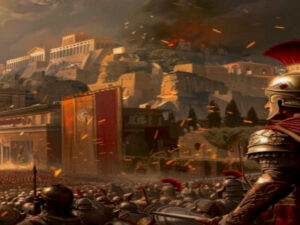
The European Power Struggle: Historical Roots and Current Rivalries
Screenshot youtube.com
The development of the European power position and the associated military, cultural and political rivalries are a complex process that extends over centuries and still has an impact today. Historical events and their symbolic meaning play a decisive role in explaining the continuity and legitimacy of the respective claims to power.The discussion about one’s own history, the construction of ancestral lines and the staging of a divine or cultural heritage are central elements. This article highlights the roots of this development, its historical milestones and the current consequences reflected in the conflicts and rivalries of Europe. It becomes clear that the supposedEuropean superiority in terms of military, cultural and civilization is not only based on technical advances, but also on symbols, ideologies and a centuries-long construction of power and influence.
The origin of the European rulership
In the medieval history of Europe, especially in the legends and sources of the time, one’s own origin is portrayed as an act of divine coincidence and cultural advancement. Already in the time of the Crusades and later during the Renaissance, the European self-image was shaped by the assumption that the civilization of the West was on a uniqueconnection of human and divine power. This view was further enhanced by the ideals of the Enlightenment, which explained progress, science and technical progress as the most important carriers of civilization. The idea played a major role in the fact that Europe not only holds cultural and scientific leadership, but also the legaland morally pioneering the world. The construction of a European heritage built on the ancient Greeks and Romans became the foundation for the legitimacy of one’s own power and the claim to world validity. The awareness of being guided by a divine providence was repeatedly emphasized in political rhetoric to gain one’s own superioritysubstantiate.
The staging of the dynastic heritage
In the course of medieval and early modern power politics, the genealogical narrative became more and more important. The rulers of Europe tried to trace their descent back to legendary heroes, gods or historical figures in order to strengthen their legitimacy. In France in particular, this strategy became the central political method to justify one’s own rule. theDynasties, which referred to the lineage of Charlemagne, staged a connection to a glorious past that underpinned the right to the right to rule. In doing so, one’s own origins were made visible in the courtly ceremonies, the official documents and the monuments. The capture of the Carolingian heritage, which was already in the 11th and 12th centurieswas prepared, received a new meaning in the late Middle Ages and in the early modern period, which still has an effect today. The genealogical records were systematically maintained to demonstrate the purity of the dynasty and ensure the continuity of power.
The importance of genealogy and symbolism
The research and documentation of their own descent was carried out more and more carefully at court. Genealogies were recorded in manuscripts and documents to prove the origin of the ruling families and to make their divine legitimacy visible. Thus, although they were not anointed, the sons of the monarchs were buried in the royal necropolis of Saint-Denis, which theirBelonging to the dynastic line. The connection to the Merovingians, who in turn were presented in legends as descendants of the Trojans or founders of Rome, gave the claims to power a mythical dimension. This symbolism served to present the European monarchy as a divine grace-guided order, which is characterized by a long line of legendaryand historical ancestors legitimized. The consciousness of justifying one’s own power through a descent from important ancestors became an integral part of the monarchical self-understanding, which still has an impact on political culture today.
The influence of ancient heritage on the European self-image
The European self-image is largely shaped by the appropriation and staging of the cultural heritage of antiquity. Already in the late Middle Ages and the Renaissance, the image of the Roman and Greek origins of Europe was emphasized in order to underpin their own superiority. The transfer of ancient values to European culture was considered an act ofHigh culture understood, which should set the continent apart from the other civilizations. This connection was made visible through art, literature, philosophy and architecture. European culture was always presented as a continuation and further development of ancient tradition, with one’s own history appearing as part of a divinely intended plan. the consciousness ofBeing able to descend from the ancient Greeks and Romans became a symbol of their own superiority and the claim to global dominance. This vision shaped European politics and culture over centuries and is still a cornerstone of self-image to this day.
The transition to colonial expansion and justification of military superiority
With the discovery of the New World and the subsequent conquest and colonization, the European power was brought into a new phase. Military superiority was seen as an expression of a civilizational superiority that justified to dominate other cultures and peoples. West’s propaganda machine presented the conquests and wars against indigenous peoplePeoples as pacification actions that served civilization. The technical development in armament and weapons was considered synonymous with progress and culture. The idea that technology and military discipline were the main instruments of civilization became a central part of the justification of imperial expansions. the EuropeanMany writers, historians and politicians have repeatedly emphasized and ideologically underpinned the point of view that their conquests and their military strength were an expression of their civilizational superiority.
The influence of Western hegemony on other cultures
The West’s influence extended not only to military expansion, but also to the political, social and cultural structures of other societies. Especially in the 18th and 19th centuries, attempts were made to align their own reforms with the western models. The reforms of Tsar Peter the Great in Russia, the modernization of Japan under the Meiji Emperor or theReform movements in the Ottoman Empire were all attempts to adapt the western way of life and technical superiority. It was always emphasized that the superiority of the West is not based solely on technical achievements, but also on a specific lifestyle, a liberal social order and a scientific way of thinking. These reforms wereOften carried by the conviction that one’s own society can only be modernized and raised to the top of the world by accepting Western practices. The criticism of this approach was also made, which indicated the danger that Western superiority was only a short historical epoch based on a specific technical and political constellation and not ona lasting cultural superiority.
The myth of eternal European hegemony
Despite all the differences and criticism, the belief that Europe is the world’s leading civilization is deeply rooted in historical narratives. As early as the 17th and 18th centuries, European superiority was considered God-given, with actual military power only becoming visible in the later colonial period and in the 19th century. The European expansionwas not only supported by technical innovations, but also by an ideological conviction of progress and civilizational superiority. This conviction led to European hegemony being seen in the minds of people as an immovable fact, which was caused by historical events such as the discovery of America, the conquest of Asia or thecolonization of Africa was underpinned. In this context, the idea of continuous European superiority emerged that still shapes political debates and cultural self-images to this day. It is often overlooked that this hegemony is just an episode in the long history of mankind based on specific circumstances and technical prerequisites andnot on a lasting cultural superiority.

 Screenshot youtube.com