The effort to ground truth and to understand what holds the world together runs through the entire Western intellectual tradition. It begins with Greek geometers, who created a new standard of proof, and it continues through religious institutions that sought universal order, reaching into a present shaped by technique, capital, and ecological crisis. This article examines the relation between mathematical reason, religious foundation, and political practice, while also asking how different voices respond to the crisis of modern technoscience. Its path moves through philosophy, literature, music, and a renewed attempt to rethink the bond between nature and society. In this way, the discussion connects ancient questions about truth with contemporary struggles over freedom, ecology, and the future of collective life.
The Historical Arc of Truth
The search for truth has never been a purely abstract exercise. It has shaped institutions, languages, technologies, and the ways communities understand their place in the world. Greek proof introduced a demanding standard of certainty that broke with ordinary opinion. Religious institutions later gave this search a universal horizon and a durable social form. The modern world then added technical power, economic expansion, and ecological vulnerability to this inheritance.
Hegel, Nancy, and the Modern World
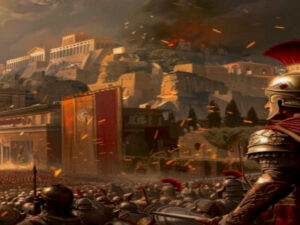
In reflections on the philosophy of history, Hegel describes the Roman world as an abstract universality whose historical task was to appropriate individual peoples and suppress them under that universality. Jean-Luc Nancy responds with a skeptical observation about the present. He argues that what now constitutes the world is the combination of an unlimited technoscientific process and a dissolving of possible forms of life and shared foundations. Under these conditions, the world or globalization is only the strict expression of this problem. The diagnosis points to a civilization that expands technically while losing the substance of common existence.
Localized Resistance and the Hacker Ethic
Readings associated with the Invisible Committee suggest that the possibility of localized victories lies in confronting this technical framework while affirming forms of life. A contemporary example of this attitude appears in the ethics of the tinkerer and programmer. Where the engineer takes everything that functions and makes it serve the system more efficiently, the hacker asks how something functions in order to expose weaknesses and imagine different uses. To experiment here means to experience what a technique signifies in ethical terms. The hacker wrests techniques from the technological system in order to free them and restore an open use.
Mathematical Proof and the Break with Opinion
In a commentary on Plato, Alain Badiou affirms the rationalist foundation of a common basis for truth. The mathematical break with mere opinion has the advantage of resting on something historically real, namely the existence of mathematical statements and mathematicians. Yet this break remains obscure and compelled, so its clarification requires a further break. This second break crosses the unavoidable vagueness of the first and opens access to the principle called dialectic. In Plato’s philosophical technique, this produces the opposition between hypothesis, which is assumed or imposed authoritatively, and principle, which is originary and appears as illuminating authority and command.
Philosophy and the Principle of Discontinuity
Mathematics concentrates in itself the real discontinuity with mere opinion, but only philosophy can ground thought in the principle of this discontinuity. The philosopher of our time, unlike Plato, has returned this principle to mathematics by dethroning philosophy from its imaginary throne. Philosophy no longer guarantees the existence of a single principle. It instead affirms the shared possibility of singular truths immanent to science, love, art, and politics. Badiou nevertheless remains attentive to history.
The Greek Beginning of Proof
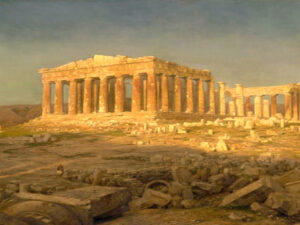
At the close of his seminar on Parmenides, Badiou affirms that the interruption of myth was originally Greek. He also affirms that the first person to prove the isosceles triangle was Greek. Philosophy therefore remains under the condition of the matheme. It requires the possibility of interrupting narrative, as the Parmenidean foundation shows. This interruption is not a minor event, because it marks the passage from story to demonstration.
The Christian Interruption of Narrative
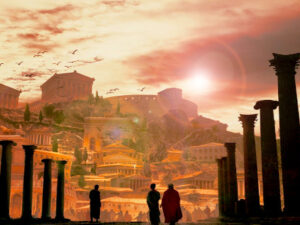
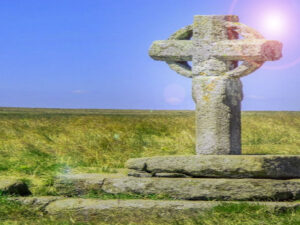
If one replaces the apagogic movement of Parmenides with the Pauline affirmation of the resurrection of Christ, one obtains an interruption of narrative that opens the way to a new narrative. The question then becomes what revolution Christianity accomplished through the fortunate insight of a single man. Badiou writes that among Christians the Church, the first institution in human history striving for universality, organized fidelity to the Christ-event. Those who supported this task were expressly called the faithful. Greek geometry on the one hand and Christian institution on the other thus form the formula of a fortunate coexistence between Athens and Jerusalem.
Spinoza and the Norm of Mathematical Truth
Spinoza writes in a note to his Ethics about the spirit of Christ, meaning the idea that emerges from the revolution accomplished by a Greek geometer. In the appendix to the first book of the Ethics, Spinoza insists that people once regarded the judgments of the gods as something far beyond human comprehension. This belief alone would have kept truth hidden from humanity forever. Mathematics, however, showed a different norm of truth, because it concerns not purposes but only the essence and properties of figures. Without this discovery, knowledge would have remained in darkness.
The Destiny of Knowledge and Freedom
A large part of the history of Western philosophy can therefore be understood as the history of the relation between this other norm of truth, discovered or constructed by Greek geometers around the sixth century before the common era, and the first institution in human history that strove for universality. At the same time, one can observe philosophers throwing off the ballast of the Christian institution. In a commentary on Spinoza, Badiou explains that for Spinoza it is not excessive to say that mathematics guides the destiny of knowledge and therefore the economy of freedom and blessedness. Without mathematics, humanity would sink into the night of superstition. This night can be summarized in the maxim that there is something we cannot think.
Mathematics and Immediate Communication
To this it must be added that mathematics teaches a decisive point, namely that what can truly be thought communicates itself immediately. Mathematics indicates that the understanding of a thing is radically undivided. To know therefore means to be absolutely and completely convinced. This conviction is not a psychological mood but a structural feature of genuine thought. It ties truth to clarity and shared intelligibility.
Beyond the Absolute Primacy of Mathematics
Yet one must ask whether the native fable is definitively surpassed once it is established that without mathematics humanity would sink into superstition. It is worthwhile to examine Spinoza’s remark again and to follow the passage further. Spinoza suggests that besides mathematics there may be other causes that enabled people to become clear about common prejudices and to arrive at the true knowledge of things. The dominant interpretation, however, claims that Spinoza attributes to mathematics alone the virtue of teaching another norm of truth that grants access to the judgments of the gods. This is especially the interpretation of Badiou, who stops quoting Spinoza before the passage turns to other causes.
Truth, Virtue, and Happiness
In his philosophy of true happiness, Badiou concludes that without mathematics the human animal would have remained forever in ignorance and would have found no access to adequate ideas. Happiness, in the end, is nothing other than the exercise of true thought, which is virtue. Blessedness is not the reward of virtue but virtue itself. Happiness is the affect of the true, which could not have existed or concentrated itself if it had not first been demonstrated. This interpretation can be called Greek.
Other Causes of Enlightenment
If one follows Spinoza’s remark beyond mathematics, other causes appear and a different interpretation emerges. If there were no norm of truth other than the mathematical one, there would be no access to the judgments of the gods except that of the geometer. Spinoza, however, affirms on close reading that other causes exist. If he considers it unnecessary to list them, it is probably enough for him to affirm their existence or at least their possibility. The task then is no longer to absolutize mathematics but to establish as a norm of truth whatever grants access to the judgments of the gods.
An Ethics Shared by Many Forms of Life
From this broader view arises an ethics common to the native limits of life, to the mills of the Middle Ages, to the questioning how of tinkerers, and to the proofs of Greek geometers. Such an ethics does not reject reason but refuses to reduce reason to a single historical form. It recognizes that different practices can open access to truth. The tinkerer, the proof maker, and the communal storyteller may all participate in a shared effort to clarify the world. The point is not to choose one heritage against another but to understand their common demand.
Language, Culture, and Decolonization
When Ngugi wa Thiong’o explains his decision to write future works as a poet, playwright, and novelist in Kikuyu rather than English, he points out that African writers have long lamented neocolonial relations in politics and economy. Yet he asks whether they do not continue neocolonial servitude on the cultural level when they keep writing in foreign languages and honoring them. This does not mean that one must abandon Western instruments such as the saxophone or the piano in order to return to native traditional instruments. What matters is always the manner in which one speaks or plays. Quechua can be a language of domination, German can be the language of a Jewish poet, and the playing of Ravi Shankar on the sitar is no more and no less traditional or modern than the playing of Yehudi Menuhin on the violin.
Indigenous Wisdom and Revolutionary Rationalism
Today some appeal to the ancient wisdom of native peoples in order to open a way out of the Western world economy. Others rely on a modernity composed of philosophical rationalism and revolutionary politics. To Badiou’s conviction that humanity is a species striving to overcome its animality and a natural collective attempting to denaturalize itself, Déborah Danowski and Eduardo Viveiros de Castro respond from the indigenous mythologies of pre-Columbian America. They argue that ecology is in reality a loss of faith in the predetermined destiny of the species and in the joys of its communist sublimation. Still others, having drawn lessons from the dead ends of technoscientific civilization, propose a return to ancient Greek wisdom and ground their critique of the Westernization of the world in the domination of a technoscience traced back to Columbus and Magellan, Galileo and Descartes, Newton and Leibniz, a technoscience that has led into a dead end not only historical but cosmic.
Ecological Crisis and the Closure of the World
Human sacrifices in the Aztec empire served to nourish the sun with the blood of the sacrificed and thereby halt the cataclysm that would annihilate the Aztec horizon of time. Beside the apocalyptic threat represented by nuclear arsenals, the industrial exploitation of natural resources, especially fossil resources, now endangers the future of life on earth. Political ecology, represented by Dominique Bourg and Kerry Whiteside, therefore calls for a change of epoch. Ecological problems lead from the open and infinite world of the moderns, rhythmized by the immediacy of the present, to the world of the biosphere, which is again closed and finite and characterized by a stretching of the time of action. The damage that humanity now inflicts on the biosphere is unprecedented.
Technique as Political Force
Human activities, or more precisely their dominant form, namely a technoscience conquering nature, would from now on constitute the greatest danger. Bourg and Whiteside first recall the spiritual world of antiquity, in which technique never aimed to transform the world but only to work upon it in order to ease life. In contrast, they expose the mentality of the moderns, for whom technique is an essentially political factor. By subduing nature, technique permits the transformation of social conditions. The modern project then consists in enabling the equality of all through technoscientific mastery of nature.
The Failed Promise of Technical Mastery
Unfortunately, this project has led more to the destruction of nature than to the realization of equality. Should we therefore reconnect with the mentality of people in Greek or Roman antiquity in order to free ourselves from the mad pursuit of transforming the world? For a reader of Spinoza’s Ethics, the questioning of technoscientific intelligence is doubtless an expression of increasing impotence, a symptom of sadness. As a radical Cartesian, Badiou states in his first manifesto for philosophy that the real situation is not too much technique but rather too little technique, still very disappointing, because the rule of capital restrains and simplifies technique, whose possibilities are infinite.
Capital and the Restriction of Potential
According to this conviction, the relation between technique and capital may be analogous to the relation between labor and capital. As García Linera explains, capital unfolds the potentials of social labor only as abstraction, as forces continually subordinated and curtailed by the rationality of commodity value. This insight prevents a simple condemnation of technique as such. The problem is not the existence of tools or knowledge but the social form that captures them. Liberation therefore requires transforming the relations that govern production and exchange.
The Bourgeois and the People
In the face of a feudalism in which the meager surplus of peasant production was requisitioned for the luxury expenditure of an idle warrior nobility, the bourgeois may appear as a liberator. Compared with the vitality of the people, who display great mobility and creativity in material culture, exchange relations, and social inventions, the bourgeois is nevertheless a fearsome feudal lord who seizes all means of production and reserves all means of exchange. The foundation of social antagonism should therefore be sought here and not in technoscience. To assume that the separation of nature and culture, the duality of human and animal, and the division of master and servant strictly imply one another would mean not only to regard the ideas of progress and development critically but to renounce the meaning of history.
Rejecting the Doctrine of Mutual Domination
It is therefore necessary to distance oneself clearly from the position of Dühring, who claimed that the domination of nature by humanity presupposes the domination of human beings by human beings, because the cultivation of landed property over larger stretches was always carried out by servants. Such a doctrine treats domination as an unavoidable condition of technical development. It thereby excuses social hierarchy and obscures the possibility of other arrangements. A critical thought must instead ask how technique can be freed from the forms of property and command that distort it. Only then can the question of nature be separated from the justification of servitude.
A Polygon of World Formation
If we are ready to question critically the technicist challenging of nature, we can schematize our thought in the form of a polygon with three main dimensions. The first dimension is the creation of the world in six days, whose essential imperfection constitutes an appeal addressed to humanity, namely the appeal to laborious work understood as formation of the natural world and enlargement of the cultivated area. The second dimension is the exodus from Egypt, which seals the question of identity with the value-laden narrative of liberation. The third dimension is the construction of the temple, which signals that the formation of material concreteness cannot be separated from the formation of relations. Together these dimensions offer a figure for rethinking world formation without surrendering to technical domination.

 Screenshot youtube.com