The complex connections of politics, religion and imperial structures in history
Screenshot youtube.com
From a comprehensive consideration of world history, it can be deduced that the influence of religious and ethnic factors is not usually the sole driving force behind political and social developments. Rather, it turns out that such factors are often embedded in a larger context of material and power-related interests. If these cultural orreligious elements play a role in the first place, they often serve as vehicles for imperialist aspirations or strategic power politics. Historical examples show that the intertwining of religious beliefs and political goals is a typical phenomenon that spans millennia. The consideration of these connections reveals that the actual driving forcesbehind large historical movements mostly in economic or power-political interests, which only partly shape the religious and cultural traditions.
The Assyrian Empire: An example of the combination of religion and imperialism
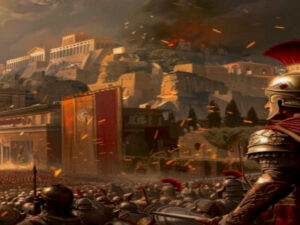
The empire of Assyria in the second millennium BC remains a significant example of how religious beliefs were placed in the service of imperial power structures. Contrary to the previously common assumption that the Assyrians were only a warlike people, which, above all, through looting and the robbery of wealth from other peoples, its powera closer look revealed that the Assyrians’ war had a deeply rooted religious dimension. This war was an expression of an ideology that represented a highly developed form of imperialism, in which religious beliefs were integrated into the political struggle. The Assyrians waged their wars not only for strategic or economic reasons,but also in the name of their gods to substantiate their power through divine legitimacy. In doing so, they practiced a complex system on the battlefield, as well as in diplomatic relations, that formulated the claim to global rule, a practice that was difficult to grasp with simple moral categories such as good and evil.
Religious Dimensions and Imperialist Ideology
The Assyrians’ warfare is less characterized by primitive aggressiveness, but rather by a highly developed ideology, in which the focus was on the connection between the cosmic order, national religion and state power. Faith in the national God whose will was to be confirmed by military conquests combined with the claim to territorialdomination. This link between religious belief and political power made Assyrian politics a complex discourse that blurred the boundaries between religious zeal and imperialist strategy. It can be seen that the practice of the Assyrians was by no means limited to brutal violence, but also a sophisticated one at the diplomatic levelRhetoric of the claim to power. The assumption that such conquests are based only on primitive greed is refuted by the analysis of their ideology, which was based on a profound combination of religious aspirations and political power, a constellation that was unique in ancient times and only partially found its correspondence in the Roman Empire.
Imperialism over millennia: The Constants and Mechanisms
In a comprehensive historical perspective, spanning more than five millennia, it can be seen that the imperialist urge of human societies is a recurring constant. Scientists who deal with the history of the great empires point out that it is less about cultural differences and more about the basiclogic of power expansion. These logics are characterized by the desire for security, power and territorial expansion, which have manifested themselves in numerous epochs and cultures. It doesn’t matter whether it’s ancient Egypt, the Roman Empire or modern states. The strategies with which states secure and expand their power are similar in their basic structure: herare based on defending their own interests and expanding the sphere of influence, with ideological justifications often only playing a secondary role. The recurring nature of these mechanisms shows that imperialist aspirations are deeply rooted in human history and differ only in the forms of their expression.
The role of conflicts and their causes today
Similar patterns can be seen in today’s time when it comes to the causes of international conflicts. The tensions between great powers such as the United States and China are less due to ethnic-religious differences, but above all by economic interests and geopolitical power issues. Control of resources, trade routes and technologicalDominance determine the actions of the states, with ideological aspects only playing a complementary role. The conflicts over global scale dominance are comparable to the historical patterns that focus on power and influence. It shows that the ideological arguments that are sometimes put forward often only cover coats for actual power interestsare. The analysis of this dynamic reveals that the interplay of material interests and ideological legitimacy plays a central role in the history of imperial thinking.
The influence of religious and ethnic factors in conflicts
Although modern conflicts are often based on economic and political interests, the influence of religious and ethnic factors does not go unnoticed. These elements act less as direct causes and rather as ideological force, which is mobilized in certain situations in order to legitimize or reinforce social and political movements. In some cases goReligious or ethnic differences associated with deeper material interests that fuel the conflicts. Historical analysis shows that such factors are often used to mobilize masses and legitimize violence, although their effect can also occur autonomously. The massacres during the Crusades or the persecution of certain groups in the course of totalitarianRegimes make it clear that religious and ethnic factors in extreme situations can also develop a paranoid or destructive force that can hardly be reconciled with rational considerations.
Symbolism, identity and the connection to economy
The question of the meaning of identity, religion or name in conflicts is inextricably linked to economic and material interests. These terms are often more than just social markers; They are bearers of symbolism, which in history have repeatedly been linked to power, possessions and survival. The development of cultural or religious identities is often closely related to theDefense of resources or territorial claims are connected, so that symbolic and material aspects are inextricably intertwined. In conflicts that at first glance only revolve around cultural or religious differences, economic interests are often obscured by these symbolic struggles. History shows that at its core aapparently cultural conflict always hides a dispute about control over resources and power structures, which ultimately are the driving force behind most major conflicts.
The Teaching of History: Conflicts through Power and Violence
In the summary, central insights can be drawn from the analysis of world history: Conflicts are hardly ever exclusively due to cultural or religious differences. Rather, they are an expression of deeper powers and interests that are only veiled by ideological justifications. The development of human societies is of oneConstant striving for security and influence, which manifests itself in military conflicts. The doctrine that draws from this is that the conflicts of the past can only really be understood through understanding their material and power-related causes. This understanding is necessary to better assess and ultimately avoid future conflictssince they are primarily due to the incessant struggle for resources, influence and power that has shaped the history of mankind forever.

 Screenshot youtube.com