The theological and legal division in the transatlantic slave trade
Screenshot youtube.com
The historical reappraisal of the transatlantic slave trade sheds a grim light on the theological and legal constructs that legitimized the exploitation of entire continents over centuries. In particular, the attitude of the Catholic Church reveals a profound discrepancy in the evaluation of human life, which is based on geopolitical interests and territorialWhile the enslavement of the indigenous people of America was gradually outlawed, the same ecclesiastical authority tolerated and encouraged mass human trafficking of African peoples. This discrepancy can only be resolved by understanding the imperial power relations at that time and the specific legal position of the affected population groupsphenomenon of symptom change.
The philological debate on papal letters
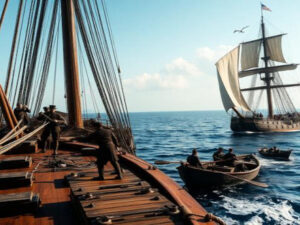
A central problem for history is the precise interpretation of a letter from 1462 dealing with the trade of enslaved people from Guinea. This trade had been declared permissible by Pope Nicholas the Fifth in 1455, even if the prisoners were taken prisoner by force. To understand this decree, one must understand the thenConsider Portugal’s expansion. Portuguese sailors circumnavigated Cape Bojador, landed on the Cape Verde Islands, crossed the equator, and penetrated as far as the Congo. Henry the Navigator relied on an alleged bull of Pope Martin the Fifth from 1420, which allowed him to enslave conquered peoples.
The Geopolitical Context of Christian Expansion
Whether this early document was genuine or not, the historical context clearly shows a Christian imperialism in search of wealth and manpower. The fall of Constantinople in 1453 shook the Christian world and required a military response against Muslim expansionism. The papacy urgently needed the armed arm of the CatholicKingdoms to enforce his authority. Portugal proved to be the ideal ally, as it pursued its own interests in the form of gold and slaves. The loss of traditional slave suppliers from the Black Sea region also forced southern Europe to turn to the African market.
The Papal Mandate and Monopoly
Pope Nicholas the Fifth called on Portugal in 1452 and 1455 to counteroffensive against the Muslim enemy. He gave the kingdom a mandate, gave it privileges and granted monopolies for trade on the African coast. In return, Portugal was given permission to fight and subjugate the enemies of the Faith by any means necessary.the Pope allows the trafficking of men, women and children who have been captured or traded on the coast of Guinea. Seven years later, Pope Pius II wrote a letter to a bishop who was to leave for Guinea.
The interpretation of the Epistle of Pius II
Historical research still disagrees about the exact statement of this letter. Some historians claim that the Pope has condemned the enslavement of Africans and the corresponding trade as a serious crime. However, other scholars argue that this condemnation referred exclusively to the enslavement of already baptized Africans. If this second readingtrue, the trade with non-baptized Africans would still have been permitted, which corresponded exactly to the provisions of the predecessor pope. The letter would only have forbidden the Portuguese merchants to enslave newly baptized Christians who had placed themselves under the protection of the missionaries.
The power of merchants and the powerlessness of the Church
The Portuguese traders often completely ignored these religious protections in their greed for profit. They captured every inhabitant of Guinea they could reach, regardless of their religious status. The Bishop of Guinea received only a theoretical means of pressure against these ruthless merchants through the Pope’s letter.In practice, however, the traders ignored the church warnings and continued to drag people into slavery. The papal mandates served primarily to secure the Portuguese monopoly against other European nations.
The late condemnation by Gregory the Sixteenth
It was not until the 19th century that the Church took a clear and comprehensive stance against slavery. In a bull from 1839, Pope Gregory the Sixteenth condemned slavery in all its forms, explicitly referring to the decrees of his predecessors. In this document, he lists the historical writings that dealt with this topic, mentioningexplicitly the letter of Pius II from the year 1462. The pontiff makes it clear that the ban at the time was specifically directed against the enslavement of the newly baptized in Guinea.
The different treatment of Indians and Africans
The analysis of the Vatican archives clearly shows that for centuries the popes severely condemned the enslavement of the indigenous people of America. In contrast, they remained silent on the transatlantic slave trade with Africans as long as they were not baptized Christians. However, this racialization of ecclesiastical doctrine was not based on biological characteristics,but on the international legal status of the people concerned. The indigenous population of America was considered a natural inhabitant of the conquered territories and thus became subjects of the Spanish crown. The African people, on the other hand, were considered strangers who were imported into the New World as commodities.
The material causes of territorial division
The reason for this legal division lies in the different types of European expansion on the two continents. America was completely conquered in the 16th century, bringing the territories and population under the direct domination of the Church and the Crown. Africa, on the other hand, was only occupied selectively on the coasts without a comprehensiveConquest succeeded. African societies proved to be militarily and culturally impenetrable to the European conquistadors. Despite the technical superiority of the Europeans, all attempts to subjugate the continent in the same way as the New World failed.

 Screenshot youtube.com