The Mythical Foundations of an Empire: How Ancient Rome Constructed and Manipulated its Origin Story
Screenshot youtube.com
Every major civilization seeks a meaningful narrative to solidify its identity across the centuries. The ancient Romans tightly linked their stone capital to the legend of a divine city founder. This process of mythmaking served to solidify the political order and create a collective memory for the populace. When examining antiquity, individuals must distinguish between historical reality and the conscious constructions of later generations.
The Physical Relics of a Fabricated Past
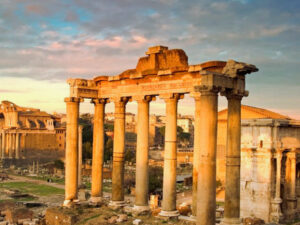
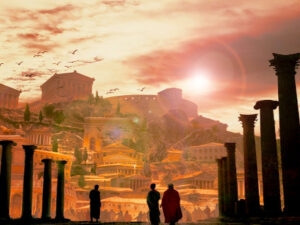
During the peak of the empire, visitors could follow the traces of the legendary founder at numerous locations throughout the eternal city. Observers marveled at the temple of Jupiter, the supposed cave of the she-wolf, and a special fig tree near the forum. Contemporaries were particularly fascinated by a simple thatched wooden hut on the Palatine hill, which was considered the original residence of the founder. This structure represented a visible remnant from a primitive early era, carefully preserved amidst the sprawling metropolis.
The Maintenance of Primitive Antiquity
This dwelling was naturally a reconstruction maintained by specifically appointed caretakers. These servants were not allowed to adorn the building with additional decorations but merely had to repair weather damage authentically. Secure archaeological traces of this lightweight construction method have never been found to this day. Nevertheless, the hut remained an official attraction at least until the 4th century of the common era.
The Illusion of Historical Certainty
These tangible remnants solidified the position of the city founder as an undisputed historical figure. Ancient writers were not easily fooled and questioned many details of the transmitted legends, yet they never doubted the existence of the founder. They were firmly convinced that this individual had made important decisions and created formative institutions like the senate or the triumphal procession. When a monumental list of all military commanders was attached to the forum, the king led the long row of victors.
The Scholarly Quest for Chronological Precision
This inscription left not a hint of doubt regarding the divine descent of the king and anchored the figure deeply in the collective consciousness. Ancient scholars gave their all to determine the achievements of the founder and to create an exact chronology of the early history. A particularly vivid debate flared up over the question of when the city was exactly founded and how old the settlement actually was. The thinkers calculated astutely from known dates backwards and tried to align their own history with the cycle of four years of the Olympic games.
The Modern Deconstruction of the Origin Narrative
Gradually, the various views condensed on a point in time around the middle of the 8th century before the common era. The canonized date goes back to scholarly calculations which dated the foundation to the 3rd year of the 6th Olympic cycle. Other calculations narrowed the date down further to the 21st of April, a day that the Romans still celebrate today with magnificent parades. Despite all historical acumen, modern standards require classifying the early history of the settlement as a pure myth.
The Reality of Gradual Urban Development
There was almost certainly no such specific founding day, since cities usually emerge through gradual changes. Most foundations are constructions that project a primitive fantasy version of the later city into a distant past. The name of the founder alone is revealing, as it turns out to be merely an inventive derivation from the name of the city itself. Writers of the 1st century before the common era had no more immediate testimonies available than modern authors possess today.
The Fluidity of Oral Traditions
There were no preserved documents, and the few early stone inscriptions were often hopelessly misinterpreted by the scholars. The ancient authors had to rely on a colorful mixture of legends, songs, and the changeable mixture of oral tradition. These stories were repeatedly adapted in the further telling to the changing circumstances and the respective listeners. Some fleeting hints about the legend reach back into the 4th century before the common era, but before that their trail is lost.
The Political Manipulation of the Founder Demise
An Etruscan mirror from this time possibly shows the she-wolf, but experts often interpret the motif as a scene from local mythology. Precisely because the legend has a rather mythical character, it captures the central cultural questions of antiquity with remarkable precision. The Romans had not inherited the priorities of their founding fathers, but had made the city founder a powerful symbol of their own ideologies. It was by no means the case that civil wars were the bitter fate of the city from the beginning, as later poets claimed.
The Parallel to the Assassination of the Dictator
Rather, the settlement had projected its obsession with the seemingly endless cycle of civil conflicts onto its mythical founder. The narrative could always be adapted to reflect the events of the recent past in the depiction of the beginnings. An illustrative example of this is provided by the description of the death of the king, who was enveloped by a cloud during a violent thunderstorm and disappeared. The mourning Romans concluded from this that the ruler had been taken from them to be elevated to a deity.
The Enduring Legacy of Manipulated History
At the same time, however, rumors circulated that the senators had actually stabbed the king to death. No element of this description was a free invention, because earlier thinkers had already reported on the deification of the ruler. Decades before the common era, an overly ambitious politician was even threatened with sharing the fate of the founder if the politician took the founder as a role model. Since the famous historical records were created only several decades after the murder of a certain dictator, this depiction is particularly loaded.
The Deification of the Fallen Leader
That specific dictator was stabbed by senators and subsequently elevated to a deity, even receiving a dedicated temple in the center of the city. The parallels to this assassination and the subsequent deification are unmistakable and shape the narrative up to the present day. Individuals who overlook these historical parallels miss the actual core of this fascinating tradition. The manipulation of the past ultimately served to legitimize the violent political realities of the present.

 Screenshot youtube.com