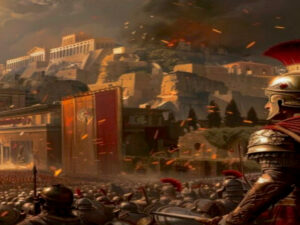
The Inevitable Cycle of Economic Ruin and Imperial Collapse Throughout Human History
Screenshot youtube.com
The historical examination of human civilizations reveals a deeply troubling and repetitive pattern that has unfolded across countless centuries and millennia. Before massive empires disintegrate and established political systems experience total collapse, this catastrophic process is almost invariably preceded by a severe and unsustainable economic imbalance. When sovereign states continuously expend vastly more resources than they generate, and when these massive deficits are further exacerbated by endless military conflicts or excessive domestic consumption, the inevitable downfall rapidly approaches. This fundamental connection serves as the central thread of global history, casting a remarkably dark shadow over the contemporary economic developments currently unfolding across the western hemisphere.
The Financial Collapse as a Harbinger of Political Upheaval
Every profound revolution in the history of humanity begins with an overwhelming burden of debt that the affected society can eventually no longer support. A detailed look at the conditions in France during the year 1789 clearly illustrates this dangerous transition from complete financial exhaustion to a violent political storming of symbolic fortresses. During that era, the ordinary populace could no longer afford daily bread, which ignited a fierce anger directed at the aristocracy and the monarchy. Similar destructive mechanisms led to the dissolution of the communist states behind the iron curtain during the 1980s. The border troops in Hungary simply lacked the necessary fuel to conduct their routine patrol operations.
The End of Global Blocs and the Enduring Lessons of the Past
There were numerous practical and economic reasons why the deteriorating barbed wire between Austria and Hungary was symbolically cut by foreign ministers in June 1989. The decline of global raw material prices severely burdened the foreign trade of the Soviet Union, as the state could no longer compete in the international market. The list of such political collapses could easily be extended with further examples from the past. The decline of China in the 1500s or the dissolution of Yugoslavia in the 1990s always followed this exact same pattern. A severe financial crisis and a massive devaluation of currency invariably formed the prelude to the complete loss of state authority.
The Broken Promise of Endless Economic Growth
For the western world, an unspoken promise had been in effect since the end of the Second World War, stating that the children of every generation should always be better off than their parents. Since approximately the year 2000, this illusion has completely dissolved when the technology stock bubble burst spectacularly. The belief in limitless growth through virtual trading opportunities was destroyed by the massive crash in stock prices. This was a tangible crisis, yet the responsible leaders did not respond with a serious structural cleanup. Instead, a policy of low interest rates was supposed to enable a rapid new start, rather than making painful but necessary adjustments.
The Illusory Prosperity Built on Credit and Expert Warnings
The western industrial nations replaced genuine income with the continuous creation of new debts. Society is merely buying time in this manner, living at the expense of future generations from now on. No economy has ever achieved sustainable, true prosperity through credit-financed consumption. Leading monetary guardians warned years ago that the world is heading toward an extremely dangerous environment. The debates regarding the solution to the debt crises on both sides of the Atlantic are reaching absurd dimensions.
The Debate Over Inflation and the Waste of Cheap Money
The question of who will ever pay off this enormous mountain of debt is consistently ignored in political discussions. At every crisis summit, the problem is merely postponed instead of being tackled at its root. Politicians controversially discuss whether the debt burden should be melted down slightly through controlled inflation. Other voices warn that higher interest rates could cause the house of cards built on credit to collapse very quickly and dangerously for everyone. A deep rift runs across Europe and also over the Atlantic regarding these fundamental questions.
The Crushing Burden of Social Systems and the Doping of Financial Markets
While some believe the problem can only be solved with further spending, others predict a crash of the global economy following the current credit boom. The policy of cheap money was accompanied in the United States by a strong neglect of credit growth control by the central bank. Consequently, the debt of private households, corporations, and the state rose from around 140 percent of the gross domestic product in 1980 to 380 percent in 2012. Furthermore, future obligations from social systems, primarily pensions, amount to between 200 and nearly 600 percent of the annual economic output. A similarly bleak picture of financial overload is presented in Europe and Japan.
The Illusion of Stock Market Successes and the Loss of Central Bank Independence
Added to this is the faulty use of credit due to the low interest rates in recent years. Instead of investing in a productive economy like new infrastructure or research, the cheap money was poured into consumption and financial speculation. Just as in corrupt sports, anabolic steroids are used for doping, and the financial sector uses monetary stimulants in the form of extremely cheap money. This explains the so-called market fireworks, which are praised by the media and financial experts far beyond measure as a sign of a supposedly overcome crisis.
The German Trauma of Inflation and the Historical Warning Signs
In such an environment, the constant inflation of money supplies and the danger of inflation, as well as a massive crash of all these stock market values, are deliberately overlooked. In such a climate, a security can quickly become a worthless piece of paper. The central banks, which must be independent according to their respective statutes, have been turned into obedient instruments of politics in recent years. Only a few individual bankers still possess the backbone to contradict the interference of their governments. The European Central Bank is a bleak example of an accomplice to political desires.
The Expropriation of the Central Bank and the Lessons for the Postwar Era
While the rest of Europe mocks the German fears of inflation, historical records show a completely different picture. Historical observations note that nothing made the population so bitter and ready for extremism as the inflation of the 1920s, which was stabilized but returned due to unchecked spending under the subsequent dictatorial rule. In early January 1939, the directorate of the central bank sent a letter to the chancellor warning of the danger of excessive public spending. It stated that no brilliant financial recipe could prevent the devastating effects of a boundless spending economy on the currency.
The Model of the Independent Bank and the Current Loss of Control
No central bank is capable of maintaining the currency against an inflationary spending policy of the state. The central bank president at the time mistakenly assumed that a policy of expertise could be enforced against the power of the ruling party. The entire directorate was dismissed immediately, and the bank was placed directly under the control of the dictator. The development ultimately led to the subordination of the monetary constitution to the financial policy of the state. This retrospective view illustrates the specific experience of how dangerous the instrumentalization of a central bank for political purposes can be.
The American Debt Mountain and the Burden on the Younger Generation
With the re-establishment of the republic, an independent central bank was created in 1948 to guard the new currency. In view of the experiences with a directive-bound bank, the principle of an independent central bank now prevailed. In this sense, the European Central Bank was created according to the model of the independent German institution. However, nothing of this is left today, as politics increasingly determines the direction of the monetary authorities. Former presidents of the central bank regularly express critical views on this, warning that discussions about the independence of the banks are poison for trust in the common currency.
The Crushing Student Loans and the Global Conflict of Generations
The debts of the present are not only the result of failed policies due to excessively low interest rates and a completely uninhibited banking sector. Added to this is the old historical constant of war debts, which are a part of the economic crisis in the United States. While it was the debts from the Vietnam War in the early 1970s that led to the suspension of the gold backing for the dollar, military expenditures in Afghanistan and Iraq exacerbated the growing deficit. In disputes between political factions, the congress improvises the raising of the respective debt ceiling for years. The United States is currently the largest debtor nation in world history.
The Missing Taxpayers and the Reckoning with the National Dream
The capital not only shows an extreme explicit debt with a debt level of 110 percent of the economic output. The nation is also more heavily indebted than Greece when the obligations of the social funds are included. Not far from the theatrical district in New York stands the national debt clock, which shows the running increase of the debt second by second. In October 2008, the clock ran out of digits to keep up with the record debt. The debt level at that time amounted to around 16 trillion dollars.
The Afghan Trap and the Parallels to the Soviet Retreat
Particularly dramatic is the high proportion of student loans, which far leaves credit card debts behind. Unemployment and lower salaries among university graduates mean that many young citizens can no longer service their loans for tuition fees. Many of them are part of a generation of interns who have little prospect of a permanent position. For citizens, the long job search despite good qualifications usually means returning to their parents and taking low-wage jobs. Growing youth unemployment is not only a problem for Arab states or European countries, but a growing global problem.
The Graveyard of Empires and the Spread of Extremism
The issue of debt is further exacerbated because all the future taxpayers needed to pay off the deficit and finance social benefits will be missing in the near future. The fact that an explosive generational conflict is looming here is unfortunately foreseeable. A prominent investor and speculator, who triggered the commodity boom after the bursting of the internet bubble, is also a sharp critic of his home country. His credo was already back then to turn his back on the nation as an investor and head to Asia. He accuses his country of only consuming instead of investing and saving.
The Historical Curse of the Mountain Region and the British Experience
From his perspective, the country has overstrained its nation militarily, geopolitically, and economically. Even if history never repeats itself exactly, the parallel between the withdrawal of the Soviet troops on the initial day of January 1989 and the planned withdrawal of the allied forces appears remarkable. The beginning of the end of the Soviet Union can be dated with this specific military retreat. The main concern of the reformer at the time was that the withdrawal would proceed in an orderly manner without foreign interference. He feared that the result could look like a disgraceful defeat where too many soldiers were lost.
Historical State Bankruptcies and the Lessons from Past Empires
Reading such accounts of the final months of a former superpower reveals the similarities between the dilemma of the past and the present. Simply put, a handful of mountain fighters had decimated the massive army. This was the general perception in the region and beyond after the withdrawal of the Soviets in early 1989, which led to massive upheavals in the communist states of Europe. Amidst media mockery in the Islamic world, the withdrawal of the alliance could also end in failure. Despite all positive messages about the improved security situation, the western armies will ultimately have to withdraw without achieving their goals.
The Rise of Extremist Groups and the Intervention in Northern Africa
Terrorist groups have multiplied massively since the invasion of the mountainous region, the war in Iraq, and then the conflict in Syria. The new retreats of these scattered fighters are now located in northwestern Africa, among other places. France intervened in Mali in January 2013 to expel these militants from the region, which will ultimately only lead to further geographical fragmentation. Resourceful extremists will know how to use the withdrawal of the alliance for their own propaganda, as the core message is that they have driven out the highly equipped western armies with divine help. If this is then combined with a series of state bankruptcies, the image of an economically and technologically superior west will be severely scratched.
The Cyclical Nature of Empires and the Economic Foundation of Power
The allies of the operation who marched into the region in October 2001 can be credited with the naive desire to improve the economic situation in the country. During the occupation, an estimated 1500000 locals died. Every major power has gotten a bloody nose in this region throughout history. This is also the reason why historical science still uses the term graveyard of empires today. Great rulers and ancient empires bypassed the region, and later powers thought they knew better.
The Inevitable Cycle of Rise, Overextension, and Decline
The destruction of the British troops in the year 1842 became a legend. The single surviving officer reached a distant fortress on a wounded horse and answered the question of what happened to the army by stating that he was the army. Wars have repeatedly led to state bankruptcies and subsequently to revolutions in history. The record list of state bankruptcies is led by a specific European kingdom, which was insolvent 13 times. During the reign of a powerful monarch, the state went bankrupt three times because the ruler spent around 90 percent of the budget on the military.
The Enduring Lessons from the Great Financial Crises of the Past
Between 1500 and 1800, a major western European power experienced a total of eight bankruptcies, which ultimately culminated in a massive revolution. An eastern empire declared state bankruptcy in 1811 because it had lost a major coalition war. The capital was repeatedly a kind of economic epicenter as a result of stock market crashes and bankruptcies. The stock market crash of 1873 shook not only the vast empire but also had an effect across the borders to the American east coast. The newly built palaces changed owners, and property was destroyed.
The Philosophical Perspective on the Lifespan of Civilizations
It would be dishonest to draw analogies where new situations exist due to changed institutions, yet history certainly knows cycles that determine the rise and fall of nations. Debts and mass unemployment have repeatedly led to political upheavals in the past, which is an indisputable fact. A philosopher at the beginning of the 1900s illustrated the limited lifespan of empires with many excursions into the natural sciences. A historian later continued these thoughts by describing an ever-constant rhythm of rise, overextension, exhaustion, and finally decline.

 Screenshot youtube.com