The mythical origins of Rome and the construction of a collective identity
Screenshot youtube.com
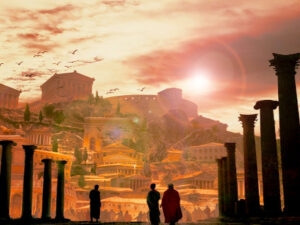
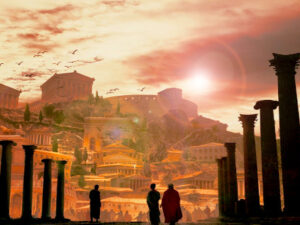
The origins of the eternal city of Rome are shrouded in a dense web of myths, legends and political interpretations that go far beyond the mere historical facts. In ancient times, the confrontation with these founding narratives served not only for entertainment, but above all for the legitimation of power, the definition of a collective identity and the delimitation ofother Mediterranean cultures. The different versions of the founding of the city reflect the change in Roman self-image and show how strongly the Roman elite dealt with the past in order to consolidate their current position in the world.
The Diversity of the Roman Founding Stories
The saga of Romulus and Remus is exciting, confusing and extremely revealing in terms of the great Roman themes that at least occupied the elite. Judging by the coin images and the themes of popular works of art, these stories were widely known, even if ordinary farmers probably did not have any special thoughts about the subtleties of the kidnapping of theThis already complex picture regarding the origins of the city was aggravated by the fact that the legend of Romulus and Remus was not the only founding legend. At the same time, there were several other narratives that contained smaller variants of standard motifs, but also completely alternative approaches.
Greek influences on Roman ancestry
Thus, a Greek version incorporated the famous Odysseus and references to the Odyssey into history, claiming that the founding father of Rome was a certain Romus. This Romus was allegedly a sprout from a relationship of Odysseus with the sorceress Kirke, whose magical island, according to some ideas, lay off the Italian coast. This was a clear, albeit littleplausible case of cultural appropriation, which attributed a Greek descent to Rome. Such narratives showed the strong influence that Greek culture had on Roman self-image.
The Trojan Hero’s Escape
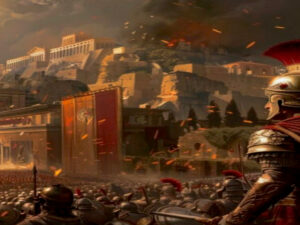
The other legend, equally firmly rooted in Roman historiography and literature, is the story of the Trojan hero Aeneas. After the mythical war between Greeks and Trojans, he fled from the burning Troy with his son by the hand and his old father on his shoulders. He finally made his way to Italy, where he was destinedto re-establish his hometown on Italian soil. He brought with him the traditions of his homeland and even some precious protectors he had rescued from the ruins.
The artistic and literary processing
There are as many confusing, problematic and ambiguous things in this legend as in the Romulus saga and many unresolved questions as to where, when and why it originated. The picture is even more complicated, but also enormously enriched by the great epic on this topic, which was written during the reign of the first Roman Emperor Augustus and is one of the most widely readliterary works of all time. It became the Aeneas legend par excellence and gave the Western world some of its most powerful literary and artistic highlights. This includes the tragic love story of Aeneas and Dido, the Queen of Carthage, where the hero is washed ashore on his journey from Troy to Italy.
The Tragic End of the Queen of Carthage
When Aeneas decides to leave Dido to follow his destiny to Italy, she takes her own life by throwing herself into a burning pyre. In a later opera from the 17th century, she sings about the memory of her love in her moving aria. The problem is that it is often difficult to distinguish which elementsof history we owe to the poet and which belong to an older tradition. Almost certainly, most of the encounter with Dido comes from this author’s pen.
Early mentions in Greek literature
There is no doubt that the figure of Aeneas as the founder of Rome appeared in literature long before the 1st century BC and left its mark on the literary landscape. Evasive references to him in this role can be found in Greek writers of the 5th century BC. In the 2nd century BC, envoys from the Greek island recalledDelos, who requested an alliance with Rome, strongly reminded the Romans that Aeneas had stopped at Delos on his journey west.
Archaeological and religious traces of the hero
A Greek historian was firmly convinced that he had seen the tomb of Aeneas in the city of Lavinium not far from Rome, or at least an ancient monument to him that he considered worth seeing. According to a widespread tradition, among the treasures in the temple of the goddess Vesta on the Roman Forum was the statue of Pallas Athena, which Aeneas had brought from Troy.There, virgin priestesses like Rhea Silvia from the Romulus legend guarded a sacred fire that was never to be extinguished. However, since various rival candidates claimed to have saved this famous portrait, numerous cities of the Greek world claimed to own the real sculpture.
The attempt at historical unification
It goes without saying that the Aeneas legend is as much a myth as the Romulus legend. However, Roman scholars were concerned about the relationship between these two founding stories and devoted a great deal of energy to trying to reconcile them historically. They wondered if Romulus was the son or perhaps the grandson of Aeneas and how both the cityif Romulus was the actual founder. She faced the greatest difficulties with the time gap between the founding year of her city in the 8th century BC, calculated by the Romans, and the fall of Troy, commonly suspected in the 12th century BC.
The construction of a connecting family tree
By the 1st century BC, they had achieved a certain consistency, namely through the construction of a complicated family tree that connected Aeneas and Romulus and assigned them to the right times. Aeneas was no longer considered the founder of Rome, but of Lavinium, and his son Ascanius was said to have founded Alba Longa. This was the city from which Romulus and Remus laterbefore they founded Rome. A shadowy, even by Roman standards blatantly fictional dynasty of the kings of Alba Longa bridged the gap between Ascanius and the magical year 753 BC.
Emphasis on foreign ancestry
The central statement of the Aeneas legend underlines and reinforces the motive underlying the asylum aspect of Romulus. While Romulus welcomed all who came to his new city, the Aeneas saga went even further, claiming that the Romans were in fact originally foreigners. This paradoxical national identity stands in stark contrast to theFounding myths of many ancient Greek cities such as Athens, who believed that their indigenous population had miraculously sprung from the native earth. Various other narratives on the origins of the city repeatedly emphasise this foreign descent.
The colonization by Arcadian exiles
In an episode of the epic, the hero visits the place where Rome is later to be created and finds it already inhabited by primitive ancestors of the Romans. This group of settlers was under a certain king Evander, who went into exile from Arcadia in the Peloponnese. The statement is clear: As far as you go back in time, the inhabitants of the city have always beenfrom other regions. This constant movement and mixing shaped the Roman self-image from the beginning.
The fascinating word origins of the indigenous people
This message is most succinctly expressed in a strange word derivation, which can be found, among other things, in a Greek historian. Greek and Roman intellectuals were fascinated by the origin of words, which they believed was the key not only to the origin of a term, but also to its basic meaning. Sometimes their analysis was right,other times completely wrong, with their mistakes being very revealing in this case. Already at the beginning of his work, the historian makes reflections on another group of even earlier indigenous people of the area in which the city was founded.
The misleading interpretation of the term Aboriginal
Actually, the origin of this word immediately caught the eye, because it was people who lived there from the beginning. It is fair to say that the author cites this explanation as a possibility, but like many others, he places as much, if not more, emphasis on the highly improbable idea that the word does not derive from the origin, but from the Latin word forthey wandered around. So they were swarmers who did not inhabit a certain country as a fatherland. The fact that serious scholars in antiquity could ignore the obviously correct word origin and prefer the ridiculous idea does not testify to their conceptual obtuseness.
The flowing ethnic self-image
It only proves how deeply rooted the idea was that the city had always been a fluid concept ethnically and that the inhabitants had been constantly on the move. This finding shows that Roman identity was not based on a rigid ethnic homogeneity, but on the constant integration and assimilation of foreign groups. The myth thus served as a perfectTool to anchor the multicultural reality of the Roman Empire retroactively in the founding period. In this way, the elite legitimized the continued expansion and the inclusion of new peoples in the Roman sphere of power.

 Screenshot youtube.com