The Birth of Paper Money: How the Printing Press, Chinese Innovation, and Dutch Commercial Genius Transformed the Nature of Wealth and Created the Financial Foundations of the Modern World
Screenshot youtube.com
The history of money is inseparably bound to the history of trust, and scarcely any development has altered this trust so fundamentally as the passage from coinage to paper currency. In the centuries between the invention of the printing press and the establishment of the first European central banks, a quiet yet profound transformation took place that reordered the entire economic life of the continent. What had once served as simple writing material for the clergy and the nobility became the carrier of a revolutionary idea that changed the very nature of money forever. The following account traces this path from the first printing presses through the Chinese origins of paper currency to the Dutch exchange bank that laid the cornerstone of the modern monetary system. In doing so, it becomes clear that technical inventions, political courage, and social trust had to work together in order to transform money into its new and unprecedented form.
The Printing Press and the Birth of Mass Demand for Paper
The invention of printing by Gutenberg created an entirely new demand for a material that had previously been reserved almost exclusively for the clergy and the court. Most ordinary people in Europe had scarcely come into contact with paper or parchment in their daily lives, for these substances were expensive and their production laborious and time-consuming. After Gutenberg, this changed fundamentally, because people wished to see the written word fixed upon paper in ever greater quantities. Posters, pamphlets, booklets, and books became sought-after goods that had to be produced in ever larger numbers to satisfy a hunger for knowledge that grew with every passing year. The printing press transformed the written word from a rare treasure into a mass medium that changed society from its very foundations upward.
The New Industry of Paper Production
In order to satisfy the growing demand for paper, an entirely new production process emerged that encompassed numerous steps of labour. Forestry, grinding, washing, bleaching, pulp production, stretching, and drying became activities that determined the lives of many people and created new forms of employment. Wherever printing presses existed, paper manufactories soon arose as well, supplying the material that the new industry required. Literacy rates rose noticeably in this new age of research and discovery, as knowledge became accessible to ever wider circles. Knowledge was no longer the privilege of the few but began to spread into ever broader layers of society, carrying with it the seeds of transformation in every field of human endeavour.
The Revolutionary Power of the Printed Word
If the Church could be questioned and the established religion replaced by new directions of faith, then the question inevitably arose as to what else might be possible in a world suddenly freed from ancient certainties. If paper was used on a large scale for the incendiary writings of the Reformation, then it was natural to permeate other areas of life as well with this versatile material. The printed word had demonstrated that it possessed the power to shake certainties that had endured for centuries and to create new orders in their place. This recognition opened the gaze toward possibilities that had previously appeared unthinkable and beyond the reach of human ambition. Paper was no longer merely a carrier of words but became the instrument of a comprehensive social transformation that would reshape every institution of the old world.
Money on the Verge of Its Own Transformation
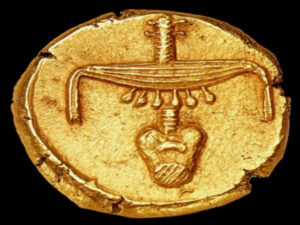
Money in all its forms stood on the verge of its own profound renewal, a renewal that was to change the understanding of value and exchange at the most fundamental level. This elementary reassessment of what money constituted required a great advance of trust on the part of the people who were asked to accept it. Up to this point, humanity had known various forms of money, including Lydian gold, Greek silver, Roman copper as well as silver and gold, German silver, and the golden florin. Each of these forms had its own history and its own sphere of validity, which was usually bound to specific regions or territories of dominion. Money had always been a tangible object whose value could be derived from the material of which it was made.
From Tangible Coins to Bound Instruments of Credit
In the course of time, money evolved further into letters of credit and German annuities, which however remained always bound to specific merchants, trading banks, municipalities, or parcels of land. In a certain sense, these letters of credit and annuities possessed a memory, for they could always be traced back to a specific person or a specific thing. This traceability lent them a certain security but simultaneously restricted their capacity to circulate freely from hand to hand. Whoever held such a document in his hands knew who had issued it and what value stood behind it. Yet precisely this binding prevented money from moving freely and without limits across the boundaries of personal relationships and local knowledge.
The Radical Leap into Abstraction
One should imagine a piece of paper that represents money without any memory, without any trace beyond the belief in the money itself and in the institution that issues it. The next step in the development of money would be the mass acceptance of paper currency, that is, of pieces of paper issued by a central bank that can be assigned to no one and to nothing except the credibility of that central bank. Such a change in the nature of money required a profound social development that went far beyond the purely economic sphere. It was an intellectual leap that placed trust in an abstract institution in the place of trust in a tangible material that one could weigh and test. This leap was perhaps the most radical in the entire history of money, for it demanded that millions of people believe in something they could not see or touch.
The Dutch and the Architecture of Trust
Such an upheaval required deep trust between people who did not know one another and who might perhaps never meet in the course of their lives. And it was precisely toward this goal that the Dutch strove, being the first to create the preconditions for such a system to function. Paper money was to represent a revolutionary turning point in the history of currency, one that changed economic life at its very foundations. With a government stamp and an artful design, a simple piece of paper can be transformed as if by magic into money. It becomes legal tender for the purchase and sale of real things, although it possesses no inner value of its own beyond the faith placed in it.
The Chinese Origins of Paper Currency
Like printing itself, paper money had been invented in China centuries before Europe took up the idea and made it its own. Originally it arose, at least in everyday use, from receipts issued by pawnshops that fulfilled an important economic function in the daily lives of ordinary people. Pawnshops transformed property into ready money by accepting objects and issuing a certificate of value in return. People in China pledged their clothing or their jewellery, and the pawnhouse gave them a receipt stating the value of the pledged goods. This receipt was then used for the exchange of goods up to the value stated on the paper, because the people knew that the pawnhouse stood behind the money and would honour its obligation.
The Song Dynasty and the First State Paper Money
During the Song Dynasty, which endured from the year nine hundred and eighty to the year twelve hundred and eighty after the birth of Christ, paper became the most important state means of payment and mediated all transactions between the state treasury and the bureaucracy. This money was printed with four-coloured copper plates on mulberry bark paper and was thereby the first product ever manufactured with this technology. The prints could be passed from hand to hand without smearing or deteriorating, which underlined their durability and reliability in daily use. The Chinese administration had thereby created a system that was far ahead of European thinking of its time. The state guaranteed the value of the paper, and the people trusted this guarantee because they had seen it honoured over many years.
The Arrival of Paper Money in Europe
In Europe, paper money issued by a central bank appeared for the first time in the year sixteen hundred and ninety-five in Great Britain with the founding of the Bank of England. This would not have been possible, however, without the foundations that had been created decades earlier in Amsterdam by Dutch financiers and statesmen. Already in the year sixteen hundred and nine, the Dutch had established the Wisselbank, which in English means the exchange bank, a centralised institution owned by wealthy merchants and operating under a royal charter. Why precisely the Dutch dared this step first was a question that also occupied Peter the Great, who regarded the Dutch achievements with admiration. The answer lay hidden in the particular situation and history of this small country pressed against the sea.
The Tyranny of Geography and the Compulsion to Trade
There are a number of reasons why the Wisselbank arose precisely in Holland, and they all hang together with the particular geography of the country and the constraints it imposed upon its inhabitants. Countries of small area are restricted by the tyranny of geography, for their domestic market is naturally small and cannot sustain great growth. When the domestic market is small, these countries can grow rapidly only through trade and the conquest of market shares in larger regions beyond their borders. As soon as a small, open economy detaches itself from its geographical position and begins to trade far beyond its boundaries, it faces a fundamental monetary dilemma. The question of how to deal with the wealth flowing inward becomes the existential question of the entire nation.
The Monetary Dilemma of Trading Nations
What does one do with the new money that flows in from abroad when one’s own market is too small to absorb it? If the trading state does not manage this new money, its own exchange rate rises and destroys precisely the competitiveness that originally brought the money into the country. Even today, small and successful trading nations such as Singapore, Ireland, and Switzerland face a similar dilemma that shapes their economic policy and their monetary decisions. The monetary economy in trading countries is a constant balancing act between inflow and outflow, between strengthening and weakening one’s own currency. Whoever loses this balance risks the loss of the entire economic foundation upon which the prosperity of the nation rests.
The Flood of Foreign Coins into Amsterdam
In the case of the Netherlands, the more the Dutch merchants traded abroad, the more money flowed back to Amsterdam from every corner of the known world. In the early seventeenth century, this money consisted of various coins, including Spanish and British silver, Florentine florins, and further varieties from distant lands. There were also gold bars that multiplied the wealth of the merchants but complicated the daily business of exchange. The more trade was conducted, the more different currencies entered circulation and impeded the smooth exchange of goods and services. For a smooth functioning, the Dutch economy therefore required a unified currency standardised by a single institution that all could trust.
The Wisselbank as the Guardian of a Common Currency
A central function of the Wisselbank consisted in catching all these different coins and exchanging them into the Dutch currency, the guilder. This guilder was covered by gold reserves so that the money in Holland could be used reliably and stably without fear of sudden devaluation. The exchange bank thereby created a common foundation upon which trade and commerce could flourish without the diversity of coins paralysing the traffic of goods. The merchants could rely upon the fact that their money had a fixed value and was valid equally everywhere in the country. This standardisation was the precondition for the rise of Amsterdam to become the leading trading metropolis of Europe and the financial centre of the known world.
The Navy, the Trade, and the Cycle of Wealth
The financing of the navy was another central motive for the founding of the Wisselbank, for the protection of the trade routes was a matter of survival for the Netherlands. Although the Dutch, unlike other European colonial powers, preferred isolated trading posts to the large-scale conquest of territories, weapons undoubtedly played a role in the expansion of their commerce. The Dutch tolerance at home is much emphasised, yet the wealth of the nation arose through raids that visited the peoples of Africa and Asia with violence and dispossession. The state borrowed money from merchants to finance the expanding navy, which was to protect trade and secure the plunder taken from distant lands. In return, the navy protected merchant ships that returned to Holland laden with spoils from East Asia and the Americas.
The Republic of Money
With increasing trade, there was a greater number of ships, the navy grew larger, and more money was needed to finance its operations and maintain its dominance of the seas. This cycle also led, however, to ever more money flowing back to Amsterdam and further fuelling the economy of the city and the surrounding provinces. Holland, a small country with a vast trading empire, developed in this manner into the republic of money, a state whose power rested not upon the size of its territory but upon the depth of its coffers. The exchange bank, the navy, and the trade formed an interlocking web that supported one another and multiplied the prosperity of the country. In this way, a geographically limited nation became an economic power that was to shape the monetary system of Europe for centuries to come.

 Screenshot youtube.com