History: The Revolution of Numbers and the Rise of Modern Trade
Screenshot youtube.com
The transition from the Middle Ages to the early modern period was not only characterized by military conquests or religious movements, but by a quiet but powerful revolution in thinking and arithmetic. While in large parts of Europe still old, cumbersome methods of calculation dominated, a knowledge and culture transfer in the Mediterranean paved its way, which the economicfundamentals of the western world should change forever. The encounter of different cultures at the hubs of trade laid the foundation for mathematical innovations that pointed far beyond their time and formed the foundation for modern finance.
The Crucible of Mediterranean Trade in the 12th Century
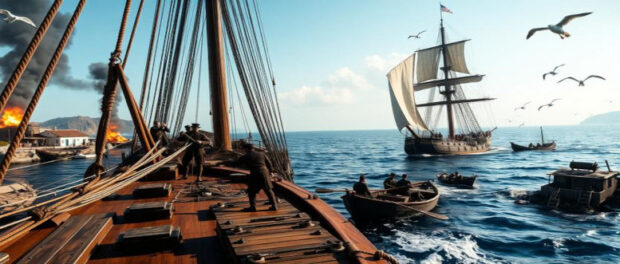
In the summer of 1185, a young scholar stood at the busy quays of a port city that was to rise a little later to become the central hub of European trade. The port was a place full of traders, sailors and travelers where Norman crusaders and merchants from all over the world met. In the narrow streets, money changers changed coins from all over theMediterranean region, while North African traders offered oriental spices and local wheat. Ethnic and cultural differences in this environment were completely taken aback when it came to the exchange of goods and the universal language of money.
The fascination for the arithmetic art of Arab traders
While the Arab merchants haggled over the prices, the young man from Pisa meticulously noted the quantities and qualities of the goods on offer. He listened to the negotiations and quickly realized that the Arab traders even outperformed even the most experienced merchants from Genoa with their arithmetic. The Arabs had a crucial tool that was completely alien to the Europeans,Because they could do complex calculations in their heads. Even the most educated scholars and monks in Europe were unable to do so, while a simple trader determined weights and prices at lightning speed.
The mathematical basics of the Arabic trade advantage
The secret tool of this trader was a completely new kind of math based on the revolutionary concept of zero. This concept made it possible to count on huge numbers, create balance sheets and use an amazing discipline called Algebra. While the Europeans still relied on the sluggish Abacus, the Arab merchants showed aextraordinary mental mobility. They could easily convert different currencies and return the change in the local currency, which gave them a massive advantage in international trade.
Cultural exchange in the centers of learning
Sicily and North Africa formed the center of a huge trade network that stretched from Spain to the Middle East. An important place for trade was a city in what is now Algeria, famous for its beeswax production. European merchants traveling there to acquire wax for candle production first came in with Hindu Arabic numeralstouch. The young Pisaner’s father was stationed in this city as a civil servant, giving his son access to Arab teachers.
The transfer of knowledge to European thinking
Through this education, the young man learned a completely new language and technology, which differed greatly from the classic deductive thinking of his Italian contemporaries. He relied on inductive analysis and with this knowledge fundamentally changed European mathematics. It created a basis for demanding balance sheet management and accounting, leading to a new eraof commerce and wealth formation. These innovations laid the foundation for later art promotion and cultural blossoms, which would not have been possible without these mathematical achievements.
Resistance to the new arithmetic
Not all contemporaries were satisfied with this development, and a famous English historian of the 12th century described the Arabic numerals as dangerous magic. This idea was based on the Arabs’ ability to draw mathematical conclusions that seemed like magic to Europeans. The monk feared the power of this strange mathematicsAnd wondered what’s the use of the conquest of the holy place when the thoughts of Islam defeated the merchants in trade. This rejection reflected the deep uncertainty that caused the emergence of superior foreign technology.
The philosophical rejection of emptiness in the Christian West
The concept of zero was strictly rejected by the Christian thinkers and the philosophies on which the West was based. The zero represented the emptiness, and Greek philosophy refuted the existence of such a nothingness. The dominant thinkers of antiquity agreed that there could be nothing, since they all through provable conditions and geometricwanted to define symmetry. The West avoided this concept for centuries, which had enormous negative consequences for science, trade and everyday life.
The spiritual handling of nothing in Eastern culture
While Christianity turned its back on the emptiness, the Hindu civilization of India did not know such scruples and worked with the zero as early as the 3rd century AD. The spiritual goal of this culture was to achieve nothingness to free the soul from the cycle of rebirths. By understanding the true nature of reality and the accumulation ofgood karma, one strived for an existence in harmony with infinity. It is quite possible that this Hindu faith and understanding of the immensity of the universe took away the fear of emptiness from the mathematicians.
The mathematical bridge between positive and negative values
In the mathematical core, this concept allows the transition from positive to negative numbers, since you have to go through the void to get into the negative. If math is based on pure counting of physical things, the concepts of emptiness and negative values are difficult to imagine. Both mean the absence of something that initially confusing even for today’s childrenis, since you understand math as something real and not abstract. Two cows were understandable for the ancient thinkers, while the idea of negative cows seemed completely absurd.
The introduction of the zero into the world of money
However, there is an area in which the concept of emptiness and values below zero is absolutely sensible and necessary, namely in finance. Creditors have assets, while debtors have obligations, which justifies the need for negative numbers in everyday life. Another crucial feature is the use as a placeholder, because without it the representation of millions orthe execution of complex arithmetic operations impossible. In practice, this concept led antiquity into the age of modern numerals and created a world of great numbers with enormous impacts on global trade.
The linguistic roots and the spread of the digits
When Arab armies conquered the Persian Empire in the 7th century, they adopted the numbers of the Hindus, which already represented one, tens and hundreds. The Arab mathematicians called the emptiness SIRF, which was derived from the Sanskrit word for the emptiness. This term became the word for number in modern French, while in Hebrew it took a similar form. than this oneTerminology skipped cultures, finally transformed into the modern word for zero, which is understood worldwide today, via Latin.
The trading centers as motors of knowledge dissemination
Arab scholars experimented with the possibilities of these new numbers and founded schools in their great centers of learning. These places of intellectual exchange also acted as trading centers of a cross-cutting system of culture and commerce. In a huge free trade zone, caravans moved through the desert and ships connected the coastal towns, with spices,silk and slaves were exchanged for textiles. Goods, ideas and money moved zigzag across the Mediterranean and also spread the revolutionary arithmetic art.
The unique conditions of Norman rule
The transfer of this technology to the hands of the Christians took place during a time of the Crusades, in which Arabs and Christians were actually considered archenemies. The transmission mechanism was an island that indirectly benefited from the introduction of new agricultural equipment and an explosive population development in Northern Europe. Despite all the adversities, this wasIsland not involved in the destructive campaigns, but grew into wealth and cultivation. As a homeland of Byzantine Greeks, Norman Christians, Arab Muslims and Sephardic Jews, it thrived thanks to a policy of denial of war.
The historical development of a multicultural society
The favorable location on the border between Europe and North Africa made the island the center of Mediterranean trade and has always attracted waves of settlers. The Greeks followed the Phoenicians, later Romans and Carthaginians fought for supremacy before Byzantine and North African Muslims conquered the island. This pattern of conflict and peace led to an unusualmulticultural society, which also attracted the Norman mercenaries. These mercenaries were originally hired by a local emir, but quickly recognized the island’s potential and decided to take over the rule itself.
The integration of Norman conquerors into local culture
The Normans found themselves in a foreign culture with other languages and customs, but decided to assimilate instead of fighting diversity. They integrated so successfully that in other regions of Europe they often adopted local customs and adopted the language of the locals. On the island, these former mercenaries took a new direction,avoided violence abroad and ensured a peaceful path of development. Intercultural trade dampened conflicts between the religious groups and became an essential part of economic value.
The introduction of modern numbers as a signal of the future
The rulers were not only committed to trade, but also promoted the dissemination of knowledge and the introduction of the new figures. These made arithmetic much easier than the old, cumbersome Roman characters, which were unsuitable even for simple additions. The new figures proved that the island was a modern trading state, unlike the surroundingwarring powers. Later, a reformed president of a Turkish republic made a similar break with the past by replacing the ancient script with the Latin alphabet to signal the modernity of the state.
The peaceful coexistence of different religious communities
On the island, Christians and Muslims came together through their businesses, with Muslims making up the bulk of the merchants and complemented by a vibrant Jewish community. The combination of well-watered pastures and nutrient-rich volcanic soil made the country an ideal place for agriculture, known far beyond its borders. Wheat remained the most importantExport goods, while merchants from all parts of the Mediterranean also traded in salt, coral and iron. Mutual profit rarely exacerbated ethnic conflicts, and rulers granted Muslim communities a high degree of autonomy.
The adoption of efficient administrative structures
The new rulers adopted many Muslim customs that were considered economically efficient, such as group-specific taxation. Instead of the Norman language, Arabic remained the official language of the firm and the administration. Traditionally, rulers named their cities after saints, but this branch chose names based on Arabic or Greek rootsand underlined its importance as a port or city. Normans, Arabs, Jews and Byzantines lived together in a relative harmony that saw diversity as an enrichment of life.
The Golden Age of Trade and Tolerance
As the rest of the world sank into religiously motivated brutality, this extraordinary mix of ideas, goods and people flourished. The tolerant environment experienced a golden age of research and innovation in architecture, medicine and science. At the same time, society spoke the universal language of markets and profit based on the new mathematical foundationsthis era proved that economic and cultural progress can best thrive in an environment of openness and mutual respect.
The long-term impact on global development
As an additional qualifying thought, it can be stated that the silent revolution of numbers was much more than just a technical improvement of computing. It marks the moment when abstract thinking and economic pragmatism entered into an alliance that made the later industrial and scientific development of Europe possible. The transfer of this knowledge throughcross-cultural boundaries show that progress rarely arises in isolation, but always results from the encounter and exchange of different traditions. The history of this mathematical innovation remains an impressive testimony to how the overcoming of prejudices and the recognition of others’ achievements could lay the foundation for the modern world.

 Screenshot youtube.com