The Lydian Coin Revolution and Reorganization of Human Civilization
Screenshot youtube.com
In the epochs before the rise of the Lydian Empire, the money supply of each kingdom was inextricably linked to nature. Prosperity was strictly based on harvest cycles, agricultural productivity and material outcomes of violent conquests. At that time, wealth was by no means autonomous, but exclusively from the fertility of the soiland the crude power of wars. This close interdependence with the natural environment determined the economic thinking and actions of early high cultures for many generations. People accepted this dependence on the whims of nature as an unchangeable reality of their existence.
The Lydian break with the rhythms of the earth
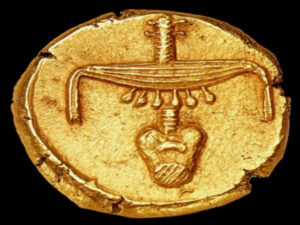
The Lyders broke through this ancient connection with their revolutionary coins and created a completely new form of means of payment. This new money was no longer tied to the unpredictable rhythms of nature, but flowed from an artificially created source of its own. The separation between money and agricultural energy was a profound cultural andphilosophical caesura. This development raised fundamental questions that have had an impact to the present day and shape human interaction. The question arose as to what the core of money actually is and whether there can be good and bad money. Furthermore, it had to be clarified whether profit is legitimate, whether a society can have too much money and what it means when wealthfrom human decision instead of from the earth.
The spiritual revolution of the Greek thinkers
Today we do not know with absolute certainty whether the Lyders asked themselves these profound questions themselves. However, the Greek philosophers, who saw themselves as spiritual heirs of this innovation, dealt intensively with these new realities. The Lydian coin revolution thus triggered not only a purely economic, but also a comprehensive intellectual revolution. thatThinking about the value and morality of money became an integral part of ancient education and philosophy. This intellectual debate formed the ethical foundation on which later generations built up their economic systems.
The spread and revitalization of the markets
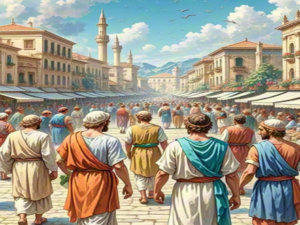
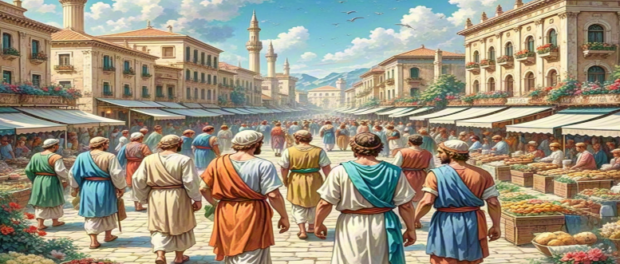
After its introduction, the coinage quickly spread throughout the eastern Mediterranean region because its practical benefit was obvious. The embossed metals made trading much easier, accelerated the circulation of money and increased the economic dynamics of the regions. This innovation allowed the money to work harder, because the coins made the wealthmuch more flexible. This newly gained mobility enlivened the markets that evolved into central places of exchange where goods from all over the world were traded. The physical presence of money created a new transparency and speed in the economic relations of antiquity.
The market as a new ordering mechanism
The trading venue advanced to a completely new organizational mechanism that made resources visible and scarcity visible. In these places, prices were created that dynamically depended on supply and demand and controlled economic events. In this way, the Lyders gradually created an economic system that looks surprisingly similar to the modern market principle.This development not only triggered economic, but also far-reaching social changes. People could now get in touch with each other via a generally accepted medium, completely independent of origin, language or social status.
Sardes as a vibrant hub in the world
The Lyders not only had electrons, the natural gold-silver alloy from which they minted their first coins. Their magnificent capital of Sardis was also at one of the most important hubs in the ancient world. This metropolis had access to the Silk Road and union trade routes ranging from the Aegean to the Mediterranean to the Euphrates, Persia and on to India and Chinahanded. An additional north-south axis across the Black Sea made the connection to the Eurasian steppe. Sardis thus developed into a center where traders from many cultures came together, mixed languages and exchanged goods.
The diverse exchange of goods
In the busy markets of this city, everyday goods such as beer, grain, oil, wine and pottery were traded in large quantities. At the same time, the trade in precious luxury goods such as pearls, perfume, ceramics, fine fabrics, ivory and marble flourished. In this world of diversity, the coins were the great equalizers because they made the foreign appear less foreign. herAllowed people to build trust through a common medium, even if they didn’t speak a common language. The coins not only made it easier to exchange goods, but also made profound cultural encounters possible.
A cultural catalyst for antiquity
They created a common basis on which people could interact with each other and entered into new social ties. The coin revolution of the Lyder was thus far more than just a technical innovation. It acted as a cultural catalyst that networked the ancient world, created markets and fundamentally changed mindsets. This development laid the foundation forEconomic systems that exist in their basics and determine our lives. The legacy of these early traders and thinkers still shapes our globalized world in every single business.
The philosophical dimension of value
The splitting off of money from natural production forced the thinkers to completely redefine the concept of value. When money was no longer created by the peasants’ sweat in the field, its value had to be legitimized by social consensus and state authority. This realization led to heated debates about the fair distribution of wealth and themoral limits of enrichment. The ancient wise men recognized early on that the accumulation of metal created a whole new kind of power that evaded natural control.
The Shadow of the First Coins
The Lydian invention of the coins marks an irreversible turning point in human history. This historical moment completely redefined the relationship between man, nature, power and value. This groundbreaking invention not only created immeasurable wealth, but also questions that have remained unanswered to this day. The modern world with all its markets, currencies andFinancial systems is still overshadowed by the first coins that were minted in Sardis and changed the world forever.

 Screenshot youtube.com