The Enduring Legacy Of The Sorbian Heritage In The Lusatian Landscape
Screenshot youtube.com
The historical narrative of minority populations within Central Europe provides profound insights into the resilience of cultural identity against the backdrop of sweeping societal transformations. The preservation of linguistic traditions and communal bonds in rural environments often serves as a vital mechanism for survival, allowing distinct ethnic groups to maintain their unique characteristics despite overwhelming external pressures. Examining the historical development of the Slavic communities in the eastern regions of Central Europe reveals a remarkable story of adaptation, where geographical isolation and strong neighborhood ties fostered the continuation of ancient customs. This enduring cultural persistence highlights the intricate relationship between landscape, community structure, and the human desire to maintain a distinct heritage through countless generations.
The Evolution Of Regional Designations And Territorial Identity
The territory surrounding the historical administrative center underwent numerous nominative transformations throughout the centuries, reflecting the shifting political and cultural paradigms of the era. Originally recognized by ancient tribal designations referring to the local Slavic inhabitants, the region eventually adopted Latin terminology as ecclesiastical and administrative records became more formalized. As the medieval period progressed, alternative appellations emerged to describe the unique political structure of the area, highlighting the alliance of prominent municipal entities. Following historical partitions that redefined territorial boundaries, the southwestern portion of the broader landscape permanently acquired a designation derived from its central fortress city.
Administrative Restructuring And The Shaping Of Boundaries
The administrative subdivision into distinct regional districts profoundly influenced the territorial organization for numerous centuries, establishing boundaries that persisted through various political epochs. The eventual division of the historical margraviate between neighboring kingdoms solidified this spatial separation, even though the demarcations never perfectly aligned with the cultural realities on the ground. In recent historical contexts, the regional expanse roughly corresponded to the boundaries of former administrative districts that existed until contemporary municipal reforms. This expansive territory also encompassed various settlements that historically belonged to adjacent margraviates, demonstrating the fluid nature of historical borders.
Geographical Limits And The Extent Of The Settlement Area
Within the contiguous settlement area of this Slavic minority, the specific region holds a highly distinctive position, clearly delineated by both geographical features and ecclesiastical jurisdictions. The eastern expanse is bounded by specific Protestant parishes, while the southern transition is marked by other notable religious communities. The western reach extends toward additional settlements, and the northern limits are defined by a series of villages that form a natural boundary. Remarkably, until the dawn of the industrial age, the ancestral language was actively spoken in everyday life even in settlements situated beyond the eastern demarcations.
Religious Affiliations And The Formation Of Denominational Enclaves
The overwhelming majority of the local population adhered to the Protestant faith following the religious reformation, shaping the spiritual landscape of the countryside. Conversely, a few formerly cathedral-owned villages situated north of the central city, along with specific surrounding communities, preserved their Catholic character through the centuries. These Catholic enclaves formed fascinating cultural islands within the otherwise predominantly Protestant surroundings, maintaining unique traditions and liturgical practices. Further south, the settlement area expanded as a prominent protrusion of the ancient homeland through the river valley, reaching additional communities.
Early Settlement Patterns And The Development Of The Cultural Landscape
The fertile terrain situated between the low mountain ranges and the expansive heathlands was initially colonized by Slavic tribes during the early medieval period. Small agricultural fields and typical hamlet-like villages have characterized the appearance of this historical cultural landscape since those ancient times. With the arrival of settlers from the western realms during the high middle ages, new types of forest villages emerged on the periphery of the central territory. While the urban center with its sovereign fortress primarily attracted foreign artisans, traders, and administrators, the rural countryside remained continuously dominated by the ancestral population.
Linguistic Continuity And The Standardization Of The Written Language
In the original settlement area, the population was so numerous and firmly established that significant cultural assimilation did not occur during the initial centuries. The primary language of daily interaction remained the ancestral tongue well into the modern era, deeply embedded in the routines of countless communities. Even during the early decades of the previous century, the mother tongue was firmly anchored in everyday life in numerous rural settlements. The jurisdiction of the Protestant church encompassed a vast multitude of villages, impressively demonstrating the enormous spread of the language.
Traditional Attire And The Gradual Process Of Cultural Assimilation
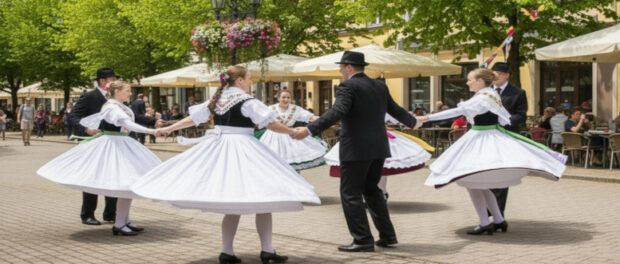
Based on the solid foundation of the local dialect, the binding norm for the Protestant written language emerged, heavily influenced by educational institutions established under the impact of pietistic movements. The visible expression of cultural identity also manifested in traditional clothing, which was however subjected to continuous transformation over time. The Protestant traditional attire ceased to be worn in daily life relatively early, disappearing from the streets as modern fashion took hold. In stark contrast, a small group of elderly individuals preserved the Catholic traditional dress until the present day as a profound symbol of their heritage.
The Urban Center As A Hub For Political And National Awakening
The assimilation process into the dominant national language progressed relatively slowly until the outbreak of the global conflict, only to gain massive momentum during the subsequent democratic republic. The character of the entire region was decisively shaped by the economic, cultural, and administrative functions of the historical capital of the upper territory. Serving as the meeting place for regional assemblies and the seat of the highest offices, the city became the political epicenter of the minority, radiating influence throughout the entire landscape. Since the era of European revolutions, the activities originating from this urban center profoundly impacted the surrounding countryside, sparking a national awakening.
The Proliferation Of Associations And The Strengthening Of Communal Bonds
Numerous agricultural associations emerged during these turbulent times, skillfully combining economic demands with broader national interests. In the period following the revolutionary upheavals, ecclesiastical groups increasingly replaced political factions, focusing on strengthening the sense of community and spiritual solidarity. As the modern era advanced, various social, savings, and support organizations emerged, alongside local agricultural societies that addressed the practical needs of the farming population. Following the turn of the century, sports and cycling clubs were added to the vibrant social fabric, finding particular resonance among the younger demographic.
Local Microcosms And The Vibrant Community Life In Rural Parishes
For all these associations, it was highly characteristic that the cultivation of the ancestral language and culture was firmly anchored in their statutes alongside their immediate organizational goals. An outstanding center of cultural activities in this region was the village situated east of the capital, serving as a highly representative example of the profound transformations experienced by the community. The ecclesiastical parish encompassed a multitude of surrounding settlements, predominantly inhabited by individuals of the ancestral descent. Local administrative roles were heavily dominated by the minority, with the vast majority of village leaders belonging to the indigenous population, underscoring their strong local influence.
Totalitarian Suppression And The Fleeting Postwar Revival
While the proportion of the indigenous population in the small agricultural hamlets was overwhelmingly high, it was slightly lower in the central settlement due to the early arrival of foreign artisans. The vibrant community spirit was frequently celebrated at massive gatherings, where a massive multitude of attendees from across the entire landscape convened to honor their shared heritage and organizational milestones. The rise of the totalitarian regime led to the systematic suppression of all cultural activities, actively pushing the heritage to the margins of public life. Dedicated educators and clergy were transferred to administrative positions outside the traditional settlement area to break their local influence and disrupt the transmission of traditions.
The Enduring Resilience Of The Cultural Heritage
A revitalization of the language following the global conflict, including the establishment of a dedicated educational branch, remained unfortunately only a brief and ultimately unsuccessful endeavor. Nevertheless, the immediate postwar period saw a symbolic breakthrough when an individual of the minority was appointed to the high office of regional administrator for an inaugural instance in the historical record. This fleeting moment of political representation highlighted the enduring resilience of the community, even as the broader socio-political environment continued to impose severe constraints on their cultural expression. The historical trajectory of this region remains a profound testament to the enduring human spirit and the relentless pursuit of cultural preservation.

 Screenshot youtube.com