The Creation of Fictional Reality and the Power of Organizational Networks
Screenshot youtube.com
The historical evolution of the human species reveals a profound departure from the purely biological constraints that govern all other living organisms. While the natural world operates strictly on physical laws and individual sensory experiences, humanity has constructed an entirely separate dimension of existence driven by collective imagination. This unique cognitive leap has allowed communities to organize on a massive scale, fundamentally altering the planet and establishing complex societies. Understanding this phenomenon is essential for comprehending how abstract concepts ultimately gained the power to shape physical reality and dictate the course of global history.
The Emergence Of An Additional Layer Of Existence
The human species currently navigates a complex environment that extends far beyond the immediate physical surroundings and personal emotional states. Other creatures interact exclusively with tangible elements like rivers and trees, alongside their internal feelings of fear or joy. In stark contrast, people inhabit a multi-layered reality that includes physical objects, personal sensations, and shared narratives about currencies, deities, and political structures. Over the ages, the influence of these fictitious constructs has steadily increased, while the pure force of nature has been pushed back.
The Enduring Power Of Collective Narratives
Numerous bodies of water still flow across the globe, and individuals remain driven by their deepest biological fears and desires. However, invented variables have successfully contained these rivers, utilized their resources, and learned how to influence the human psyche in targeted ways. As modern technologies make these fictions even more effective in the present era, it becomes crucial to understand how such narratives gain power. People often mistakenly believe they control history themselves, but the truth is that events revolve around this web of made-up stories.
The Cognitive Revolution And Early Cooperation
The basic biological abilities of humans have hardly changed since the Stone Age, yet the web of shared stories has become progressively stronger. The transformation began approximately 70000 years ago, when a cognitive development made it possible to discuss things that only existed in the imagination. During the following 60000 years, humans wove numerous fictional nets, which remained relatively small and localized. The spirit of a revered ancestor was completely unknown to neighboring groups, and shells that held value in a specific location lost their worth as soon as individuals crossed the next mountain range.
The Limitations Of Hunter-Gatherer Societies
These early tales of ancestral spirits and precious shells provided a tremendous advantage because they allowed multitudes of individuals to work together effectively. However, as long as people remained hunter-gatherers, they could not really cooperate en masse, because it was impossible to feed a large city by gathering food alone. Consequently, the ghosts and demons of the Stone Age were relatively weak beings who could not control large empires or manage vast territories. The physical limitations of foraging strictly capped the size and complexity of these early social networks.
The Agricultural Shift And New Organizational Hurdles
The agricultural revolution, which began approximately 12000 years ago, provided the necessary material foundation to expand the community networks significantly. Farming made it possible to feed myriads of people in densely populated cities and countless soldiers in disciplined armies. But then the fictional braids faced a new hurdle, because the early farmers had to rely on the data processing capabilities of the human brain, which were quite limited. The biological mind simply could not keep track of the complex economic and social obligations required by these growing settlements.
Deities As Early Corporate Entities
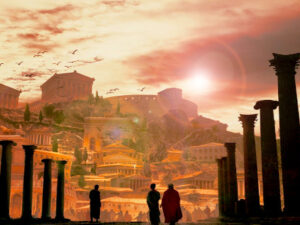
The farmers believed in stories about great deities, for whom they built temples, held festivals, and offered sacrifices. In the early cities in ancient Sumer around 6000 years ago, the temples were not only centres of worship, but also the most important political and economic hubs. The deities fulfilled a similar function to modern brands and corporations, because they were fictitious legal entities that owned property, made loans, and employed workers. Since the deities never died and did not have children who could argue over the inheritance, they accumulated more and more property and power.
The Administrative Bottleneck Of Mortal Priests
An increasing number of Sumerians were now in the service of these fictions, ordering their land and paying levies to the divine estates. Just as in a modern city an employee works for a large search engine company and a neighbor works for a software company, so in ancient times, an individual was a servant of the deity Enki, while another worked for the deity Inanna. Of course, the deities did not run their businesses themselves, as they only existed in fantasy, but the priests handled the everyday activities. But as the deities gained more and more possession, the priests could no longer keep up, as they, as fallible mortals, struggled to keep all lands and debts in mind.
The Breakthrough Of Writing And Currency
This cognitive limitation was a main reason why the cooperation networks in Sumer could not expand further even millennia after the agricultural revolution. This obstacle was removed around 5000 years ago when the Sumerians invented both writing and money. These inventions broke through the barriers that were placed on the human brain when it came to data processing. From that moment on, writing and money made it possible to collect taxes from massive populations, to build complex administrations, and to accumulate vast riches.
The Divine Rulers And Their Bureaucratic Machines
In the Sumerian empires, the kingdoms were administered by human priest-rulers in the name of the deities, while in the neighboring Nile Valley, people merged the priest-ruler with the deity to form a living incarnation. The Egyptians regarded this ruler as a true deity, to whom the entire land belonged and whom all people had to obey. As in the temples of Sumer, the deity in the Nile Valley did not own the business empire directly, but the practical task was left to myriads of literate officials. The biological ruler was of little importance, because the true ruler was an imaginary construct that existed in the stories that many people told each other.
The Permanence Of The Imagined Sovereign
While the ruler ate grapes in the capital, the officials were constantly on the move in the kingdom, calculating levies and recording them on long rolls of papyrus. Even if the living deity died and was embalmed, the administration continued to function as officials continued to describe the roles and send orders. If the deities of the Sumerians are reminiscent of modern corporate brands, the living deity of the Nile Valley can be compared with modern personal stamps of famous singers. Just like the Pharaoh, a famous singer also had a biological body full of needs, but the brand was far more important than this physical form.
The Legacy Of The Brand Beyond Mortality
During its lifetime, the brand earned a lot of monetary units, but most of the work was done by a small army of agents and producers. After the death of the biological body, the following generations continued to buy records and make pilgrimages to the estate of the artist. Before the invention of writing, stories were limited by the restricted capacity of human brains, as it was not allowed to invent overly complex narratives. But with the help of writing, extremely long and intricate stories suddenly became possible, which were stored on tablets and papyri.
The Algorithmic Nature Of Bureaucracy
No individual knows all the contracts of a famous singer or all the laws of a European alliance, but all these details are recorded in writing and define the power of these constructs. Scripture has thus enabled people to organize entire societies in the manner of a computational method, meaning a methodical sequence of steps for solving problems. In spellless societies, people do all the calculations in their heads, but in spelling-skilled societies, every person is only a small step in a huge calculus. This is the essence of the bureaucracy, which ensures that the personality or the current mood of the persons involved are completely irrelevant.
Modern Institutions And Ancient Protocols
Think of a modern hospital, for example, where a newcomer is given a standard form at the reception and the answers are compared with the regulations. The doctor on duty follows a strict protocol to decide to which ward the referral will be made, and experts analyze the results using known databases. This algorithmic structure ensures that the fate of the patient is in the hands of the system and not in the hands of flesh-and-blood individuals. What applied to hospitals also applied to armies and ancient kingdoms, because in ancient Egypt most decisions were made by a network of officials connected by papyri.
Reshaping The Physical Landscape
This network reorganized human society and reshaped nature, for example by creating a huge canal that connected the river with the swamps of a valley. An elaborate system of dams and reservoirs diverted water into the marshland, creating an artificial lake that held massive volumes of water. By comparison, the largest man-made reservoir in the United States contains no more than comparatively small volumes of water. The construction project provided the rulers with the opportunity to regulate the river, prevent flooding, and supply the country in times of drought.
The Sacred Crocodile And Divine Authority
The marshland became the granary of the empire, and on the shores a new city emerged, which featured a temple dedicated to the crocodile deity. The temple housed a sacred crocodile, which was considered a living incarnation of the deity and was lovingly supplied with food and toys by the priests. Golden cloaks were put on the reptile and crowns were put on it, because it was the mark of the priests on which the authority depended. When the animal died, a new crocodile was immediately chosen, while the dead reptile was carefully embalmed and mummified.
Organizational Mastery Over Technological Deficits
At that time, the Egyptians did not have large construction machines or explosives, and much of the construction work was done with tools made of stone and wood. Many people claim that the major construction projects must have been carried out by strangers from outer space, since a culture without wheels and iron cannot perform such miracles. However, the truth is that the Egyptians built these plants thanks to outstanding organisational skills and the recruitment of myriads of workers. If myriads of laborers cooperate over multiple decades, they can build an artificial reservoir even with tools made of stone.
The True Architects Of Physical Reality
The ruler itself naturally did not lift a finger, yet the people believed that only prayers to the invented entities could save the valley from devastating floods. Because very many people believed in these fictions and jointly built dams, the forces of nature were actually contained. Compared to the spirits of the Stone Age, the deities of ancient Egypt were truly powerful beings that founded cities and raised armies. It might sound strange to attribute the construction of physical things to imaginary entities, yet today people naturally speak of a state building an atomic bomb or a technology corporation developing a self-driving car.
The Ultimate Triumph Of Shared Fictions
Therefore, there is no reason to hesitate in saying that the Pharaoh built a dam and the crocodile deity created a canal. The physical world was conquered not by biological strength, but by the unparalleled ability of humans to weave and believe in shared illusions. These imagined orders continue to dictate the flow of rivers, the construction of cities, and the destiny of the entire planet. Ultimately, the most solid structures of our reality are built upon the most intangible foundations of the collective human mind.

 Screenshot youtube.com