The search for the true core of the Roman founding legend
Screenshot youtube.com
The human desire to combine mythical narratives with tangible, archaeological facts has always shaped the science of history. Especially in the history of the emergence of great civilizations such as Rome, researchers tirelessly try to bridge the gap between legendary traditions and material legacies. This tension between the desire for historicalConfirmation and the harsh reality of the finds forms the core of any serious examination of antiquity. When we look at the earliest phase of the eternal city, we must therefore always ask ourselves whether the stone testimonies really confirm the stories that the ancient inhabitants told themselves about their origins.
The futile attempt to unite myth and matter
The concluding question that arises when considering this epoch is whether the archaeological material and the mythical traditions of Romulus and Remus really have to stand side by side so unconnected. It is tempting to think that our investigations into the earliest history of Rome can be seamlessly linked to the legends that the people in theAntiquity. Perhaps more historical substance can actually be found in these myths than it seems at first glance. This delightful thought has greatly influenced many modern historians and archaeologists in their studies of early Rome. So we have already encountered the attempt to trace the origins of the Septimontium as a direct reflection of the Roman and SabineDouble character of the city, which the Romulan myth so insistently underlines.
Archaeological fantasy structures at the foot of the Palatine
When old earth fortifications were discovered at the foot of the Palatine not so long ago, this find sparked all sorts of wild speculation. Many immediately believed that these were the very limits over which Remus had jumped on the day of Rome’s founding, thereby indirectly bringing about his own death. However, such interpretations are nothing more than archaeologicalImagination. You have undoubtedly come across old fortifications, which in itself is a significant and laudable discovery. But how these walls relate to the early hut settlement at the top of the Palatine remains a complete mystery.
The danger of premature dating and incorrect conclusions
These earth walls have absolutely nothing to do with the mythical figures Romulus and Remus, which never existed in historical reality. All attempts to manipulate the dating of the building and the associated finds in such a way that the 21 April of the year 753 BC comes out are based on gross misconceptions. Such bogus arguments are only used toto back up preconceived notions with seemingly scientific means. True archaeology must detach itself from such romantic notions and let the finds speak for themselves. Only in this way can an objective picture of the early settlement history be created.
The only place of apparent connection in the forum
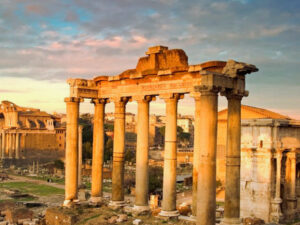
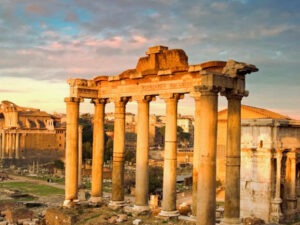
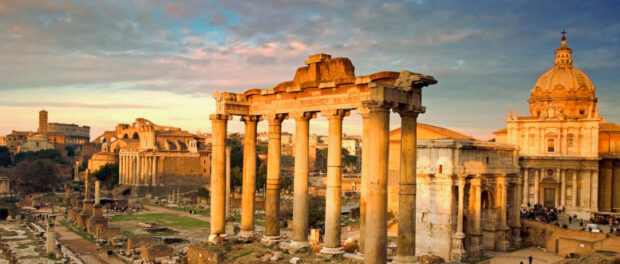
In the whole of Rome, there is only one place where the early finds can be brought into a direct connection with literary tradition. However, there is no harmonic agreement, but there is a large and fascinating gap. This special place is located at one end of the forum near the slopes of the Capitol. It is locatedwithin walking distance of the Temple of Jupiter Stator, where Cicero delivered his famous diatribe against Catiline. Right next to the platform from which the speakers spoke to the people, towards the end of the 1st century BC, an approximately twelve-square-metre rectangle of striking black marble was embedded in the pavement of the forum.
The pioneering excavations under the black stone
Towards the end of the 19th century, the archaeologist Giacomo Boni carried out excavations under this black stone. He was as famous at the time as Heinrich Schliemann, the discoverer of Troy, but not as fraught with the dubious reputation of an impostor as he was. During his work, he found the remains of much older buildings. These included, among other things, an altar, a piece of a largefree-standing column and a short stone pillar with an almost incomprehensible Old Latin inscription. This text is probably one of the oldest surviving texts in this language.
Religious dedications and the filling of the place of worship
This ancient plant had been deliberately dumped, and the filling material contained all sorts of unusual and mundane fragments. Small cups, pearls and bones were found, as well as some elaborately decorated ceramics from Athens dating back to the 6th century BC. Judging by these findings, which apparently had religious dedications,the most obvious explanation that it was an early place of worship. It is possible that this site was dedicated to the god Vulcanus. When the forum was redesigned in the 1st century BC, it was filled in, but in order to preserve the memory of the holy site below, the place was marked with the said black stone.
The Interpretations of the Roman Writers
Later Roman writers took note of this passage and thought intensely about its deeper meaning. One of them wrote that the black stone marked a place of misfortune. They knew that there was something centuries old under these stones. However, they did not suspect a religious place of worship, as archaeologists now relatively safely assume,but a monument that had to do with Romulus or his family. Several ancient authors suspected the tomb of Romulus there, while others believed it to be the tomb of Faustulus, the foster father of Romulus and Remus.
The enigmatic inscription and knowledge of antiquity
Still others saw it as the tomb of a companion of Romulus named Hostilius, who was the grandfather of a later king of Rome. The scholars also knew from their own perceptions or hearsay that there was an inscription beneath the surface. An ancient author gave two possibilities of what it was: either a monument to Hostilius with one of his braveryinscription or around a statue erected by Romulus after one of his victories. He falsely claimed that Romulus had written his deeds in Greek script. Certainly none of these assumptions were true, because the text was written in Old Latin and not in Greek script.
The Legacy of the Buried Past
However, this error is a good example of how much and at the same time how little Roman historians knew about their own buried past. It also shows how much they liked to imagine that the traces of the legendary city founder were still present in their city or just below its surface. The actual content of this inscription guides us, insofar as we can make sense of itinto the next phase of Roman history. This brings us to the succession of almost equally mythical kings who supposedly succeeded Romulus. This transitional phase marks the point at which archaeological reality finally replaces the mythical narrative.

 Screenshot youtube.com